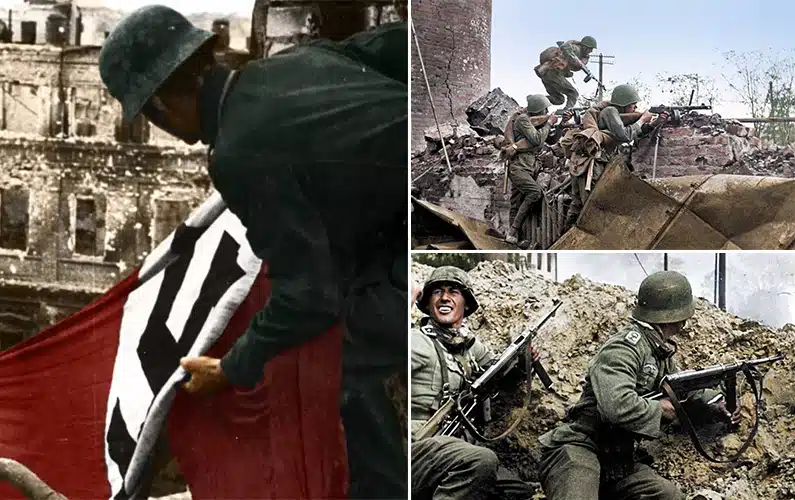
The Battle of Stalingrad, fought between August 23, 1942, and February 2, 1943, was one of the most catastrophic and brutal confrontations of World War II. It marked a decisive turning point that reshaped the course of the war and had a profound impact on the history of Europe. In this article, we will explore ten devastating, harrowing, and true facts about this epic battle—a stark reminder of both humanity’s destruction and its resilience.
First of all: what was the strategic importance of Stalingrad, and why did the fighting take place there?
Let’s clear up this point before we move on to ten more intriguing facts—something many people wonder about. Stalingrad had immense strategic significance during World War II for several reasons. To begin with, it was an industrialized city located along the Volga River, making it a vital hub for the Soviet Union’s war production and transport routes. Gaining control of the city would have allowed the Germans to cut Soviet supply lines, severely hindering the USSR’s ability to continue the war.
In addition, the city protected the northern flank of the crucial oil fields in the south, which were essential to the German war effort. Capturing Stalingrad would have opened the door for the Germans to secure these oil resources, crippling Soviet oil supplies and reducing their ability to sustain the fight.
The fact that Stalingrad also bore the name of Hitler’s enemy, Joseph Stalin, made the city particularly significant to the German leadership, and its capture would have carried enormous symbolic value. These factors contributed to making the Battle of Stalingrad one of the most intense and devastating confrontations of the Second World War.
With that settled, let’s move on to the ten more fascinating points about the Battle of Stalingrad!

1 A soldier’s average life expectancy on the battlefield was only about 24 hours…
General Paulus and the German forces initially underestimated the resistance and expected to capture the city of Stalingrad within just ten days. Although the Germans did manage to take control of large parts of the city, the battle took far longer than anticipated—almost two months—and the fighting was incredibly bitter and bloody.
Stalingrad became a brutal battlefield where every meter was contested with extreme intensity. Soviet troops used the city’s ruins to their advantage, and German soldiers referred to the fierce urban combat as “Rattenkrieg” (“rat war”) due to its chaotic, close-quarters, street-fighting nature.
The situation for those fighting was extremely dangerous, and it is said that the average life expectancy for a soldier in Stalingrad was only about 24 hours because of the relentless combat and the harsh conditions on the battlefield. For officers, the average life expectancy was reportedly around three days. [source]
2 The ineffective Luftwaffe was a major factor in the German failure…
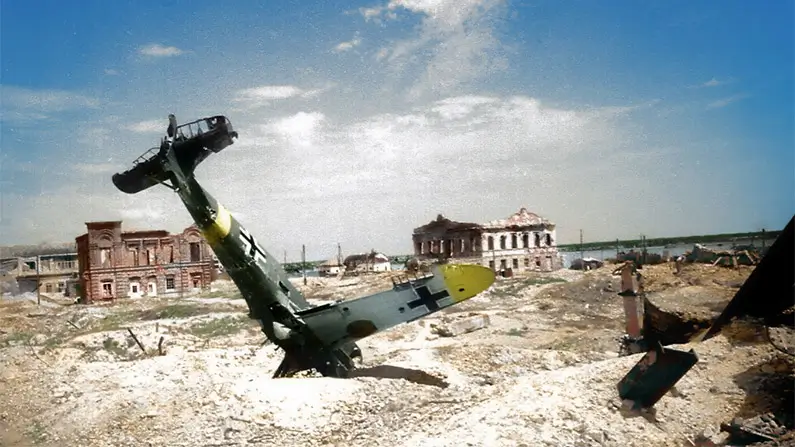
The attempts to supply the German 6th Army via the Luftwaffe during the Battle of Stalingrad were inadequate and almost entirely unsuccessful. The Germans found themselves in a desperate situation, with a large portion of their forces trapped inside the Stalingrad “kessel” and in critical need of supplies to survive.
The Luftwaffe was not only limited by a shortage of aircraft capable of carrying out the necessary deliveries, but also by Soviet air attacks that destroyed planes, killed aircrew members, and obliterated supplies. Luftwaffe leadership was fully aware of these limitations, and Hermann Göring himself knew how dire the situation was—despite his overconfidence in the Luftwaffe’s abilities. The insufficient supply efforts were one of the decisive factors that contributed to the German army’s defeat at Stalingrad. [source]
3 Only 6,000 of 100,000 prisoners of war returned to Germany after the war…
Somewhere between 150,000 and 250,000 Germans are estimated to have died in Stalingrad. Of the 100,000 German soldiers captured by the Soviets, only about 6,000 had returned to Germany by 1956 — among them General Paulus. [source]
4 The Germans were not properly equipped for the record-cold Russian winter…
The winter preceding the Battle of Stalingrad was extremely harsh, with temperatures in Russia dropping to dangerously low levels. The Germans suffered from a lack of proper winter clothing and struggled to supply their troops with essential provisions, leaving them particularly vulnerable to the cold. The severe weather conditions — with temperatures regularly falling to around –25°C — worsened the already miserable situation for the German soldiers.
The Soviets also faced challenges due to the weather and harsh conditions, but they generally had access to slightly better winter clothing and more food than the Germans. [source]

5 The German public was unaware of the catastrophic situation in Stalingrad…
To a large extent, the German public was kept in the dark about the true scale of the losses and hardships at Stalingrad. The authorities and the propaganda apparatus did everything they could to minimize and distort the information reaching the population in order to preserve morale and maintain support for the war.
It took a long time before the German government acknowledged the severity of the situation regarding the encircled 6th Army at Stalingrad, and even then they tried to present events in a positive light to keep public optimism alive. Many German citizens remained unaware of the situation for weeks after the defeat — some for months. [source]
6 Soviet losses were significantly greater than the German losses…
The exact number of those wounded or killed during the Battle of Stalingrad is not known. This is due to several factors: many records from the war were unreliable, and the vast geographical scope of the fighting also complicates accurate estimation. What is clear, however, is that Soviet losses were vastly higher than those of the Germans.
It is estimated that more than 1,120,000 Soviet soldiers were wounded, missing, or killed in Stalingrad alone. Over 2,700 aircraft were lost, along with more than 4,000 tanks and nearly 16,000 artillery pieces.
German losses, while still immense, were considerably smaller by comparison. During the Battle of Stalingrad, they lost just over 900 aircraft, several hundred tanks, and a few thousand artillery pieces. [source]

You may also like
7 The Battle of Stalingrad triggered a shift in German war policy…
After the Battle of Stalingrad, Hitler, his generals, and the leadership of the Oberkommando der Wehrmacht (the German Armed Forces High Command) realized that Germany’s situation was far more serious than merely losing the war against the Soviet Union. They understood that the Soviets now had the capability to push German forces all the way back to Germany itself, and that the threat facing the nation was existential. This led Hitler and the Nazi regime to initiate a total mobilization of the entire German state and population in an effort to avoid the complete destruction of the Nazi state.
Following the battle, the infamous “Total War” speech was delivered at the Berlin Sportpalast, where Joseph Goebbels (pictured below) emphasized the need for every German to contribute to the war effort. This was an attempt to mobilize and motivate the German population to fight harder and sacrifice more for the war. [source]

8 Dogs were widely used by both sides…
An interesting fact about the Battle of Stalingrad, one that is rarely discussed, is the extensive use of military and combat dogs by both sides during the fighting. German forces used trained dogs as explosive carriers, sending them toward enemy trenches with mines or charges attached to their backs. The Soviet Union, on the other hand, also employed dogs as part of its war effort, particularly for detecting German tanks. Soviet dogs were primarily trained to search for the smell of oil and fuel, and when they located a German tank, they had been conditioned to place a bomb beneath it. [source]
9 Over 1.1 million Soviet soldiers and nearly 900 tanks took part in the decisive “Operation Uranus”…
The Soviet effort to retake Stalingrad was enormous in scale and required extensive logistical capability and meticulous planning. Operation Uranus, launched by Soviet forces on November 19, 1942, was a massive offensive designed to encircle and trap the German 6th Army.
During Operation Uranus, a total of 1,143,500 Soviet soldiers, 894 tanks, 13,451 artillery pieces, and 1,500 aircraft (fighters, bombers, reconnaissance planes, and transport aircraft) took part.
Within four days, the Soviet Union had successfully severed German supply lines and placed the German forces in a dire situation by cutting them off from reinforcements and provisions. This was one of the decisive factors that led to the German army’s defeat at Stalingrad. [source]

10 Joseph Goebbels was forced to put a positive spin on the defeat for the German public…
The 6th Army finally surrendered on February 2, 1943. Immediately after the defeat, Propaganda Minister Joseph Goebbels instructed the media to craft a myth of heroism around the German 6th Army’s downfall.
The official radio broadcast on February 3 stated the following:
“The battle for Stalingrad has come to an end. True to their oath to fight until their last breath, the Sixth Army, under Field Marshal Paulus’s exemplary leadership, has been overcome by the enemy’s superiority and by the unfavorable circumstances our forces were facing.”
Adolf Hitler ordered three days of mourning in Germany. During this time, all amusement parks were closed, and radio stations were instructed to play somber music. [source]
5 Common Questions About the Battle of Stalingrad
The Battle of Stalingrad took place between August 1942 and February 1943, during World War II.
It was crucial because it marked a major turning point in World War II, stopping the German advance in the East and shifting momentum to the Soviet Union.
An estimated 1.7 to 2 million soldiers and civilians were killed, wounded or captured, making it one of the deadliest battles in history.
The Soviet Union won the battle, surrounding and forcing the surrender of Germany’s Sixth Army.
Stalingrad was important because it controlled key transport routes along the Volga River and held symbolic value as a city bearing Stalin’s name.