

Robin Williams was an American actor, stand-up comedian, film producer, and screenwriter, born on July 21, 1951, in Chicago. On August 11, 2014, the world was shocked by his sudden death at the age of 63. Shortly before his passing, Williams had been struggling with severe depression and the early stages of Lewy body dementia, a neurological condition often associated with Parkinson-like motor symptoms, depression, and hallucinations.
Loved by audiences around the globe, he starred in countless iconic films that left a lasting mark on popular culture. Below, we take a closer look at 10 surprising facts about Robin Williams—facts that many fans may never have known about the man behind the laughter.
1 Robin Williams was a master of improvisation…
Robin Williams completely improvised the famous scene in Good Will Hunting (1997) where his character talks about his wife farting in her sleep. Matt Damon couldn’t hold back his laughter during the take—meaning his reaction in the scene is 100% genuine.
The director was so impressed by Williams’ brilliant improvisation that he decided to keep the scene in the final cut of the film. [source]
2 Williams signed on instantly to voice the Genie in Aladdin…
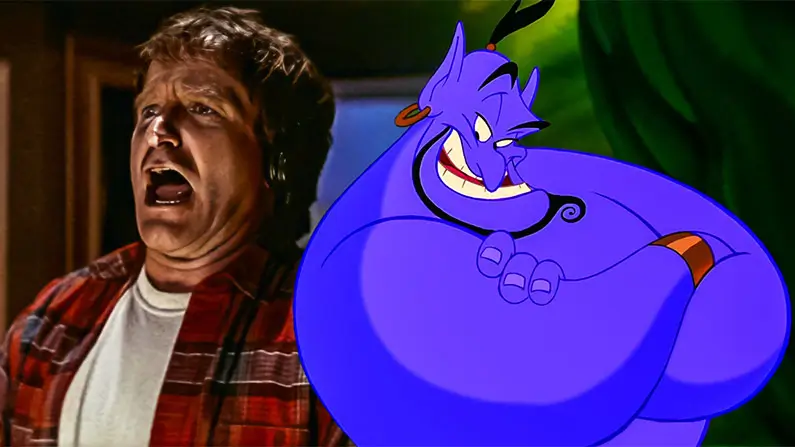
Walt Disney wanted Robin Williams so badly for the role of the Genie in the animated film Aladdin (1992) that the animators designed and lip-synced the character using material from Williams’ real stand-up performances—before he had even been officially offered the part.
Williams was so impressed by the animation that he signed on immediately, making the Genie one of the most iconic animated characters of all time. [source]
3 But voicing the Genie came with a few conditions…
Robin Williams agreed to voice the Genie in Aladdin (1992) on the condition that his name or image would not be used for marketing purposes, and that his supporting character would not occupy more than 25% of the space on promotional posters. Walt Disney accepted these terms, and the film went on to become a massive box office success.
For his work, Williams reportedly accepted a fee of just $75,000, a fraction of what he typically earned—highlighting that the role was driven more by creative passion than money. [source]
4 Robin Williams struggled with both drug and alcohol abuse…
One of the darkest chapters in his life involved the death of comedian John Belushi (to the right in the image below). The three last people Belushi reportedly used cocaine with before his fatal overdose were a drug dealer, Robin Williams, and Robert De Niro.
The incident deeply affected Williams and became a turning point in his relationship with substance abuse. [source]

5 Robin Williams lifted spirits during the filming of Schindler’s List…
During the production of Schindler’s List (1993), director Steven Spielberg would put Robin Williams on speakerphone to cheer up the cast and crew. Spielberg felt that everyone needed moments of relief, as the filming process was emotionally exhausting due to the film’s dark and devastating subject matter.
Williams’ humor reportedly provided brief but much-needed moments of light during an otherwise heavy production. [source]
6 Robin Williams almost landed the lead role in The Shining…
Robin Williams was considered for the role of Jack Torrance in the now-iconic film The Shining (1980). However, after director Stanley Kubrick watched Williams’ performance in the TV series Mork & Mindy (1978–1982), he reportedly decided that Williams was “too psychotic” for the role.
Ironically, the concern wasn’t that Williams couldn’t portray madness—but that he might be too convincing. [source]

You may also like
7 He once shopped at an adult store dressed as Mrs. Doubtfire…
During the filming of Mrs. Doubtfire (1993), Robin Williams decided to test just how convincing his disguise really was. Fully dressed as Mrs. Doubtfire, he walked into an adult store and made a purchase—without being recognized.
The experiment proved just how remarkably believable the character’s transformation was. [source]

8 When improvisation became the script…
During the filming of Mork & Mindy (1978–1982), Robin Williams deviated from the script so frequently—and so brilliantly—that producers eventually stopped trying to rein him in.
Instead, writers and producers began intentionally leaving blank spaces in the scripts, often marked with notes like: “Mork goes wild here“, giving Williams free rein to improvise. The result was some of the show’s most memorable and spontaneous moments. [source]

You may also like
9 Robin Williams was a huge fan of the Zelda games…
Robin Williams had been a devoted fan of The Legend of Zelda ever since the very first game was released in 1986, and he even named his daughter Zelda after the iconic character.
In 2011, both Williams and his daughter Zelda Williams appeared together in a commercial for The Legend of Zelda: Skyward Sword. In the image below, you can see Williams alongside his daughter, Zelda. [source]

10 A chilling coincidence…
On the same evening that Robin Williams’ death was announced in the United Kingdom on the BBC News Channel, BBC Three happened to be airing a Family Guy episode in which Peter Griffin wishes that everyone were Robin Williams.
Peter is struck by lightning and gains the power to turn anyone he touches into Robin Williams. Given the timing, many viewers found the coincidence eerily unsettling. [source]
5 Common Questions About Robin Williams
He died in 2014 at the age of 63. His death was ruled a suicide, and it was later revealed that he had been suffering from Lewy body dementia, a severe neurological disease.
He was diagnosed with Lewy body dementia, a condition that can cause depression, anxiety, hallucinations, and Parkinson-like symptoms.
He became iconic for roles such as the Genie, a gifted therapist in a Boston drama, and a teacher who inspired students—showcasing both comedy and dramatic depth.
Yes, he was famous for extraordinary improvisational talent, often going far beyond scripts and creating spontaneous, unforgettable moments on set.
Because of his unique ability to combine humor with deep humanity, generosity toward others, and performances that connected emotionally with audiences worldwide.