
The Empire State Building is a world-famous skyscraper and office tower located at the intersection of Fifth Avenue and West 34th Street in Manhattan, New York City. Construction began in 1929, and remarkably, the building opened just two years later, on May 1, 1931. Standing 381 meters tall—or 449 meters including its spire and radio mast—the tower rises across 102 floors and remains one of the most iconic landmarks in the United States. Its name comes from New York State’s nickname, “The Empire State”.
Perhaps you’ve visited and taken in the breathtaking view from the observatory? Whether you have or not, here are ten fascinating facts you should know about this legendary skyscraper.
1 The steel beams for the Empire State Building were so freshly made that they were still warm when they arrived…
During the construction of the Empire State Building in New York City, advanced engineering and highly efficient logistics were essential to handle the massive amount of material required. The steel beams were precision-produced in Pittsburgh and shipped rapidly to the construction site, arriving still warm from the mills.
The building was equipped with an innovative vertical railway system to efficiently transport both materials and workers to different floors, and a strict schedule was followed to minimize delays and maximize productivity throughout the construction process. [source]
2 The construction of the Empire State Building was record-breaking…
The entire Empire State Building was completed in just one year and 45 days. At certain points, workers built 14 floors in only ten days, averaging 4.5 finished floors per week. That’s four times faster than the construction speed of modern skyscrapers such as the Petronas Twin Towers in Kuala Lumpur and Taipei 101 in Taiwan. [source]
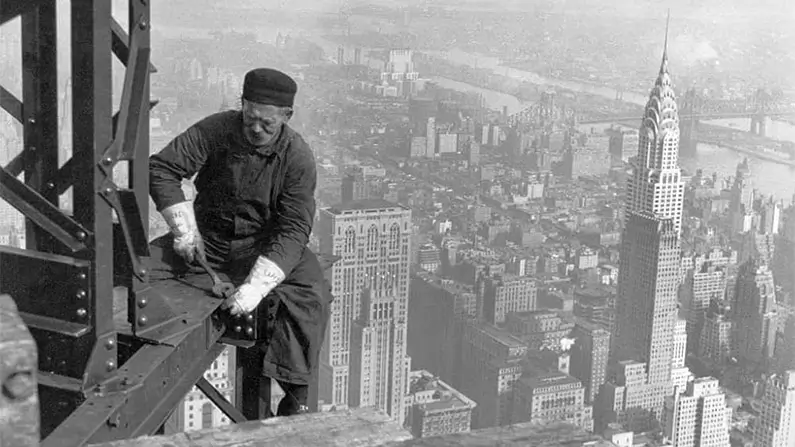
3 From 3:30 a.m. to 4:30 p.m., workers labored on the Empire State Building…
More than 3,400 workers—earning $1.92 per hour—were employed during the construction. In August 1930, when productivity was at its peak, the exact number reached 3,439 workers.
Particularly noteworthy were the four-man riveting teams, often Mohawk ironworkers, who drove over 800 rivets per day. They worked at breathtaking heights of 300 meters, tossing red-hot metal pieces over 40 meters through the air, which were caught with funnel-shaped gloves.
The workday began at 3:30 in the morning and ended at 4:30 in the afternoon, reflecting the intense pace required to build the skyscraper at record speed. [source]
4 The Empire State Building weighs over 365,000 tons…
The Empire State Building is constructed with 210 massive steel and concrete columns that support its impressive total weight of 365,000 tons. Inside these steel columns, there is space for electrical cables and essential piping systems that form the backbone of the building’s infrastructure. To create a high-quality interior environment, colorful limestone imported from Germany was used throughout the structure.
Photographs taken during the construction—especially by the renowned photographer Lewis Hine—became internationally famous and are still used in advertising and as historical documentation. Hine’s work capturing the building’s construction is considered a major milestone in the history of photography, showcasing the scale and ambition behind this iconic landmark. [source]
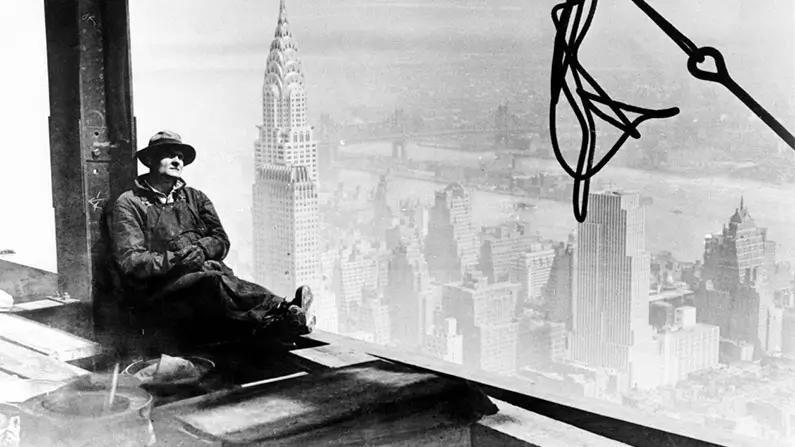
5 So many workers died during the construction of the Empire State Building…
During the construction of the Empire State Building, several accidents occurred — something that was not uncommon in major building projects of the 1930s. According to various sources and accounts, fourteen workers lost their lives during the project. However, the official figure reported by the builders lists only five deaths. Safety measures at the time were far less comprehensive and strict than they are today, which significantly increased the risk of such tragic incidents. [source]
6 In the beginning, it was difficult to rent out office space in the Empire State Building…
When the building was inaugurated on May 1, 1931, by President Herbert Hoover, many offices remained completely empty until the 1940s. Typically, the lower floors were rented out, while the upper levels were only partially finished. At times, the observation deck — which attracted over one million visitors annually — generated more revenue than the rest of the building’s leasing combined. [source]
7 “The Great Depression” was finally over…
The building became known as the “Empty State Building” instead of the Empire State Building because the upper half was so difficult to rent out. Despite this, the tower eventually became beloved by the city’s residents and was seen — both then and now — as a symbol that the Great Depression had finally come to an end. [source]
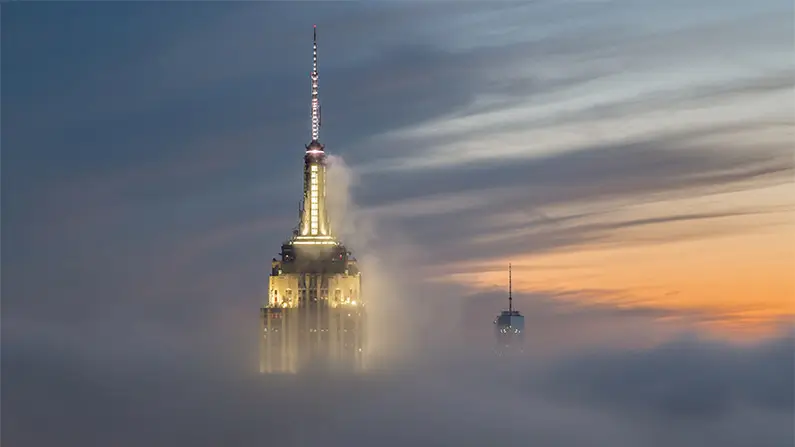
8 The Empire State Building’s mast lights up in different colors depending on the holiday…
Today, the building’s spire is a broadcast mast that is illuminated in different colors every night. The standard color is simple white, but during American holidays it shines red, white, and blue. For Christmas it turns red and green; at Halloween, orange; on Valentine’s Day, red; on Saint Patrick’s Day, green; during New York Yankees home games, blue and white; and for Christopher Street Day, it glows bright pink. [source]
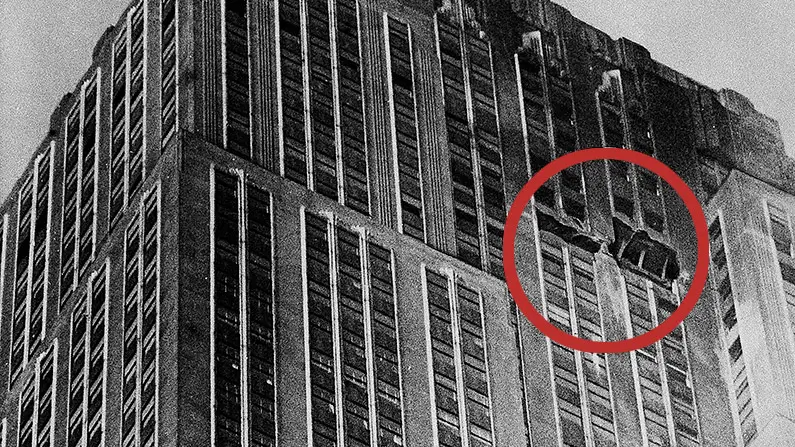
9 A bomber plane crashed straight into the Empire State Building in the 1940s…
On July 28, 1945, an unarmed B-25 Mitchell bomber, piloted by William F. Smith Jr., crashed into the 79th/80th floors on the north side of the Empire State Building. The collision, which occurred in heavy fog, resulted in the deaths of 14 people.
The skyscraper caught fire, but the blaze was extinguished within about an hour, and after repairs, the building was able to reopen. [source]
10 Suicides and attacks at the Empire State Building…
After five people took their own lives within just three weeks by jumping from the observation deck, a three-meter-high fence was installed around the platform in 1947. The fence reduced the quality of the view, but successfully prevented further suicides.
Likewise, on April 23, 1997, a man opened fire on seven tourists before taking his own life. Six of the tourists survived, and the motive was believed not to be political but rather linked to personal problems. [source]
You may also like
5 Common Questions About Empire State Building
The Empire State Building stands 381 meters (1,250 feet) tall to its roof, and 443 meters (1,454 feet) including its antenna. When it was completed in 1931, it was the tallest building in the world.
Construction began in 1929 and the skyscraper was completed incredibly quickly — opening on May 1, 1931. The entire building was finished in just 1 year and 45 days, a construction speed that remains legendary.
The building has 102 floors. The most famous levels are the 86th-floor observatory and the 102nd-floor top deck, which offer panoramic views of New York City.
Yes! The Empire State Building has two public observatories: the main one on the 86th floor with outdoor viewing, and the 102nd floor observatory offering a fully enclosed panoramic view of New York City.
Yes. The most notable accident occurred in 1945, when a B-25 bomber crashed into the 79th floor due to heavy fog, killing 14 people. Despite the damage, the building was repaired and reopened quickly. Safety measures — including the 1947 suicide prevention fence — have made the site significantly safer today.