
New Year’s is the world’s biggest — and longest — celebration. Nearly every country marks the occasion, and the reason it stretches out so much is simply due to time zones. Most people celebrate New Year’s between December 31st and January 1st, but some countries observe it on entirely different dates. How do you prefer to celebrate the New Year? Either way, here are ten fun facts and bits of trivia worth knowing for your future celebrations!
1 Adult diapers are surprisingly common at the Times Square New Year’s celebration…
It’s not unusual for people to wear adult diapers while celebrating New Year’s Eve at Times Square in New York City, simply because there are very few bathrooms available. On top of that, the massive crowds make it nearly impossible to get to a restroom even if you wanted to. [source]
2 13 months instead of 12…
Ethiopia uses a calendar with 13 months instead of the usual 12. The current year (2025) corresponds to 2017–2018 in the Ethiopian calendar, and they celebrate New Year’s on September 11th. [source]

3 A tradition since World War I…
Beethoven’s 9th Symphony was introduced to Japan by German prisoners of war during World War I, who performed it there. Today, it has become a national New Year’s tradition to play the symphony every year. [source]
4 From 0 to 2 years old in just one day…
In South Korea and some other Asian countries, a person is considered one year old at birth, and everyone ages one additional year on New Year’s Day. So if you were born on December 29th, you would be regarded as two years old by New Year’s Day. [source]
5 A mobile operator’s New Year greeting accidentally saved Moscow…
In 2010, a suicide bomber planning an attack in central Moscow on New Year’s Eve was killed prematurely when she received a New Year’s SMS from her mobile operator. Her explosive device was connected to her phone and detonated upon receiving the message, resulting in her killing only herself and preventing the planned attack. [source]
6 The New Year’s prank that earned top marks…
On New Year’s Day in 1976, a student named Danny Finegood changed the famous Hollywood sign to read ‘Hollyweed’ as a college prank celebrating the decriminalization of marijuana. The student received an ‘A’ grade for his unusually creative stunt. [source]

You may also like
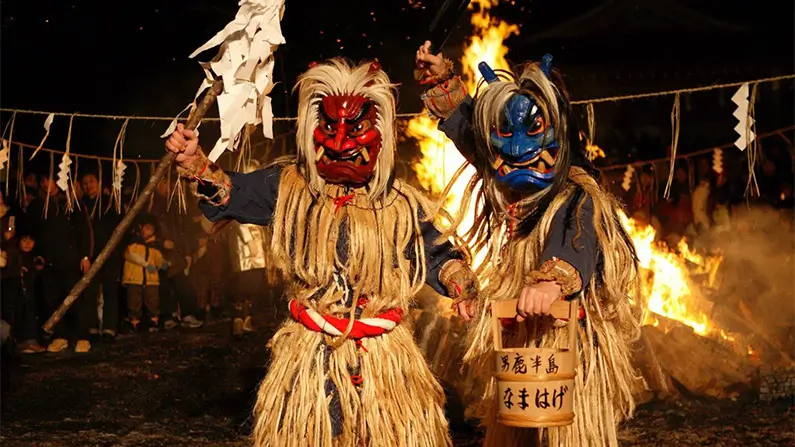
7 A very unusual New Year tradition in Akita, Japan…
On New Year’s Day in Akita, Japan, men dress up as mountain demons, get drunk, and frighten children who are being lazy or disobedient. The tradition is meant as a reminder for kids to behave well in the coming year. [source]
8 A four-month-long celebration…
In ancient Hawaii, the New Year festival lasted four months, during which war was forbidden, people stopped working, and everyone spent their time dancing, feasting, and simply enjoying life. Honestly… why wasn’t I born there and then? [source]
9 North Korea does not use the Gregorian calendar…
North Korea does not follow the regular Gregorian calendar used by most of the world. Instead, it uses the Juche calendar, which numbers years starting from the birth of Kim Il-sung, the founder of North Korea (pictured below). [source]

10 Britain’s year 1752 lasted only 9 months…
Before 1753, Britain and its colonies celebrated New Year’s Day on March 25th, also known as Annunciation Day. Additionally, the year 1752 lasted only nine months, because the dates from January 1 to March 24 (as well as September 3 to 13) were skipped in order to align with the calendar used by the rest of Europe and allow 1753 to begin on January 1st. [source]
5 Common Questions About New Year’s
Most countries follow the Gregorian calendar, which sets January 1st as the start of the new year. This date was chosen by Pope Gregory XIII in 1582 to replace the old Julian calendar. Some cultures, however, celebrate New Year’s on different dates, such as Chinese New Year or Nowruz.
The first places to celebrate New Year’s are Kiribati and Samoa in the Pacific. The last places are usually American Samoa and parts of the U.S. Minor Outlying Islands — nearly a full day later.
New Year’s resolutions date back to ancient Babylon and Rome. Today, people use January 1st as a symbolic “fresh start.” The idea is to set goals for self-improvement, such as exercise, diet, finances, or habits.
Fireworks are believed to ward off evil spirits — a tradition that dates back thousands of years in China. Today, they’re mainly used to celebrate and create excitement, marking the dramatic countdown into the new year.
Popular traditions include fireworks, countdowns, kissing at midnight, and eating symbolic foods for luck (like grapes in Spain, noodles in Japan, or beans in the U.S.). Many cultures also celebrate with family gatherings, parades, or special religious ceremonies.