
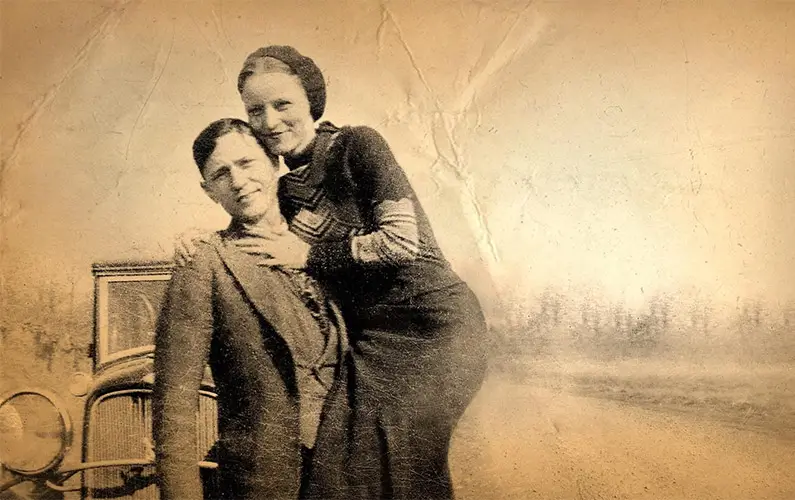
Bonnie Elizabeth Parker and Clyde Chestnut Barrow — better known simply as Bonnie and Clyde — were two legendary criminals who mostly robbed small stores and rural gas stations across the central United States during the Great Depression, often together with various accomplices. Their gang, known as the Barrow Gang, is believed to have killed at least nine police officers and several civilians.
The couple’s crimes, along with those committed by other notorious outlaws such as John Dillinger, Pretty Boy Floyd, and Ma Barker, gained nationwide attention, turning the pair into infamous figures across the country. Below, you’ll find ten incredible and fascinating facts about Bonnie and Clyde!
1 Bonnie and Clyde kidnapped the man who later embalmed them…
In April 1933, Bonnie and Clyde — along with an accomplice — stole a car in Ruston, Louisiana, belonging to H. Dillard Darby, a local undertaker. Darby chased after the gang in another vehicle owned by Sophia Stone. Eventually, Darby and Stone found themselves face-to-face with Clyde. Clyde forced them into the car and kidnapped both of them.
After driving into Arkansas, Bonnie and Clyde released their captives — Darby and Stone — and even gave them five dollars to help them get home. In a twist of fate or pure irony, the once-kidnapped H. Dillard Darby later embalmed Bonnie and Clyde after they were killed the following year. [source]
2 Clyde lost two toes in prison — and he may have cut them off himself…
While Clyde was imprisoned at the Eastman Prison Farm in Texas in 1932, he went to the infirmary for a foot injury. He no longer had ten toes — he had only eight. Either he cut off his own toes to avoid hard labor, or he had his cellmate do it for him.
What Clyde could not have known at the time his toes were removed was that he would be released less than a week later; his mother had pleaded for his parole — and it had been granted. [source]

3 Bonnie and Clyde were never buried together…
Bonnie and Clyde wanted to be buried together when they died — both seemed well aware that death was inevitable — but Bonnie’s family refused to allow it. Her mother, Emma, had Bonnie’s body sent to the McKamy-Campbell Funeral Home, while Clyde’s body was taken to the Sparkman-Holtz-Brand Funeral Home — both located in Dallas. Thousands of people attended Bonnie’s funeral on May 26, 1934. She was first buried at Fish Trap Cemetery but was later moved to Crown Hill Cemetery in 1945.
Clyde’s funeral, held on May 25, was significantly smaller, and he was buried beside his brother Marvin (“Buck”) at Western Heights Cemetery. Bonnie and Clyde’s final resting places are about 1.5 miles apart, though many have urged that they be reunited. Bonnie’s last surviving relative, Rhea Leen Linder, once said: “Their wish was to be buried side by side. I think that’s how it should be.” Buddy Barrow, a descendant of Clyde, has also stated that a burial plot was reserved next to Clyde for Bonnie — and it remains available. [source]

You may also like
4 Preparing their bodies for burial was difficult — because they were full of bullet holes…
It’s not entirely clear how many bullets authorities fired at Bonnie and Clyde’s car on May 23, 1934. According to sheriff’s deputy Ted Hinton, he and the other officers together fired around 150 shots. Some reports claim that Bonnie had 26 entry wounds while Clyde had 17; others list numbers as high as 25 and 23, respectively.
The sheer number of bullet holes made it difficult to keep the embalming fluid inside their bodies. As a result, when H. Dillard Darby arrived to identify the bodies — after having previously been one of their hostages — he was recruited to help funeral director C. F. “Boots” Bailey with the task. [source]

5 Bonnie had previously been in a car accident that severely injured her leg…
Clyde walked with a limp because he had lost two toes, but Bonnie’s ability to walk was also impaired. In 1933, while Clyde was driving near Wellington, Texas, he missed the detour signs. When the car crashed, Bonnie was burned by acid from the car battery. The burns on her right leg were described by their associate W.D. Jones: “The skin on her right leg was gone from her hip down to her ankle. I could see the bone in places”.
After the accident, they made their way to the nearby Pritchard farm, where baking soda and other homemade remedies were used to slow the spread of the acid burns. Residents at the Pritchard farm urged the group to seek medical help, but they refused. [source]
You may also like
6 Bonnie died holding half a sandwich…
When Bonnie and Clyde were ambushed by police on May 23, 1934, they were driving a Ford near the Texas–Louisiana state line. Authorities from both states had set up a roadblock, and as the pair slowed down, the officers opened fire. Officers like Frank Hamer had hoped to capture them alive, but confusion took over and they opened fire instead.
More than 160 bullets (the exact number remains unknown) were fired at Bonnie and Clyde from six different angles, and when the car finally came to a stop, the police gathered around it. There were initial fears that one or both might still be alive, but when the officers reached the vehicle, they found both of them dead.
Bonnie was holding a half-eaten sandwich in her hand. [source]
7 They never actually preferred robbing banks…
In the 1967 film Bonnie and Clyde, Warren Beatty famously delivers the line: “We rob banks”. While this was true to some extent, the duo — along with the rotating members of their gang — also obtained money from many other sources. The Barrow Gang stole from grocery stores, gas stations, and even paid for many of their daily needs using coins taken from gumball machines. Robbing smaller establishments was easier and less dangerous, even if the payout was often minimal.
All in all, Bonnie, Clyde, and members of the Barrow Gang robbed fewer than 15 banks. Another type of target for the gang was armories, such as the one at Phillips University in Enid, Oklahoma. Clyde reportedly saw “so many guns” there that he “didn’t know what to do with them”. [source]

8 Bonnie was married to another man when she died…
When Bonnie and Clyde were shot to death in Louisiana on May 23, 1934, Bonnie was wearing a wedding ring — but it didn’t come from her criminal partner. When Bonnie was only 15 years old (some sources say 16), she married Roy Thornton. She was in love with him and even had their names tattooed on her thigh. They married in September 1926, but their relationship was marked by violence and turmoil. In 1929, Thornton was imprisoned for robbery. Bonnie met Clyde in 1930, but she and Thornton never divorced.
At the time of his wife’s death, Thornton was in prison for murder. When he heard about the deaths of Bonnie and Clyde, Thornton reportedly said he was glad they died together. He was killed during an escape attempt in prison in 1937. [source]

You may also like
9 People tried to steal souvenirs from the crime scene…
When word spread about the deaths of Bonnie and Clyde, people in the area rushed to the site. Those who managed to get close tried to take souvenirs, including bullets from trees and even pieces of the outlaws themselves. One man reportedly tried to cut off Clyde’s ear, while someone else snipped a lock of Bonnie’s hair and part of her dress using a pair of scissors they happened to have with them.
When Bonnie and Clyde’s bodies were later taken to Arcadia, Louisiana, they were met by crowds eager to catch a glimpse. Even today, Bonnie and Clyde memorabilia remains highly sought after. In 2019, a collection of items connected to the outlaws sold for more than $180,000 at auction. [source]

10 Bonnie didn’t smoke cigars — despite the ‘photo evidence’…
One of the most enduring photographs of Bonnie shows her standing in front of a car with a gun in her hand and a cigar in her mouth. In reality, however, she was a cigarette smoker, just like Clyde. The cigar actually belonged to their associate W.D. Jones, who had simply handed it to her to hold for the picture.
The image of Bonnie with the gun and the cigar greatly contributed to the glamorization of the duo, according to The Highwaymen screenwriter John Fusco. [source]
5 Common Questions About Bonnie and Clyde
Bonnie Parker and Clyde Barrow were American outlaws during the Great Depression, best known for robbing small stores and gas stations and for their violent confrontations with law enforcement. They became nationally infamous due to sensational media coverage.
Yes. Historical accounts and letters strongly suggest that Bonnie and Clyde were deeply devoted to each other. While their relationship was tied to crime, their bond remained strong until they died together in 1934.
They did rob banks, but far less often than people think. In reality, the Barrow Gang robbed fewer than 15 banks. Most of their crimes involved small businesses, gas stations, and local stores, which were easier and less risky targets.
They were killed in an ambush by a posse of Texas and Louisiana law officers on May 23, 1934. More than 160 bullets were fired into their car, ending their two-year crime spree instantly.
Their story became legendary due to newspaper sensationalism, dramatic photos (like the famous picture of Bonnie with a cigar), and the myth of them as rebellious lovers fighting against the system. Hollywood later amplified this image, especially with the 1967 film Bonnie and Clyde.