
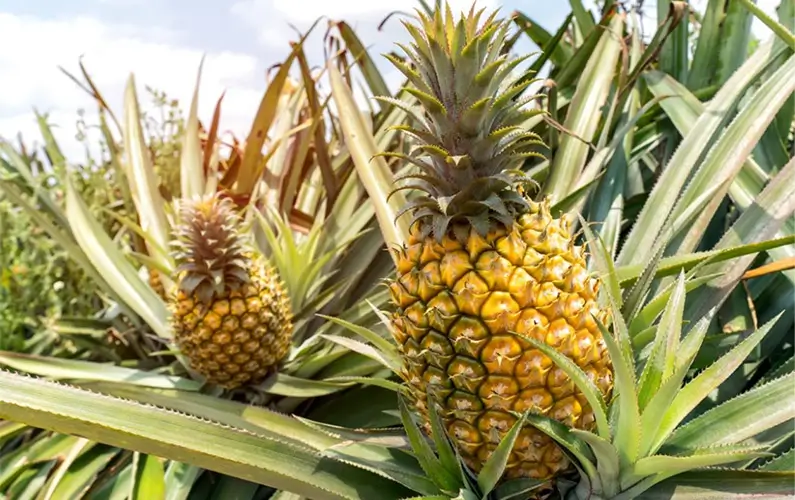
The pineapple is one of the world’s most recognizable fruits — sweet, juicy, and instantly associated with tropical beaches and sun-soaked days. But behind its spiky exterior lies a history and biology that few people truly know. From its unexpected symbolism and unusual growth pattern to its role in cuisine and cultures around the world, the pineapple is far more fascinating than you might think.
Here are ten surprising facts that give this tropical fruit a whole new dimension!
1 Pineapples were a highly prized luxury in 18th-century America…
In America during the 1700s, pineapples were considered extremely luxurious, especially those imported from the Caribbean. A single pineapple could be worth up to $8,000 in today’s money, adjusted for inflation.
If you couldn’t afford to buy one, you could even rent a pineapple — carrying the precious fruit with you to show it off at parties and social events. A true symbol of wealth and status. [source]
2 The pineapple that became an accidental work of art…
In Scotland in 2017, two students walked into an art gallery, found an empty table, and placed a pineapple on it — just to see if people would mistake it for art.
When the students returned four days later, the pineapple had been placed under a protective glass cover, treated as a legitimate exhibit. An image from the incident can be found below. [source]

3 Is pineapple sour? Here’s an easy way to make it sweeter…
Adding salt to pineapple can actually make it taste sweeter. The salt interacts with the acids in the fruit, neutralizing some of the sourness and reducing the sharp taste.
As a result, the natural sweetness becomes more pronounced, giving the pineapple a smoother, sweeter flavor. [source]
4 Primarily pollinated by hummingbirds…
The pineapple is native to South America and has been cultivated there for centuries. In the wild, the fruit is mainly pollinated by hummingbirds, whose long beaks are well suited to the plant’s flowers.
Some wild pineapple varieties are also visited and pollinated at night by bats, showing how the plant has adapted to different pollinators in its natural environment. [source]

5 With Alaska Airlines, you can travel with fruit as luggage…
If you’re flying from Hawaii with Alaska Airlines, pineapples can actually become a completely free part of your checked baggage. The airline allows departing passengers to bring a “properly packed” box of pineapples as complimentary checked luggage.
This initiative helps support local Hawaiian growers while letting travelers take a piece of island life home with them. The only requirement is that the box is securely sealed and packed according to the airline’s guidelines. [source]
6 This is why you get a sore, tingling feeling in your mouth when eating the fruit…
That strange, slightly sore sensation in your mouth after eating fresh pineapple has a completely natural explanation. The fruit contains bromelain, an enzyme that breaks down proteins.
When you take a bite, bromelain begins to digest the proteins in your own mouth lining, causing the familiar tingling or tender feeling. In other words, it’s not just you eating the fruit — the pineapple is, in a way, starting to “eat you back”.
Fortunately, the enzyme is quickly broken down by stomach acid, making the effect harmless and temporary. [source]

You may also like
7 Is pineapple on pizza okay…?
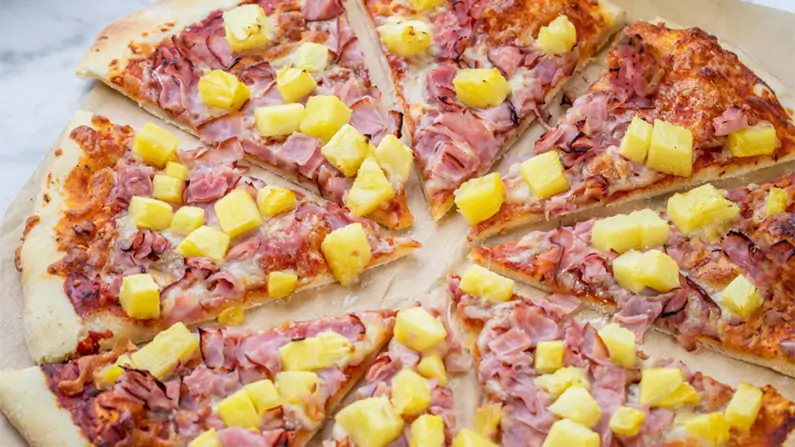
The controversial pineapple topping on pizza — loved by some and hated by others — actually originated far from Hawaii. The combination was created in Canada in 1962 by restaurant owner Sam Panopoulos, who experimented with different flavor pairings at his diner in Ontario.
By adding sweet pineapple to a classic ham-and-cheese pizza, he wanted to create something entirely new. The result was the now world-famous Hawaiian pizza. Although it still divides the pizza world into two camps, it has since achieved iconic status in fast-food history. Panopoulos himself lived until 2017, passing away at the age of 83. [source]
8 Received 500 boxes of canned pineapple as a wedding gift…
When Queen Elizabeth II married Prince Philip in 1947, Australia wanted to contribute a gift that was both practical and symbolic. The country chose to send 500 boxes of canned pineapple, a valuable and highly sought-after product in post-war Europe, where rationing was still in effect.
At the time, the exotic fruit was considered a luxury item and served as a way for Australia to demonstrate loyalty and support for the British royal family. The gift became one of the most unusual — and most tropical — wedding presents among the many received. [source]
You may also like
9 Requires massive amounts of pesticides…
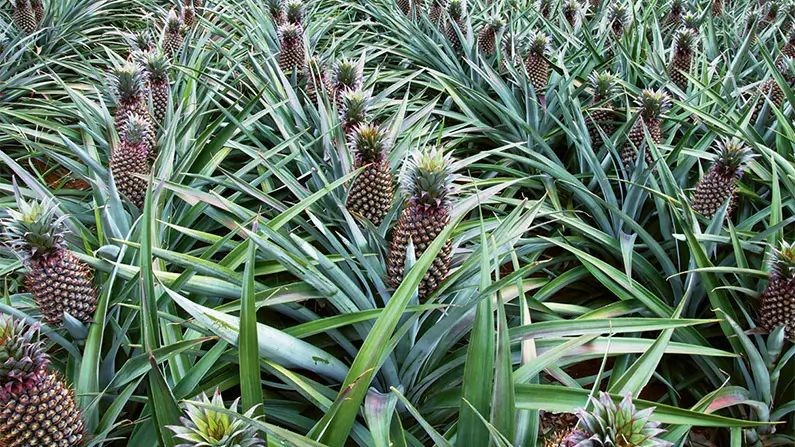
Pineapple cultivation requires very large quantities of pesticides, around 20 kilograms per hectare per growing cycle. The soil is often sterilized, meaning biological diversity is effectively eliminated.
In total, 14 to 16 different treatments are usually needed, and many of them must be applied multiple times throughout the growing process. [source]
10 It has even found its way into Wimbledon…
There is also a pineapple featured on top of the Wimbledon trophy, as the fruit was once regarded as a symbol of prestige and wealth at the time the trophy was designed. [source]
5 Common Questions About Pineapple
Yes. It is rich in vitamin C, antioxidants, and digestive enzymes, which support the immune system and aid digestion.
It contains bromelain, an enzyme that breaks down proteins, causing a temporary tingling or sore sensation in the mouth.
In moderation, yes. Eating it daily can be healthy, but large amounts may irritate the mouth or stomach due to acidity and enzymes.
Botanically speaking, it is a multiple fruit, formed from many flowers fused together into one structure.
Once cut, it typically stays fresh for 3–4 days in the refrigerator if stored in an airtight container.


