

From the very first bricks that saw the light of day in Denmark, LEGO has transformed into a global phenomenon that has captured the imagination of both children and adults. But behind the colorful plastic pieces lies a world of surprising history, impressive achievements, and even a few secrets.
In this article, we reveal 10 fascinating facts about LEGO that not only explain why it is the world’s most beloved toy, but also how it continues to shape culture and inspire creativity. From innovative building projects to lesser-known details — get ready to be both informed and inspired by the magical world of LEGO.
1 This many LEGO bricks are produced every hour — and this many sets are sold each year…
The LEGO Group produces an astonishing number of bricks every second, minute, and hour. Around 1,300 LEGO bricks are manufactured every second, which equals 78,000 bricks per minute and an incredible 4,680,000 bricks per hour.
These numbers highlight the massive scale of LEGO’s production and how its manufacturing capacity supports global demand for the iconic building system. And considering that more than 220 million LEGO sets are sold worldwide every year, it’s no surprise that production runs at full speed. [source]
2 Six 2×4 LEGO bricks can be combined in over 915 million ways…
It sounds almost unbelievable — but it’s absolutely true. This figure has been used by The LEGO Group in its marketing to illustrate the nearly limitless building possibilities of LEGO bricks.
The exact number is 915,103,765 different possible combinations for six 2×4 LEGO bricks, depending on how the calculation is defined and what is included. This total accounts for every possible way the bricks can be stacked and arranged, including all rotations and symmetries. [source]

3 LEGO bricks sold in a single year could stretch around the Earth five times…
According to The LEGO Group, the bricks sold in just one year — if laid end to end — could wrap around the Earth five times. This estimate is based on the total number of LEGO bricks sold globally each year, which amounts to an enormous volume (as mentioned earlier).
The exact distance may vary slightly depending on brick size and assumptions, but it remains an impressive illustration of LEGO’s massive global sales and its far-reaching impact around the world. [source]
4 This is how tall the world’s tallest LEGO tower became — and why it was built…
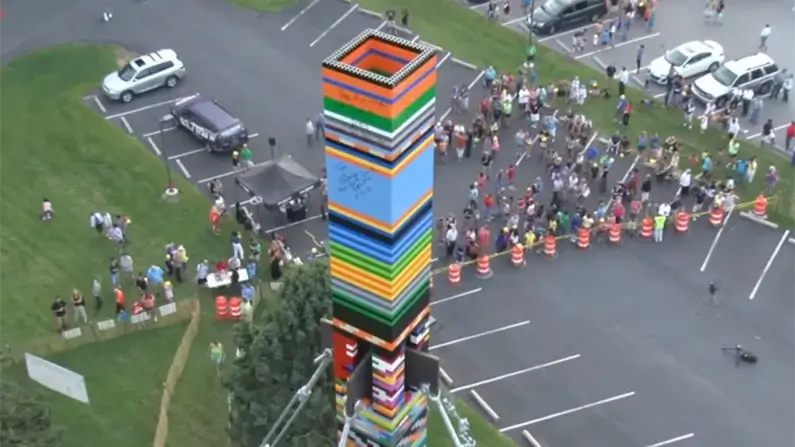
LEGO Italia constructed an impressive structure in Milan that reached a height of 35.05 meters and required around 550,000 LEGO bricks to complete. To achieve this record, The LEGO Group donated seven euros for every centimeter of the tower to a project focused on the protection and development of urban green spaces, in collaboration with the World Wildlife Fund (WWF).
The goal of the initiative was to highlight that just as every small LEGO brick was essential to completing the tower, small actions — such as charitable donations — are also crucial in building a better future.
However, this was not the tallest LEGO tower in the world. The record-holder was built in Tel Aviv, Israel, in 2017, reaching an impressive height of 36 meters — just under one meter taller than the Milan tower. The Tel Aviv tower was built to honor the memory of a young boy, Omer Sayag, who had passed away from cancer and loved building with LEGO. The project engaged the entire city, with many volunteers contributing to the construction of the remarkable tower. An image of (part of) the tower can be found below. [source]
5 LEGO is by far the world’s largest tire manufacturer (sort of)…
LEGO produces around 318 million LEGO tires every year, which equals more than 870,000 tires per day. This technically makes the toy company one of the world’s largest tire manufacturers — even though the tires are small and used exclusively in toy models. [source]
6 To the Moon and back — this is how much LEGO is estimated to have been sold since the beginning…
Exactly how much LEGO has been sold over the years is difficult to track, but The LEGO Group estimates the total at around 400 billion LEGO bricks. This estimate is based on production figures dating back to 1958.
That also means that if all 400 billion bricks were stacked on top of one another, they would span a distance of roughly 3,840,000 kilometers — about ten times the distance from Earth to the Moon, which is approximately 384,400 kilometers away. [source]
You may also like
7 This is why stepping on a LEGO brick hurts so much — they can withstand enormous amounts of force…
A standard LEGO brick can endure an astonishing amount of pressure before breaking. Tests show that a LEGO brick can withstand up to 4,240 newtons of force, which corresponds to roughly 432 kilograms of pressure.
That’s an impressive level of strength for such a small piece of plastic, and it also explains why stepping on a LEGO brick hurts so incredibly much — it doesn’t give way under the pressure of your foot. Instead, the force is concentrated onto a very small area, resulting in intense pain. [source]

8 This is how strong a single LEGO brick is: a 3.5-kilometer tower before the bottom one fails…
Speaking of withstanding enormous amounts of force, researchers have actually investigated how many LEGO bricks can be stacked on top of one another before the bottom brick buckles or breaks. They found that a single LEGO brick can support the weight of around 375,000 other bricks before giving way.
This corresponds to a theoretical LEGO tower height of about 3.5 kilometers. The exact height may vary slightly depending on manufacturing tolerances and material differences, but this is, of course, purely theoretical — it’s not practically possible to build such a tower resting on just one LEGO brick. [source]

You may also like
9 Star Wars played a crucial role in saving LEGO from a financial crisis…
In the late 1990s and early 2000s, LEGO faced a serious economic downturn. The company struggled with overproduction, rising competition, and sharply declining sales.
A major turning point came when LEGO entered a licensing agreement with Lucasfilm to create LEGO Star Wars sets. The first LEGO Star Wars series launched in 1999 and became an instant success. The Star Wars theme quickly gained massive popularity and significantly boosted sales, helping to stabilize LEGO’s financial situation.
Licensed products like LEGO Star Wars, along with other successful themes and strategic changes within the company, helped LEGO recover and return to profitability. The Star Wars license became one of LEGO’s most successful and long-lasting themes, playing a key role in the company’s revival and continued growth. Even today — 25 years later — new LEGO Star Wars sets are still being produced for both collectors and players. [source]

10 Minifigures are by far the world’s largest single population group…
LEGO introduced its first minifigure in 1978, and it has since become an iconic part of LEGO’s product range. Minifigures are the small, buildable characters commonly used in LEGO sets to represent people and fictional figures.
Since their introduction, LEGO has produced more than 4 billion minifigures, making them the largest single population in the world when measured purely by number of individuals. [source]
Xtra This many virtual LEGO bricks were used to make The LEGO Movie…
In The LEGO Movie from 2014, a total of 3,863,484 unique virtual LEGO bricks were used to create the film’s scenes and characters. Despite this huge number of unique pieces, many were reused across different parts of the movie. To recreate the entire film, a staggering 15,080,330 virtual LEGO bricks were required, highlighting the immense level of detail and complexity behind the production.
And the movie was a success, too. With a budget of 80 million dollars, it grossed an impressive 468.1 million dollars worldwide. The sequel, The LEGO Movie 2: The Second Part (2019), was not as successful. It had a budget of 99 million dollars and earned “only” 199.6 million dollars at the box office. [source]
5 Common Questions About LEGO
The bricks are primarily made from ABS plastic (acrylonitrile butadiene styrene), a durable material known for its strength, color stability, and precision.
The company was founded in 1932 in Denmark, originally producing wooden toys before shifting to plastic bricks in the late 1940s.
Because they are extremely rigid and strong, they don’t bend under pressure. Instead, the force from your foot is concentrated onto a very small surface area, causing intense pain.
Estimates suggest that hundreds of billions of bricks have been manufactured since production began in 1958, making it one of the most produced toys in history.
Yes. Bricks produced today are fully compatible with those made over 60 years ago, thanks to remarkably consistent manufacturing standards.