The Moon has fascinated humanity for thousands of years, and it remains one of the most mysterious and captivating objects in the sky. Even though we’ve sent humans there and explored its surface with advanced spacecraft, much about it is still unknown or surprising to many of us. Here, we present ten crazy facts about the Moon that will challenge what you thought you knew — and might even make you see our closest celestial neighbor in a completely new light. Prepare to be amazed!
1 Who actually owns the Moon…?
During the 1960s, as the United States and the Soviet Union competed in the race for space, the United Nations (UN) anticipated that questions of ownership over the Moon and other celestial bodies would arise. To clarify the rules and avoid a “finders keepers” situation, the UN adopted the Outer Space Treaty in 1967.
The Outer Space Treaty states that the Moon and other celestial bodies cannot be owned by any nation or individual, and that the exploration and use of outer space must benefit all countries. The treaty also prohibits military activities on celestial bodies and establishes that space must be used solely for peaceful purposes. In other words, no one owns the Moon. [source]
2 The U.S. wasn’t actually the first to reach the Moon…
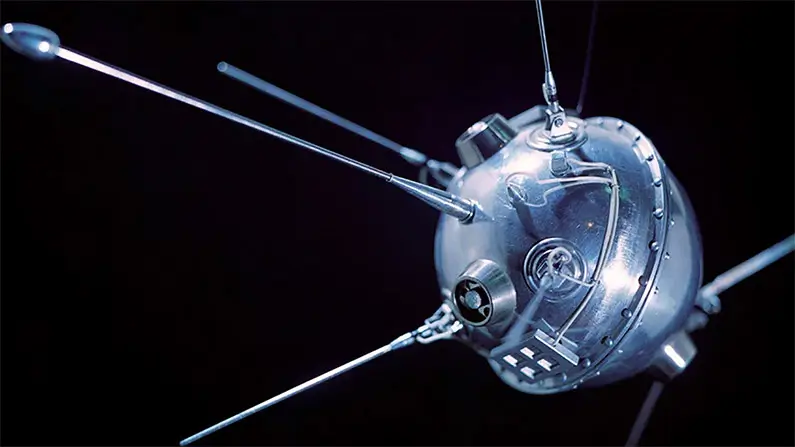
The headline is true — but only partly. The United States was the first to land humans on the Moon during the Apollo 11 mission in 1969. However, the Soviet Union was actually the first to reach the Moon using an unmanned spacecraft (Luna 2) — a feat they accomplished 10 years before the manned Moon landing took place.
The Soviet Union was also the first to successfully soft-land on the Moon, which they achieved with Luna 9 in 1966 and Luna 12 in 1967. Below is an image of the Luna 2 spacecraft. [source]
3 It can get insanely cold on the Moon…
What would Moon facts be without mentioning its extreme temperatures? Unlike Earth, the Moon has no atmosphere to protect it from drastic temperature shifts. Because of this, temperatures on the lunar surface vary dramatically between sunlit and shadowed areas.
Temperatures on the Moon can drop extremely low. In the coldest locations — where sunlight never reaches — temperatures can fall to about –233°C. This occurs in certain craters near the poles where the Sun’s rays never touch the surface.
But temperatures can also become extremely hot, especially in areas exposed directly to sunlight. During the lunar daytime — which lasts about two weeks due to the Moon’s slow rotation — surface temperatures can rise to around 127°C. [source]

You may also like
4 The Moon is slowly drifting farther away from us…
The Moon moves slightly farther from Earth each year, and this shift can be measured using laser pulses. More specifically, the Moon is receding at a rate of about 3.8 centimeters per year.
This phenomenon was discovered by firing laser pulses at the retroreflectors left on the Moon by the Apollo astronauts. By measuring the time it takes for the laser to travel to the Moon and back, scientists can calculate the distance with extremely high precision.
But don’t worry — at this rate, it would take the Moon 263 years to move just 1 kilometer farther away from Earth. And considering it already sits an average of 384,400 kilometers from us, an extra kilometer won’t spell the end of the world. [source]
5 People once thought the Moon used to have a magnetic field — but that now appears to be wrong…
Earth, as we know, has a magnetic field that protects the planet from solar wind and cosmic radiation. This field plays a crucial role in preserving Earth’s atmosphere and supporting life.
For a long time, geophysicists believed that the Moon once had a strong magnetic field, similar to Earth’s, based on analyses of lunar samples brought back during the Apollo missions. These samples showed magnetic properties that suggested the presence of a magnetic field between 4 and 2 billion years ago.
However, more recent research indicates that these magnetic signatures were likely the result of meteor impacts magnetizing the lunar surface. The current scientific consensus is that the Moon no longer has a meaningful magnetic field to shield it from solar wind and radiation, and that any past magnetic activity was limited in strength and duration. [source]
6 The Moon was once volcanically active…
As mentioned earlier, the Moon hasn’t always been a cold, barren place. Around four billion years ago, it was a hotspot of volcanic activity. Deep beneath its rocky surface, the Moon once resembled Earth with distinct layers — crust, mantle, and a core. At the core, temperatures could reach over 2,500°C, hot enough to produce molten iron. This molten material — lava — rose to the surface and smoothed out much of the Moon’s early rugged landscape.
For a long time, scientists believed that the Moon had not experienced volcanic activity for about three billion years, which partly explains why its craters are so prominent today. However, new research has revised this view and uncovered evidence of volcanic eruptions as recent as 50 million years ago. While that may sound ancient, it is only a tiny fraction of the universe’s history. These eruptions occurred around the time dinosaurs went extinct and mammals began to dominate — a sequence that ultimately led to the rise of humans. [source]
You may also like
7 Yes, there really is water on the Moon! But it likely came from Earth…
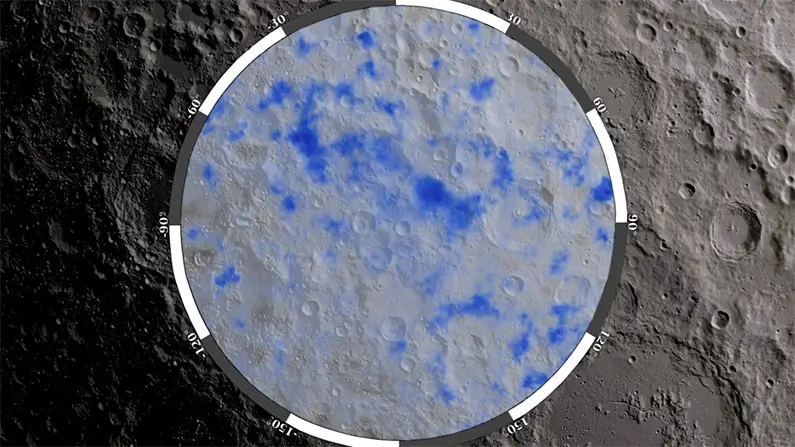
For centuries, experts speculated that water might exist on the Moon, but it wasn’t confirmed until the Indian spacecraft Chandrayaan-1 used high-tech instruments to detect it. Through infrared light analysis, scientists discovered ice deep inside the Moon’s polar craters. Later exploration found water in additional locations. Some regions remain permanently shadowed due to large craters, creating “cold traps” that reach the extremely low temperatures mentioned earlier (–233°C).
On a smaller scale, water also exists in micro–cold traps, which cover about 40,000 square kilometers of the lunar surface. The harsh conditions explain why there is so little water on the Moon — roughly 100 times less than what’s found in the Sahara Desert.
How did the water get there? The question is still debated, but many researchers believe it may have originated from Earth during the Moon’s formation. [source]
8 What would Moon facts be without mentioning a lunar base…?
It has been nearly 60 years since humans first landed on the Moon. But in the future, such trips may become far more common. NASA is planning to build a lunar base camp as part of the Artemis missions. The project aims to establish a foundation for deeper space exploration by setting up telescopes, scientific equipment, and long-term infrastructure.
The first camp is planned for the Moon’s south pole to take advantage of maximum sunlight for solar power and access to frozen water. The structures will need to be lightweight, and one idea is to use a 3D printer on the Moon that builds habitats using lunar dust as the primary material. [source]
You may also like
9 Seeing the far side of the Moon for the first time was a shock…
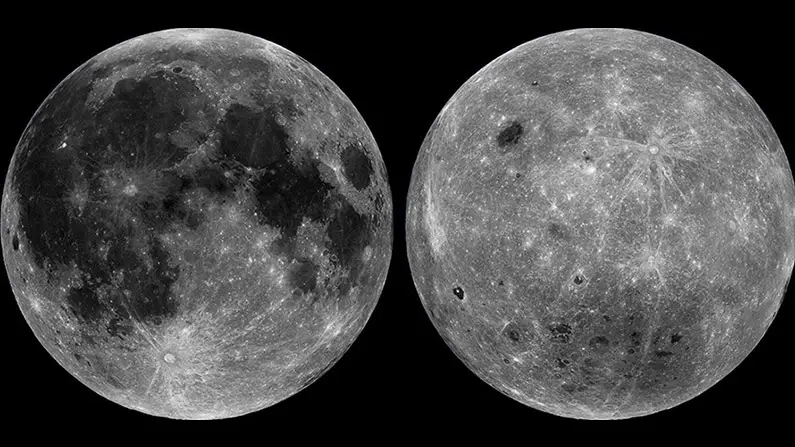
For as long as humans have looked up at the Moon, most assumed it looked more or less the same on all sides — after all, we always see the same face from Earth. That’s why it was such a shock when the Soviet spacecraft Luna 3 photographed the far side of the Moon for the first time in 1959.
The images revealed dramatic differences from the side we see. While the near side has dark, smooth areas where lava once flowed, the far side is covered in many more small craters. One possible explanation is a massive collision that occurred about one billion years ago near the Moon’s south pole. This event may have triggered volcanic activity on one side but not the other.
In the image below, you can see the difference between the Moon’s near and far sides. The left image shows the Moon as we see it from Earth, and the right shows its “far side.” [source]
10 How the Moon formed — and what it’s made of…
When it comes to origin stories, the Moon has a pretty good one. Our planet and its Moon formed when dust and rock orbiting a young star slowly clumped together over millions of years. Eventually, these larger objects — some roughly the size of Mars — began colliding with one another, until a massive impact between one of them and the early Earth created the Moon.
This theory was supported by the hundreds of kilograms of lunar material brought back by Apollo astronauts. Analysis showed that the Moon and Earth share very similar chemical compositions, reinforcing the idea that they originated from the same event.
The Moon is composed primarily of silicate rocks, a type of rock containing silicate minerals such as feldspar, pyroxene, and olivine. Its surface is covered by a layer of regolith, a mix of fine rock particles, dust, and fragments of lunar bedrock. Regolith was formed through meteor impacts and other processes that have ground down the surface over time.
Additionally, the Moon contains small amounts of metals, such as iron and magnesium, and some regions even contain water ice. [source]

You may also like
Plus The Moon is responsible for Earth’s tides…
The gravitational pull between our planet and the Moon keeps the Moon in orbit — but at the same time, the Moon has a major influence on Earth. One of the most noticeable effects is on our oceans, which the Moon pulls toward itself.
This creates high tide on the side of Earth closest to the Moon, and low tide on the side farthest away. Twice each month, a phenomenon called “spring tide” occurs, when the Earth, Moon, and Sun are perfectly aligned, causing higher-than-normal high tides. [source]
5 Common Questions About the Moon
Because the Moon is tidally locked to Earth, it rotates at the same rate that it orbits our planet. This means the same hemisphere is always facing us, while the “far side” remains hidden from direct view.
The Moon has only a very thin exosphere, not a true atmosphere like Earth’s. It cannot support weather, wind, or breathable air, and offers no protection from radiation or meteoroids.
Yes. Scientists have confirmed the presence of water ice in permanently shadowed craters near the poles, as well as traces of water molecules in the lunar soil.
The most accepted explanation is the giant impact hypothesis, which states that the Moon formed after a Mars-sized body collided with early Earth, ejecting debris that eventually clumped together to form the Moon.
Possibly. NASA’s Artemis program aims to establish a lunar base at the Moon’s south pole, where sunlight and water ice can support long-term missions and future human habitation.