
For most of us, outer space is, in a way, a little scary — and for several reasons. It can feel frightening because we know so little about it and don’t fully understand how it works. Or it might be unsettling simply because it’s dark. There are many reasons why people find outer space to be an uncomfortable topic, even if they also find it interesting and fascinating at the same time.
That’s why we’ve gathered ten facts about outer space that you might not have been aware of before — and ones you might even wish you still didn’t know. Because, to be honest, some of these points are a bit unsettling.
1 Dark Flow — the terrifying cosmic pull that has never been fully explained…
There is a phenomenon known as “dark flow“. This term is used to describe the observation of galaxy clusters moving in a specific direction at a speed that cannot be explained by normal cosmic expansion. The phenomenon was discovered in the early 2000s through studies of the Cosmic Microwave Background (CMB), the oldest light in the universe.
It remains unclear what causes dark flow, but some hypotheses suggest it may be the effect of gravitational forces from beyond the observable universe, or perhaps a leftover imprint from early cosmic events such as inflation. [source]
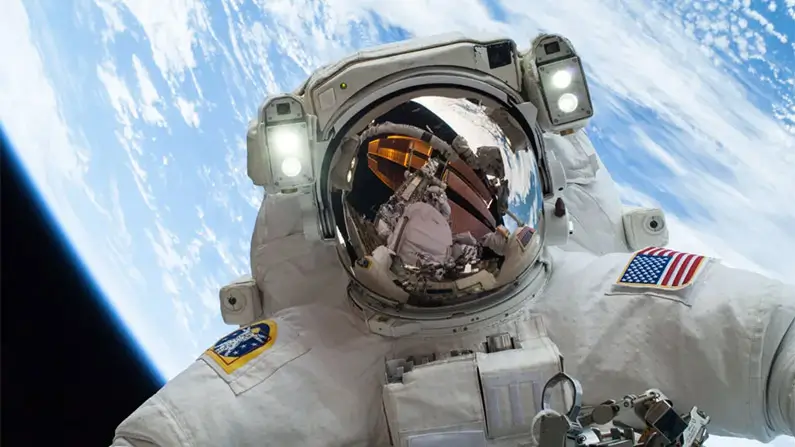
2 Astronauts must drink 730 liters of recycled sweat and urine to survive a year in space…
Water is a limited resource in space — which means astronauts must recycle their own waste. During his year-long mission on the International Space Station (ISS), NASA astronaut Scott Kelly consumed about 730 liters of recycled urine and sweat to stay alive. Nom-nom-nom… [source]
3 Meteors can hit Earth without any warning…
Small meteors and asteroids can sometimes strike Earth without warning because they are too small to be detected in advance by current observation systems. These objects may be so tiny that they burn up completely in the atmosphere, causing no damage — or they may produce small, barely noticeable explosions.
However, on February 15, 2013, a meteor exploded over the Chelyabinsk region in Russia. The explosion created a powerful shockwave that shattered windows and damaged around 1,500 buildings. An estimated 400 people were injured, mainly by glass fragments. There was initially confusion about whether it was a single meteor or part of a meteor shower, but it was later confirmed to be a single meteor that exploded in the atmosphere. [source]
You may also like
4 Super-sized solar storms can cause worldwide power outages…
In July 2012, a coronal mass ejection (CME) — sometimes referred to by the media as a solar superstorm — crossed Earth’s orbital path and collided with the spacecraft STEREO-A. According to Daniel Baker from the University of Colorado, if the superstorm had occurred just one week earlier, Earth would have been hit, likely resulting in devastating global consequences. [source]

5 Long space missions change astronauts’ DNA and gut bacteria…
Astronaut Scott Kelly, who spent a year aboard the International Space Station in 2016, discovered that he was about five centimeters (two inches) taller when he returned to Earth than when he left. The new physical differences between Scott and his identical twin brother, Mike — also an astronaut — were striking. Scientists compared their DNA and found that, in addition to the height difference, Scott’s gut bacteria had changed completely, and his gene expression had shifted.
Researchers concluded that these changes were caused by the “stressors of spaceflight, which can alter a cell’s biological pathways“. Although Scott eventually returned to his original height, many of his other genetic changes appear to be irreversible. [source]
6 Gamma radiation can destroy entire planets in outer space…
Gamma-ray bursts (GRBs) are massive explosions in distant galaxies that release incredibly powerful waves of gamma radiation. If such an event were ever directed straight at Earth, it could be catastrophic and has the potential to wipe out all life on the planet.
Fortunately, Earth is relatively safe from this scenario. GRBs are extremely rare, and the vast distances between us and the regions of space where they occur provide additional protection. According to 2018 estimates, a gamma-ray burst happens in the Milky Way only about once every five million years, and even then, the radiation would most likely be far enough away to avoid causing any major harm to life on Earth. [source]
You may also like
7 Long-term weightlessness greatly increases the risk of eye disorders…
Astronauts’ bodies are affected in many ways during long periods in space, as mentioned earlier. One of the known effects is that their eyes can be negatively impacted after extended time in microgravity, including deformation of the eyeballs and vision impairment.
The condition is known as Spaceflight-Associated Neuro-Ocular Syndrome (SANS), also referred to as Visual Impairment and Intracranial Pressure (VIIP) syndrome. During prolonged missions, fluid can accumulate around the brain, leading to increased intracranial pressure. This, in turn, can cause the eyes to swell and vision to deteriorate.
It’s a well-documented issue that scientists and space agencies are actively studying to better understand — and hopefully counteract — during future long-duration space missions. [source]

8 Galaxies can “eat” each other…
Galactic cannibalism is a process in which a large galaxy merges with a smaller companion galaxy through tidal gravitational interactions. This process often results in an irregular galaxy, as seen in well-known examples such as the Whirlpool Galaxy, the Mice Galaxies, and the Antennae Galaxies. [source]

You may also like
9 We inhabitants of Earth are “moving along” at over 100,000 km/h…
Our planet rotates on its axis, causing everyone on Earth to move at a speed of about 1,040 kilometers per hour (646 mph) at the equator. In addition, Earth travels through its orbit around the Sun at an average speed of about 107,000 kilometers per hour (66,500 mph). [source]

10 So-called “ghost Galaxies” contain no visible stars or bright matter…
An unusual — and unsettling — aspect of outer space is the existence of so-called “ghost galaxies“. These are galaxies that have no visible stars or bright matter at all, yet still exert a clear gravitational influence on the material around them.
These ghost galaxies are extremely difficult to detect because they emit no visible light, making them impossible to see through traditional observation methods. Instead, they can only be identified by how they distort light from background objects or through observations of the motion of nearby stars or gas clouds.
The explanation for their mysterious nature is often linked to dark matter — a strange substance that makes up a large portion of the universe’s mass but does not emit or reflect any visible light. Some theories suggest that ghost galaxies may be made primarily of dark matter that does not interact with electromagnetic radiation the way normal matter does. [source]
You may also like
5 Common Questions About Outer Space
The exact size of the universe is unknown. The observable universe stretches about 93 billion light-years across, but the entire universe may be much larger — possibly infinite.
Dark matter is a mysterious, invisible substance that makes up about 27% of the universe. It doesn’t emit or reflect light, but scientists can detect it through its gravitational effects on galaxies and cosmic structures.
Yes. When massive stars reach the end of their life cycle, they can explode in colossal events called supernovae. These explosions are powerful enough to outshine entire galaxies and help create heavy elements like gold and iron.
In theory, yes — a large enough asteroid impact could be catastrophic. However, NASA and other space agencies track thousands of near-Earth objects, and no known asteroid is currently on a collision course that threatens global extinction.
We don’t know — yet. Scientists have found potentially habitable exoplanets, discovered organic molecules, and detected possible biosignatures, but no confirmed evidence of extraterrestrial life has been found so far.