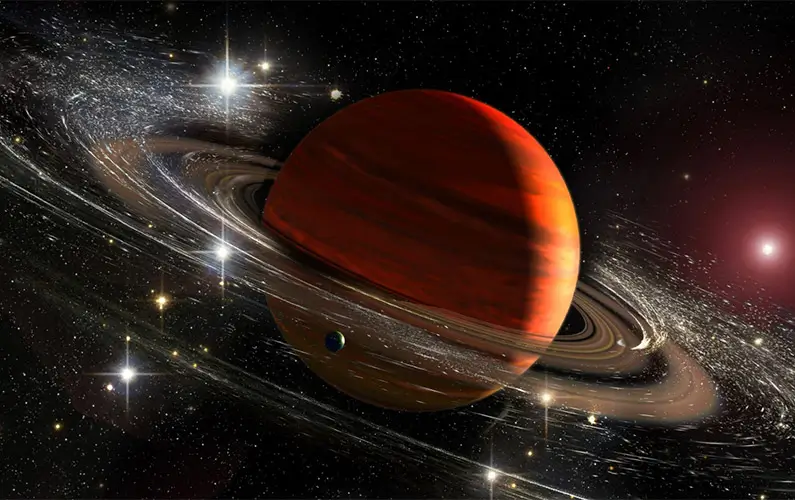
Saturn is the sixth planet from our Sun and the second-largest in the solar system. It is a gas giant composed primarily of hydrogen and helium, first observed through a telescope by Galileo Galilei in 1610. When he viewed the planet, the angle of the rings made Saturn appear as though it were three bodies clustered together, which greatly puzzled scientists of the time.
Saturn has a mass 95 times greater than Earth’s and a diameter nine times larger. Here are ten more facts you should know about the Milky Way’s gigantic planet!
1 Saturn is considered the most beautiful planet in the solar system…
Many astronomers — and the general public — regard Saturn as the most beautiful planet in the solar system, mainly because of its spectacular ring system. The planet’s rings, which are extremely wide and made up of ice and rock particles of various sizes, give Saturn a unique and striking appearance that can be seen even through small telescopes from Earth.
Because of this, Saturn is often referred to as the “jewel of the solar system“. [source]
2 Saturn isn’t the only planet with rings…
Saturn has what is known as a planetary ring system, a thin, disk-shaped region of dust and small particles orbiting the planet. But Saturn is not the only planet in our solar system with rings — Jupiter, Uranus, and Neptune also have them, although theirs are far fainter and less spectacular than Saturn’s prominent seven rings.
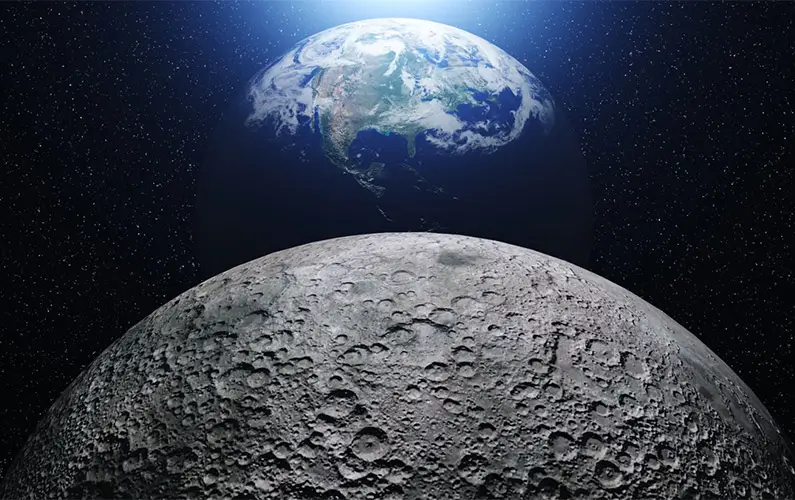
Saturn’s ring system is also extremely wide, stretching up to 282,000 kilometers. In fact, if you traveled that same distance from Earth, you would be more than halfway to the Moon. [source]
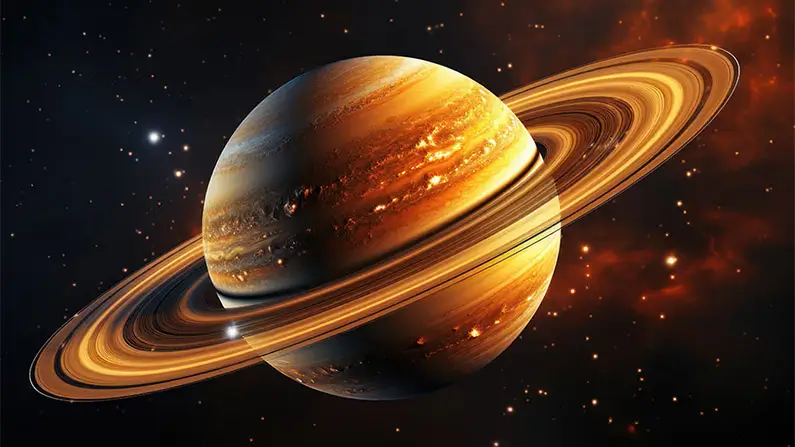
3 Saturn could theoretically float on water…
This planet has an average density of about 0.687 grams per cubic centimeter, which is lower than the density of water (1 g/cm³), making it the least dense planet in the solar system. This means that if there were a hypothetical bathtub large enough to hold Saturn, the planet would actually float on the water.
Earth and Mercury, however, would sink the fastest of all the planets, because their densities are much higher than water’s. Earth has a density of about 5.52 g/cm³, and Mercury’s is about 5.43 g/cm³. [source]
You may also like
4 The first close-up images of the planet weren’t seen until 1979…
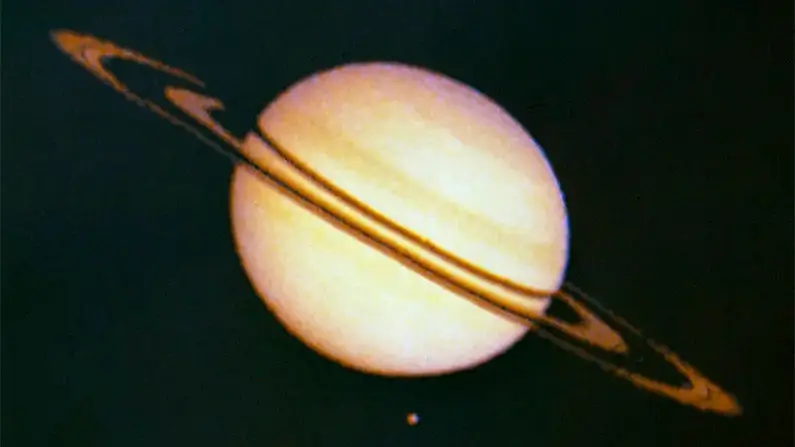
The first spacecraft to fly past Saturn was Pioneer 11, which was launched from Earth in 1973 and didn’t arrive until 1979. Voyager 1 and Voyager 2 also conducted flybys in 1980 and 1981.
Today, Voyager 1 is the farthest-traveled human-made object in space. Below is an image of Saturn taken by Pioneer 11 in 1979. [source]
5 How cold Saturn can get…
The coldest known temperature on Saturn is far lower than the coldest temperature ever recorded on Earth. According to scientists, temperatures on the planet can drop to –212°C (–350°F) at the poles and in certain cloud layers. However, the average temperature typically sits around –180°C (–292°F).
For comparison, the coldest temperature ever measured on Earth is –89.2°C (–128.6°F), recorded at Vostok Station in Antarctica in 1983. [source]
6 Just how enormous Saturn is…
Saturn’s surface area is about 83 times larger than Earth’s, and its volume is an astonishing 764 times greater. In other words, you could fit 764 Earths inside Saturn.
That really puts into perspective just how much bigger this giant planet is compared to our small, familiar home world. [source]

You may also like
7 How long a day on Saturn is…
A year on Earth — defined as the time it takes our planet to complete one orbit around the Sun — is about 365.256 days. A year on Saturn, however, is much longer due to its great distance from the Sun and its slower orbital speed. One Saturnian year lasts about 10,759.22 Earth days, which is roughly 29.5 Earth years.
A single day on Saturn, on the other hand, is only 10 hours, 33 minutes, and 38 seconds long — that’s how long it takes the planet to rotate once on its axis.
So in a way, we should probably be grateful we’re born on Earth… because who would want to wait 10,759.22 days for their next birthday? [source]
8 How many moons have been discovered around Saturn…
Saturn currently has 274 confirmed moons, officially recognized by the International Astronomical Union. Among these, the largest and most well-known are Titan, Rhea, Iapetus, Dione, Tethys, Enceladus, and Mimas — all of which are icy moons.
The first moon ever discovered around Saturn was Titan, identified by the Dutch astronomer Christiaan Huygens back in 1655. Titan is the largest moon orbiting Saturn and the second-largest moon in the entire solar system, surpassed only by Ganymede, which orbits Jupiter. [source]
You may also like
9 Storms on Saturn are on an entirely different level…
The atmospheric conditions on Saturn are extremely different from those on Earth. Wind speeds on the planet can reach up to 1,800 km/h (1,118 mph), which is far faster than the highest wind speed ever recorded on Earth — 483 km/h (300 mph) during extreme tornado conditions.
The storms on Saturn are also vastly different in scale and duration compared to those on Earth. Some storms can last for months or even years. The most famous example is the “Dragon Storm“, a massive storm that has been raging for over 2,000 years, according to observations from the Cassini spacecraft.
This long-lasting and intense atmospheric activity is fascinating and dramatically different from anything we experience here on Earth. [source]
10 A summer on Saturn lasts more than 8 years…
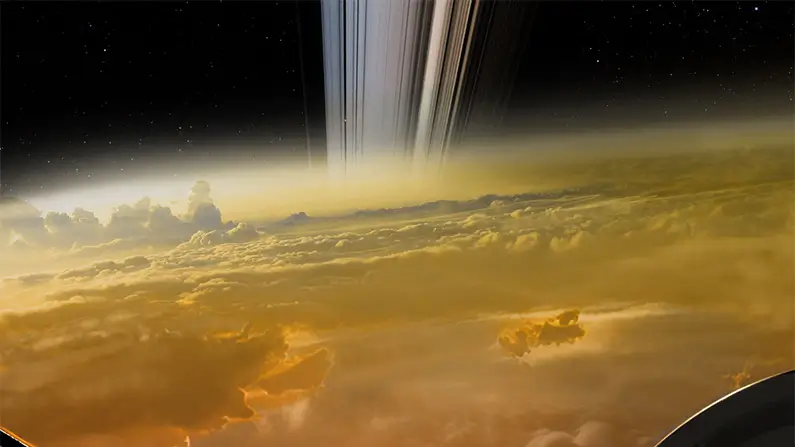
Saturn has seasons due to its axial tilt, just like Earth. The difference is that Saturn is more tilted than Earth, which leads to much longer seasonal periods. Because of its long orbit around the Sun, both summer and winter on Saturn last far longer than on Earth.
Summer on Saturn lasts about 7.5 Earth years, and the frigid winter lasts just as long. [source]
You may also like
5 Common Questions About Saturn
Saturn is a gas giant composed mostly of hydrogen and helium, with traces of methane, ammonia, and water vapor. It has no solid surface, unlike rocky planets such as Earth.
Saturn has seven major ring groups, made up of countless pieces of ice, rock, and dust. Its rings are the largest and brightest in the entire solar system.
As of now, the planet has 274 confirmed moons, including the famous Titan, which is the second-largest moon in the solar system and has a thick atmosphere.
One Saturnian year — the time it takes to orbit the Sun — is about 29.5 Earth years (10,759 Earth days). Saturn’s long orbit also gives it very long seasons, each lasting over 7 years.
Winds on Saturn can reach 1,800 km/h (1,118 mph), among the fastest in the solar system. These extreme winds fuel massive, long-lasting storms, some lasting months to years, such as the famous Dragon Storm.