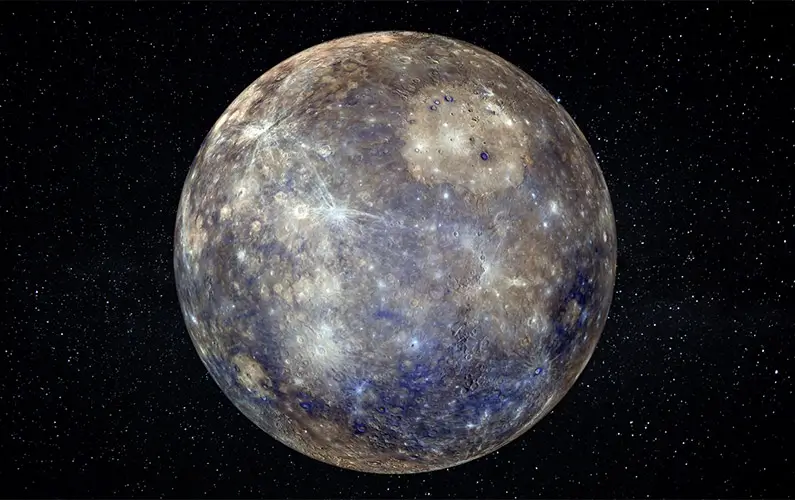
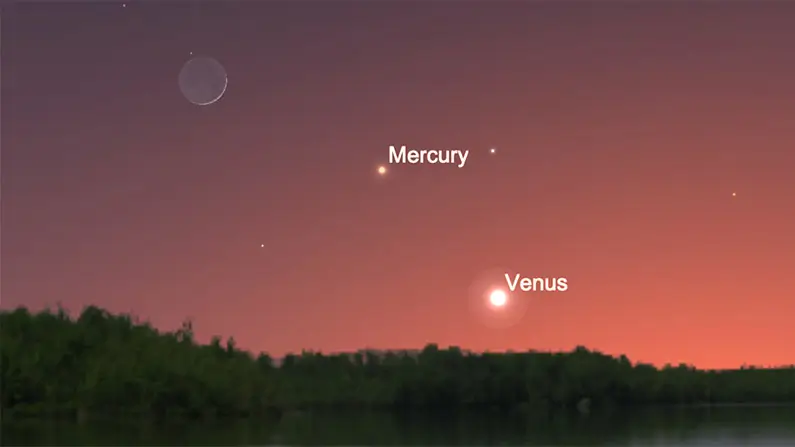
Mercury is the innermost and smallest planet in the solar system, making it the world closest to the Sun. It completes an orbit around the Sun in about 88 days. Because of its proximity to the Sun, it is very difficult to observe from Earth and can only be seen around dawn or dusk with the naked eye or through binoculars.
Despite this, the planet has an observational history of at least 3,400 years that we know of. Below, you’ll find ten more fascinating facts about this planet, which in many ways resembles our Moon in appearance!
1 Mercury has the greatest temperature swings in the entire solar system…
Even though Mercury is the closest planet to the Sun, its surface can still become extremely cold. Daytime temperatures can reach a scorching 450°C (842°F), while nighttime temperatures can plunge to –170°C (–274°F).
This means Mercury experiences a temperature fluctuation of more than 600 degrees, the largest of any planet in the solar system. [source]
2 Many scientists believe the planet may contain ice…
Scientists believe there may be ice inside Mercury’s craters. The planet’s north and south poles are cold and permanently shadowed, which could allow them to preserve water-based ice, according to several researchers.
This ice may have been delivered by meteorites and comets, or it could have formed when water vapor from Mercury’s interior escaped and then froze. [source]
3 The smallest planet in the solar system…
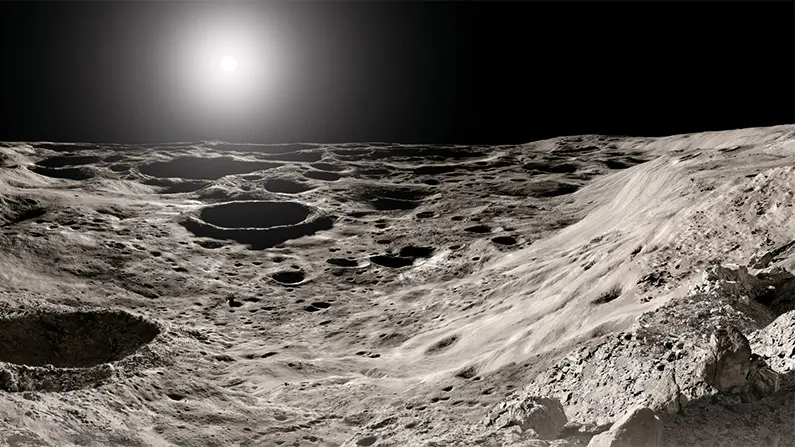
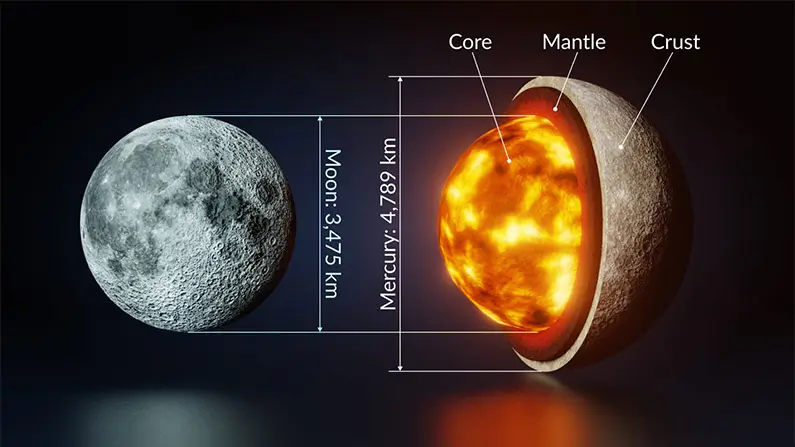
Mercury is the smallest planet in the entire solar system. The tiny planet measures only about 4,876 kilometers in diameter, making it just slightly larger than our Moon.
To put its size into perspective, Mercury is actually smaller than Saturn’s moon Titan and Jupiter’s moon Ganymede. Pluto was once considered the smallest planet, but since it was reclassified as a dwarf planet, Mercury now holds the title of the smallest true planet. [source]
You may also like
4 A 100 km–wide asteroid likely crashed into the planet 4 billion years ago…
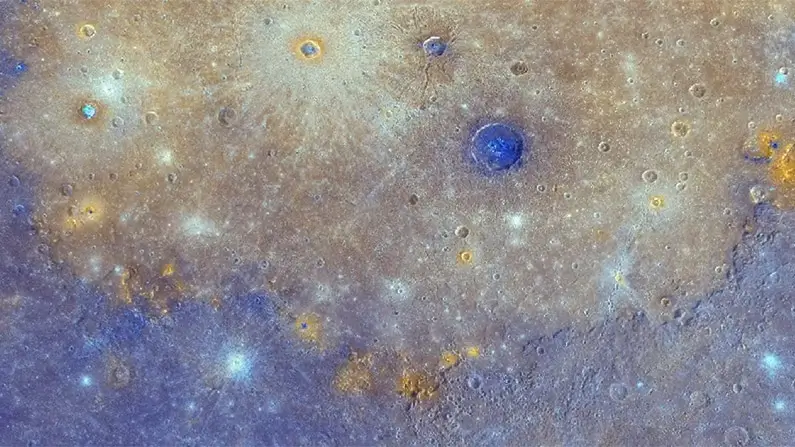
Scientists believe that a massive asteroid slammed into Mercury around 4 billion years ago, creating a gigantic crater about 1,545 kilometers (960 miles) wide. This immense crater is known as the Caloris Basin, and the entire U.S. state of Texas could theoretically fit inside it.
Researchers estimate that the asteroid responsible must have been roughly 100 kilometers (62 miles) wide. [source]
5 Mercury moves faster around the Sun than any other planet…
No planet reaches the incredible orbital speed that Mercury does as it travels around the Sun. Measurements show that Mercury races through space at about 118,000 km/h (73,000 mph).
When the planet is at its closest point, it lies only 47 million kilometers from the scorching star, and at its farthest, it is 70 million kilometers away. [source]
6 NASA has created a complete map of the planet…
NASA’s MESSENGER spacecraft (short for MErcury Surface, Space ENvironment, GEochemistry, and Ranging mission), which orbited Mercury starting in 2011, has sent back remarkable images of the planet closest to the Sun.
Researchers have used these images to produce the first fully complete map of Mercury’s surface. [source]
You may also like
7 75% of the planet’s total radius is made up of an iron core…
Mercury’s iron core makes up about 75% of the planet’s entire radius. This massive core contains more iron than any other planet in the solar system. Scientists are not entirely certain how Mercury’s oversized iron core formed, but most believe it is connected to the planet’s early formation history.
If Mercury formed very quickly, it may have ended up with only a thin outer shell surrounding its huge core. The illustration below shows the core’s proportion: the outer rocky layer is only about 400 kilometers thick. [source]
8 Mercury is one of only two planets in the solar system without moons…
The planet has no moons and no rings. Mercury and Venus are the only two planets in the entire solar system that do not have any natural satellites.
As a result, these planets are not illuminated by moons at night, unlike Earth. [source]

You may also like
9 One of five planets visible to the naked eye…
Mercury is one of the five planets in the solar system that can be seen with the naked eye from Earth. The other four are Venus, Mars, Jupiter, and Saturn. And of course, we’re not counting our own planet — Earth. [source]
10 The Sun appears three times larger from Mercury’s sun-facing side…
If you were standing on the sunlit side of Mercury when it is at its closest point to the Sun, the Sun would appear three times larger from the planet than it does from Earth. [source]
You may also like
5 Common Questions About
Mercury has no significant atmosphere to trap heat, which means it experiences extreme temperature swings. Daytime temperatures can reach 450°C (842°F), while nighttime temperatures can drop to –170°C (–274°F).
No. Mercury has no moons at all, making it one of only two planets in the solar system without natural satellites (the other is Venus).
A day on Mercury — one full rotation on its axis — lasts about 59 Earth days. Interestingly, a Mercury year (one orbit around the Sun) is only 88 Earth days, meaning its day is almost as long as its year.
Because Mercury is very close to the Sun, it can only be seen around sunrise or sunset. Looking at it at other times is nearly impossible because it stays lost in the Sun’s glare.
Mercury has a massive iron core that makes up about 75% of its radius, making it the planet with the highest metal content in the solar system. Its thin outer layer consists of rocky material similar to Earth’s crust.