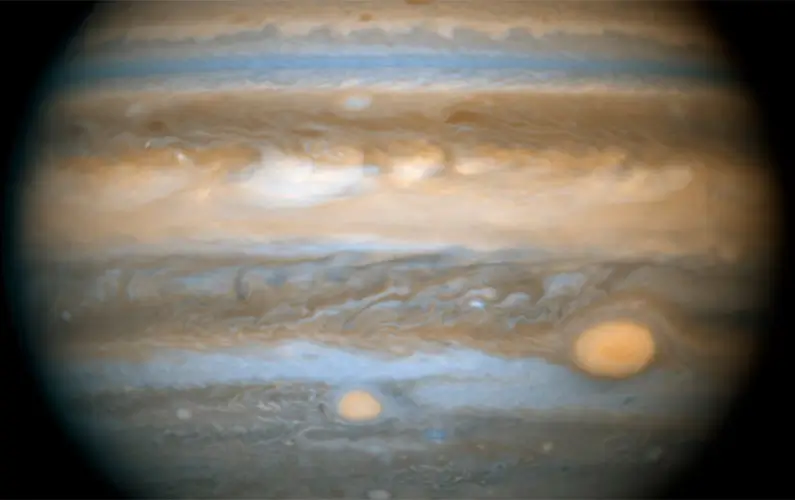
Jupiter (symbol: ♃) is the fifth planet from the Sun and by far the largest planet in our solar system. It is classified as a gas giant, and even today scientists are unsure whether the planet has a solid core at all. Jupiter is named after the chief deity of Roman mythology, but the planet has been known since ancient times and has carried many different names throughout history. As we know it today, here are ten facts you probably didn’t know about Jupiter!
1 To put Jupiter’s size into perspective…
As mentioned in the introduction, Jupiter is by far the largest planet in our solar system. Its mass is 2.5 times greater than the combined mass of all the other planets, which truly highlights the immense giant we’re dealing with. [source]
2 But more mass doesn’t mean it would get bigger…
If Jupiter were to accumulate even more mass, it actually wouldn’t grow larger — in fact, the opposite would happen. Additional mass would make the planet denser, causing it to compress under its own gravity. Astronomers estimate that Jupiter could absorb up to four times its current mass and still remain roughly the same size. [source]
3 Jupiter could never become a star…
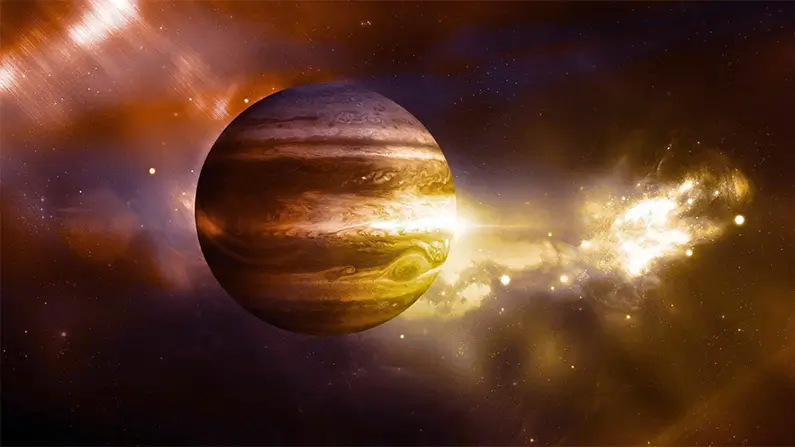
Astronomers sometimes refer to Jupiter as a “failed star“, but that isn’t an accurate description. Although the planet, like a star, is rich in hydrogen and helium, it doesn’t have enough mass to trigger nuclear fusion in its core. Fusion — the process that powers stars — requires extreme heat and pressure to fuse hydrogen atoms into helium, releasing light and heat.
For Jupiter to ignite fusion and become a true star, it would need to have a mass about 70 times greater than it does today. [source]
You may also like
4 Jupiter is huge — and also the fastest-rotating planet…
Despite its enormous size and mass, Jupiter spins incredibly fast. In fact, with a rotational speed of 12.6 km/s (~7.45 miles/s) or 45,300 km/h, the planet completes a full rotation on its axis in only about 10 hours.
Because it rotates so rapidly, Jupiter is slightly flattened at the poles and bulges at the equator. [source]
5 The clouds on Jupiter are only 50–80 km thick…
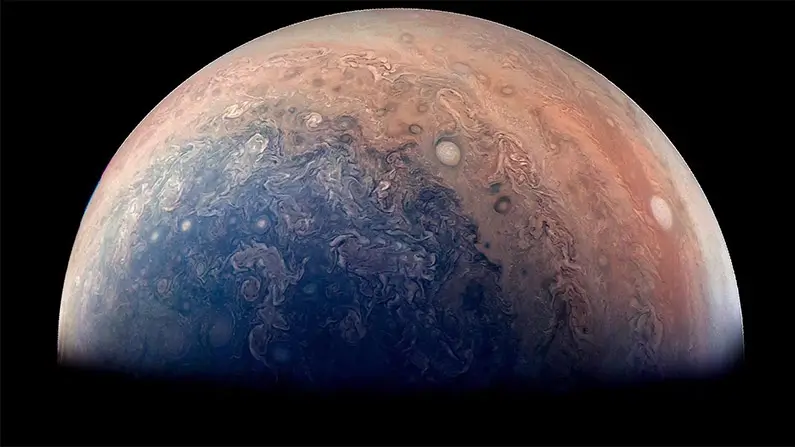
That’s right — all those beautiful swirling clouds and storms you see on the planet are only 50–80 km thick. They are made of ammonia crystals arranged in two distinct cloud layers. The darker material is believed to be compounds brought up from deeper within the planet, which then change color when they react with sunlight.
But below these clouds, it’s nothing but hydrogen and helium all the way down. [source]
6 Jupiter has rings, just like Saturn…
Just like Saturn, Jupiter also has rings — though they are far smaller and much fainter. Jupiter’s rings were the third ring system discovered in the solar system, after those of Saturn and Uranus. They were first detected in 1979 by Voyager 1 and later studied extensively by NASA.
Over the past 25 plus years, the rings have also been observed by the Hubble Space Telescope and from Earth, although very large telescopes are required to see them from the ground. These rings are widely believed to have formed from material ejected from the planet’s moons after being struck by meteoroids. [source]
You may also like
7 Jupiter’s Great Red Spot is disappearing…
The most iconic feature of Jupiter is the Great Red Spot (in the southern hemisphere), a gigantic storm system more than twice the size of Earth. The storm has existed for at least 400 years and was first observed in 1665 by the Italian astronomer Giovanni Cassini.
However, scientists know that the Great Red Spot is shrinking, and some estimates suggest it could disappear within 50–100 years. [source]

8 Jupiter has a magnetic field 14 times stronger than Earth’s…
A compass would work exceptionally well on Jupiter. That’s because the planet has the strongest magnetic field in the entire solar system. Astronomers believe this field is generated by eddy currents — swirling motions of conductive material — in Jupiter’s liquid metallic hydrogen core.
This powerful magnetic field traps sulfur dioxide particles from Io’s volcanic eruptions, producing sulfur and oxygen ions. Together with hydrogen ions from Jupiter’s atmosphere, these particles form a plasma sheet in the planet’s equatorial plane. [source]

You may also like
9 A total of 95 moons have been discovered around Jupiter – so far…
Astronomers have identified 95 moons orbiting Jupiter at the time this article was written (October 2021). However, it is estimated that the planet may have over 200 natural moons in total. Almost all of them are smaller than 10 kilometers in diameter and were only discovered after 1975, when the first spacecraft (Pioneer 10) reached the planet.
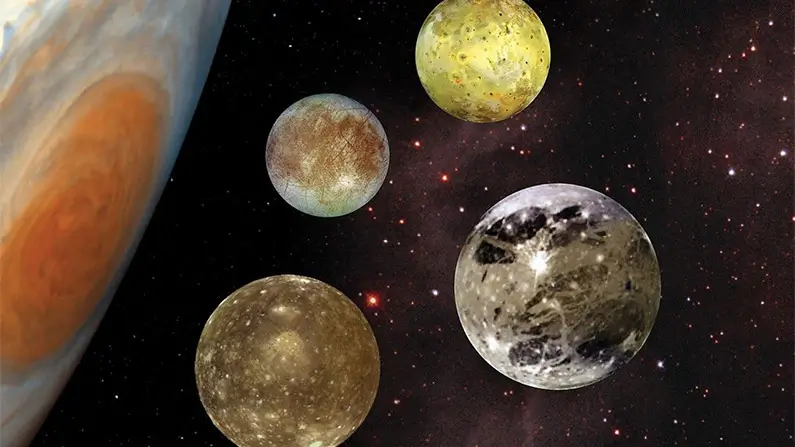
Jupiter also has four major moons, collectively known as the Galilean moons (named after their discoverer, Galileo Galilei). In order of distance from the planet, these are Io, Europa, Ganymede, and Callisto. These moons are among the largest in the solar system, with Ganymede being the largest, measuring 5,262 km in diameter. For comparison, Earth’s diameter is 12,742 km. [source]
10 Astronomers believe there may be life on Jupiter’s moons…
The Voyager and Galileo missions, which sent spacecraft to Jupiter and its moons, discovered that Europa, one of the largest moons in the solar system, has a liquid ocean beneath its icy surface. Now, researchers believe Europa may actually harbor life, as it meets three essential conditions:
- biochemically useful molecules,
- an energy source, and
- a liquid solvent (water) in which dissolved substances can undergo chemical reactions.
With future missions planned, we may finally get answers within our lifetime — even if the discovery turns out to be simple bacteria. Still, finding life beyond Earth, no matter how small, would be extraordinary. [source]

You may also like
Xtra How cold it is on Jupiter…
In the planet’s upper atmosphere, where temperature measurements are taken, it is typically around –145°C. The deeper you go into Jupiter’s atmosphere, the warmer it becomes, due to increasing pressure and the compression of growing amounts of hydrogen and helium.
At the lower boundary of the cloud layer, temperatures can rise to about 0°C, though this is still extremely cold compared to conditions on Earth. [source]
5 Common Questions About Jupiter
No. Although the planet is made mostly of hydrogen and helium, just like a star, it doesn’t have enough mass to ignite nuclear fusion. It would need to be about 70 times more massive to become a star.
Jupiter has 95 confirmed moons, but scientists believe it may have over 200 in total. The four largest — Io, Europa, Ganymede, and Callisto — are known as the Galilean moons.
The Great Red Spot is a massive storm on Jupiter, more than twice the size of Earth, that has been raging for at least 400 years. However, it has been shrinking and may disappear within the next 50–100 years.
No. the planet is a gas giant, meaning it has no solid surface like Earth. As you descend into the planet, the atmosphere becomes hotter and denser, eventually turning into liquid metallic hydrogen around the core.
While the gas giant itself is too hostile for life, some of its moons — especially Europa — may have the right conditions. Europa has a subsurface ocean beneath its icy crust, and scientists believe it could potentially harbor microbial life.