
Venus, our closest neighbor in the solar system, is a planet full of fascinating secrets and surprises. Although it’s roughly the same size as Earth and often referred to as our planet’s twin, Venus has a climate and surface that are completely different from our own. This planet, symbolized by the sign ♀ and named after the Roman goddess of love, remains a mystery to scientists and space enthusiasts around the world. Here are ten facts about our planetary neighbor that you probably didn’t know before!
1 How hot Venus can get – and why the planet has its yellowish color…
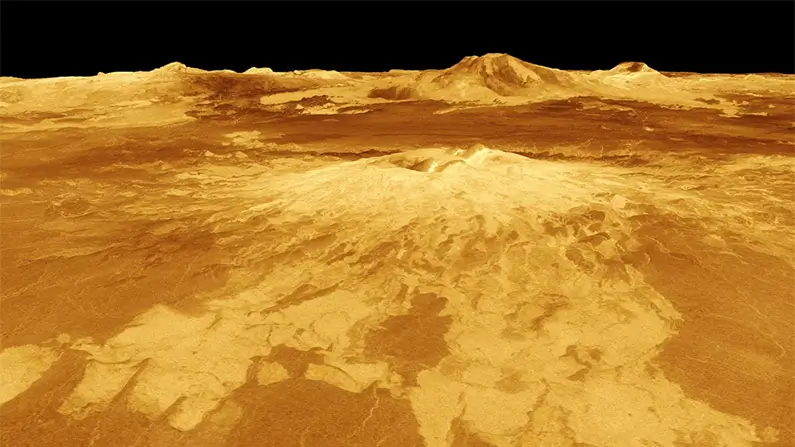
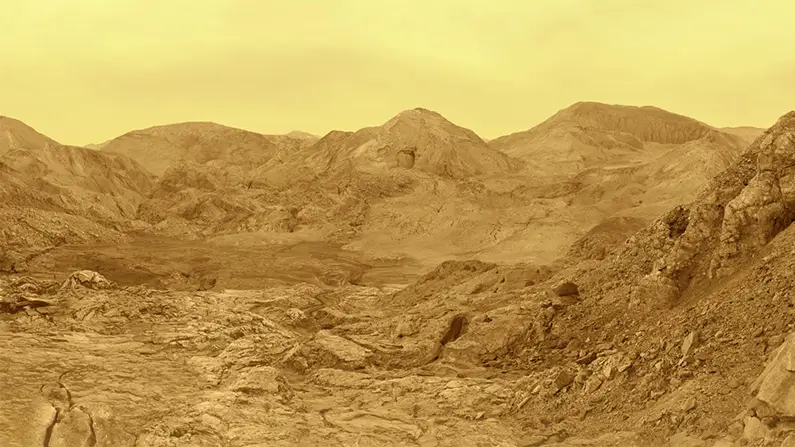
Venus is the second planet from the Sun and is known for its extreme heat and thick atmosphere. The surface temperature reaches around 465 degrees Celsius (869°F), making it the hottest planet in the solar system. Its terrain consists of vast volcanic landscapes with large lava flows and towering mountains.
The atmosphere is extremely dense and made up primarily of carbon dioxide, with thick clouds of sulfuric acid that give the planet its distinct yellowish hue. Venus also has a very slow rotation, meaning that one day on Venus is longer than one Venusian year. [source]
2 The planet Venus has no moons at all…
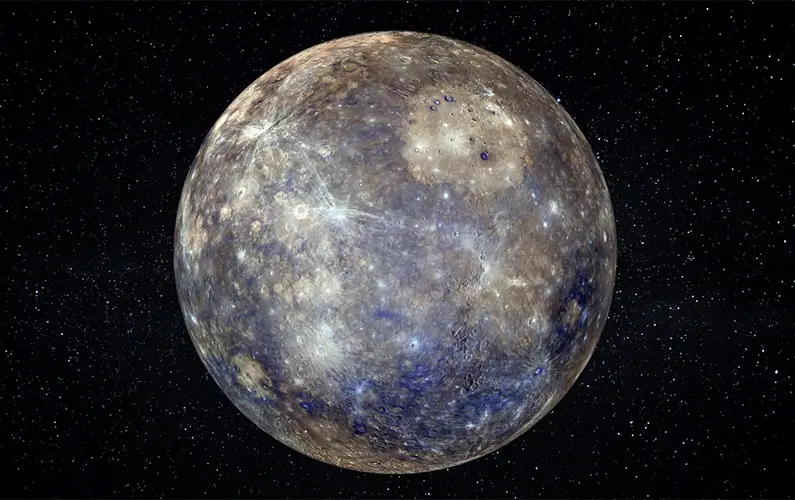
Among the planets in our solar system, only two planets lack natural moons orbiting them. All the others — including Earth — have at least one moon in orbit. These satellites vary greatly in both size and number, ranging from Earth’s single moon to the dozens orbiting Jupiter and Saturn.
That these two planets are completely moonless is an unusual characteristic that sets them apart from the rest, and it’s something scientists are still studying to understand why this occurred during the early formation of the solar system. [source]
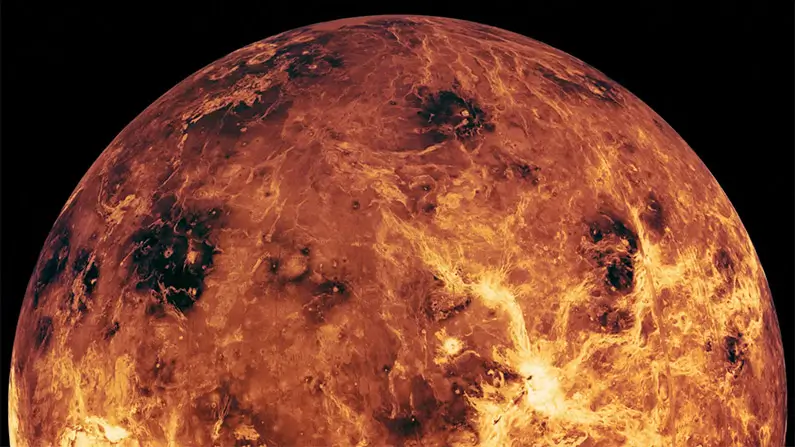
3 Venus has more volcanoes than any other planet in the solar system…
This planet has more volcanoes on its surface than any other planet in our solar system. Even though the number is immense, scientists are still uncertain about how active these volcanoes are today.
There have been signs of recent volcanic activity, but the evidence is not yet strong enough to confirm that the volcanoes are currently active. [source]
You may also like
4 It’s virtually always scorching hot on Venus…
As you’ve probably realized by now, the planet has no cool winters or rainy autumns like we do here on Earth.
In fact, the surface of Venus experiences no temperature variations at all. Everywhere on the planet, the heat is essentially hellish (in other words, it’s hot… really hot). Regardless of the time of day, the temperature is almost always between 450–470 degrees Celsius (842–878°F). [source]
5 Have you ever heard of Venus shadows…?
After the Sun and our own Moon, Venus is the brightest object in the sky as seen from Earth. The planet can be bright enough on the night sky to cast shadows! These unusual shadows are known as “Venus shadows“. [source]
6 Why Venus is called “Earth’s twin planet”…
Our neighboring planet is often referred to as Earth’s twin because of its similarities to our own world. The two planets are almost the same size, have a similar mass, and share a comparable composition of materials. They are also located relatively close to each other in the solar system.
Despite these similarities, Venus differs greatly from Earth. Its atmosphere is extremely thick and made up primarily of carbon dioxide, which creates a powerful greenhouse effect and results in surface temperatures hot enough to melt lead.
The planet also has very high surface pressure and completely lacks liquid water, making its environment extremely hostile to life as we know it. [source]
You may also like
7 Venus is the only planet named after a female deity…
The planet is named after the Roman goddess Venus, the goddess of love, beauty, and fertility. This connection to Roman mythology reflects the ancient tradition of naming planets after gods.
Because Venus is the only planet named after a female deity, it’s no surprise that its symbol is ♀, which is, of course, the same symbol used to represent women. [source]
8 The Romans also called the planet Venus “Lucifer”…
In Roman times, the planet was often referred to as “Lucifer“, a name that means “light-bringer“. Since Venus is one of the brightest objects in the night sky, it’s easy to understand where the name came from.
The name, however, never truly caught on and is no longer used today. Perhaps that was for the best, since the planet ultimately received a female name instead! [source]
You may also like
9 The atmospheric pressure on Venus is about 92 times higher than on Earth…
The atmospheric pressure on Venus is far higher than on Earth, even though the two planets are roughly the same size and have a similar mass. On Venus, the pressure is about 92 times greater than Earth’s.
This immense pressure causes small asteroids entering the atmosphere to be crushed before reaching the surface. It’s also the reason why there are no small craters on Venus, since smaller objects cannot reach the planet’s surface without being destroyed first. [source]
10 The volcano Maat Mons — almost as tall as Mount Everest on Earth…
Maat Mons, the tallest volcano on Venus, rises to over 8,000 meters when measured from the planet’s radius. For comparison, Earth’s highest mountain, Mount Everest, stands at 8,848 meters above sea level. [source]

You may also like
5 Common Questions About Venus
Venus is incredibly hot because of its runaway greenhouse effect. Its thick atmosphere is made mostly of carbon dioxide, trapping heat so efficiently that surface temperatures reach around 465°C (869°F) — making Venus the hottest planet in the solar system.
No. Venus has no moons at all, making it one of only two planets in the solar system without natural satellites (the other is Mercury).
Life as we know it cannot survive on Venus’s surface due to the extreme heat, crushing atmospheric pressure, and toxic clouds of sulfuric acid. Some scientists speculate that microbial life might be possible in the upper atmosphere, but there is no confirmed evidence.
Venus is often called Earth’s twin because the two planets have similar size, mass, and composition. Despite this, Venus is radically different in climate, with a dense CO₂ atmosphere and surface temperatures hot enough to melt lead.
Venus rotates in the opposite direction compared to most planets, a motion called retrograde rotation. The most common theory is that Venus experienced a massive collision early in its history, which flipped its rotational axis. This causes the Sun to rise in the west and set in the east on Venus.