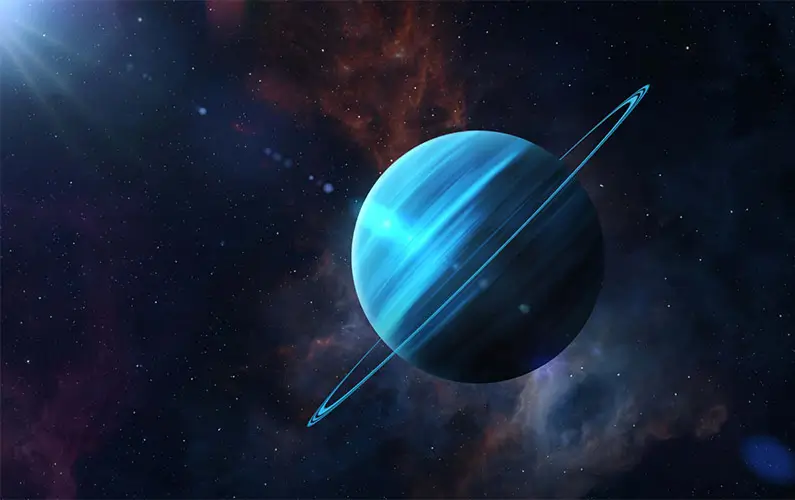
If you’d like to visit a place where summers last more than 20 years, the winds hit harder than a hurricane, and the temperature makes the Arctic feel like a sauna, then Uranus is the destination for you — at least in theory. This strange and often overlooked planet in our solar system has more extreme characteristics than you might think. From its unusual tilt to its record-low temperatures, here are 10 fascinating facts about Uranus that are guaranteed to make you raise an eyebrow — and shiver.
1 A summer on Uranus like no other…
If you feel like summers fly by too quickly where you live, you might want to look toward this distant planet in our solar system. On Uranus, summer lasts a full 21 Earth years — a season that truly takes its time. But before you start packing sunscreen, it’s worth noting that the temperatures aren’t exactly inviting. Even during summer, Uranus is bitterly cold, with temperatures far below freezing.
And it doesn’t stop there — a year on Uranus is divided into only two seasons: summer and winter. So yes, you get an extremely long summer, but also an equally long 21-year winter. This happens because Uranus is tilted so dramatically on its axis that each hemisphere receives prolonged periods of sunlight or darkness during its orbit, creating these extreme seasonal shifts.
So if you’re dreaming of a really long summer (or winter), Uranus might be the place — as long as you don’t mind the subzero temperatures. [source]
2 Winters on Uranus are unbelievably, brutally cold…
As if its distant position from the Sun weren’t enough, the winter season on Uranus is brutally cold. In fact, scientists have recorded the coldest temperature ever measured on any planet in our solar system — not in the entire Milky Way, as is sometimes mistakenly claimed. Temperatures drop to a staggering –224°C (–371°F), making it feel as though all warmth has completely vanished from the atmosphere. It’s so cold that molecular motion slows to nearly a standstill.
So if you’ve ever dreamed of traveling there — don’t forget a winter coat. Or rather, an entirely new kind of insulation we haven’t invented yet. It’s not just cold; it’s cosmically cold. [source]
3 Uranus is truly a giant…
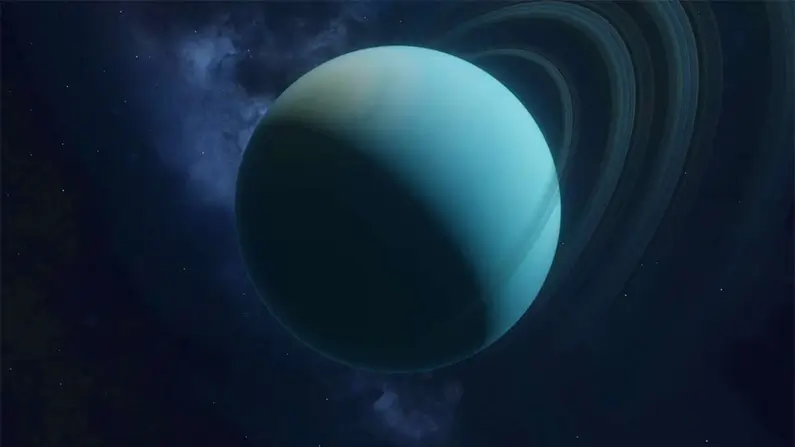
Even though Uranus isn’t the largest planet, it is still enormous in both size and mass. Its diameter is about four times larger than Earth’s, meaning that if Earth were the size of an apple, this planet would be closer to a grapefruit. But it doesn’t stop there — Uranus has a mass that is about 14.5 times greater than Earth’s, which means it weighs far more despite being made mostly of lighter materials such as gas and ice.
It’s important to understand the difference between diameter and mass. Size tells you how wide a planet is, but mass tells you how much material it contains. Because Uranus is an ice giant, it has a completely different density and composition compared to our rocky Earth. In terms of size, it is the third-largest planet in the solar system, surpassed only by the two giants Jupiter and Saturn. [source]
You may also like
4 Uranus is the only planet named after a Greek god…
There’s a fascinating detail that sets this planet apart from all the others in the solar system — it is the only one named after a Greek god instead of a Roman one. All the other planets take their names from Roman mythology, but in this case, astronomers chose to reach back into the Greek mythological tradition.
The name comes from Uranus, the god of the sky in Greek cosmology, who according to legend was both the son and the consort of Gaia, the goddess of Earth. Uranus represented the heavens and was the ancestor of many gods and Titans who later dominated mythology. The fact that the planet carries his name is therefore both unique and symbolic — it looks out toward the stars, just like its mythological namesake. [source]
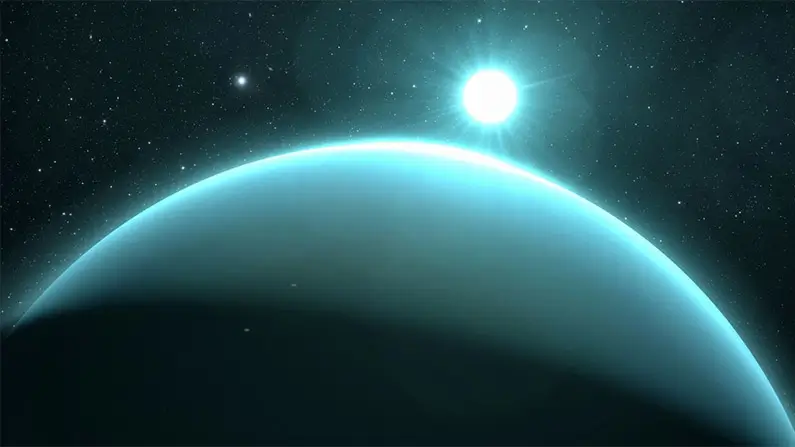
5 Uranus has a total of 28 moons…
Uranus boasts 28 known moons orbiting around it — an impressive collection compared to many other planets. What makes them especially interesting is that they are not named after classical mythology, as is usually the case, but instead after characters from the works of William Shakespeare and writings by Alexander Pope.
This gives the moons names such as Titania, Oberon, Ariel, and Umbriel, among many others. With so many companions, it’s almost like a little theatrical ensemble in orbit — and it definitely takes a good memory to keep track of them all. [source]
6 Hold on to your hat — because the winds here are intense…
The winds on this icy giant can reach speeds of up to 900 kilometers per hour (560 mph), far stronger than the most powerful hurricanes on Earth. And as if that weren’t enough, the temperatures out there are among the coldest in the entire solar system, dropping to an extreme –224°C (–371°F).
The combination of freezing temperatures and violent winds makes Uranus one of the most inhospitable environments imaginable. It would take far more than a warm fire to stay comfortable there. [source]

You may also like
7 Almost like home — the gravity on Uranus is similar to Earth’s…
The gravitational force at Uranus’s surface is actually very similar to the gravity we experience on Earth, and the same is true for Saturn, Venus, and Neptune. This means that the weight and physical sensation of gravity would feel surprisingly familiar for a human standing there.
This has led scientists and futurists to wonder whether it might one day be possible to settle on such worlds — setting aside, of course, the extremely cold temperatures that dominate the planet. Surviving there would require advanced technology and significant protection from the harsh climate, but when it comes to gravity itself, the planet offers a notable advantage for human adaptation. [source]
8 Uranus moves differently from the other planets in our solar system…
This planet behaves in a way that is very different from most others in the solar system. Instead of rotating like a typical spinning ball, Uranus is tilted almost completely on its side, causing it to “roll” around the Sun in a sideways position.
This unique axial tilt sets it apart from how other planets rotate and results in seasons and climate patterns that are completely unlike anything we experience on Earth. [source]
You may also like
9 The first close-up image of Uranus wasn’t taken until 1986…
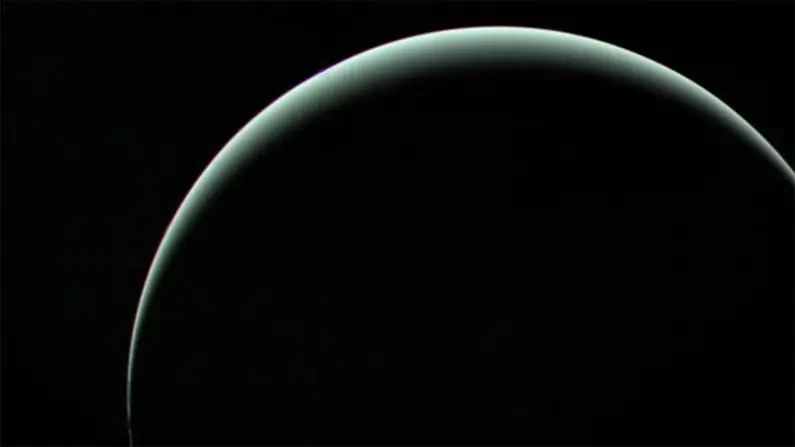
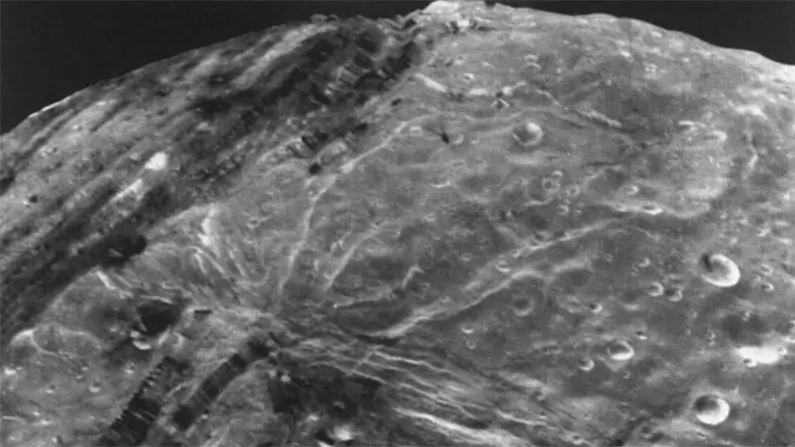
Only one space mission has ever flown past Uranus. It was the Voyager 2 spacecraft, which in 1986 passed the planet at close range and managed to capture the very first close-up image, taken from a distance of only about 81,500 kilometers (50,600 miles).
This unique image gave us an entirely new understanding of the planet’s appearance and composition, something that previously could only be studied from afar through telescopes. The photo can be seen below. [source]
10 How long it takes Uranus to complete one orbit around the Sun…
It takes a full 84 Earth years for the planet to complete a single orbit around the Sun — far longer than our own one-year cycle. For humans, that means one Uranian year equals almost an entire lifetime.
It’s fascinating to consider how slowly the planet moves along its orbit compared to Earth, causing its seasons and planetary cycles to stretch across multiple human generations. [source]
You may also like
5 Common Questions About Uranus
The planet is tilted by 98 degrees, meaning it essentially rotates on its side. Scientists believe this extreme tilt was caused by a massive collision with another large object early in the planet’s history.
Uranus is one of the coldest planets in the solar system, with temperatures dropping to –224°C (–371°F) — the coldest ever recorded on any planet.
The planet is an ice giant, composed mainly of water, ammonia, and methane ices, along with hydrogen and helium. The methane in its atmosphere gives the planet its distinct blue-green color.
Uranus has 28 known moons, many of which are named after characters from Shakespeare and Alexander Pope. The largest ones include Titania, Oberon, Umbriel, Ariel, and Miranda.
One year on Uranus — the time it takes to orbit the Sun — is 84 Earth years. This means the planet’s seasons last over 20 years each due to its long orbit and extreme axial tilt.