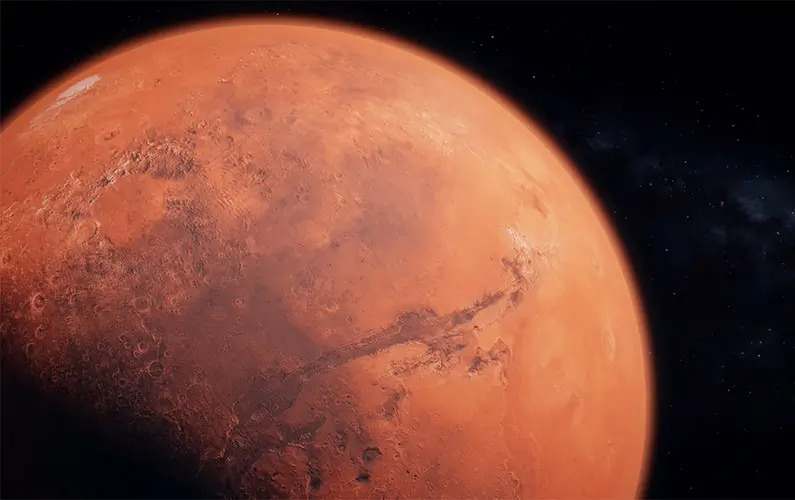
The Milky Way’s red pride — Mars. While we Earthlings have already visited the Moon, the planet Mars is next in line. Major nations around the world are preparing, and a new space race has more or less begun over who will reach it first. Will it be the Americans, the Russians, the Chinese, the Indians — or someone else entirely? Until we find out, you can at least enjoy ten fascinating facts about the planet in question!
1 Mars has had many names…
Mars has gone by many names throughout history. The Egyptians called it “Har dècher” (“The Red One”). The Babylonians named it “Nergal” (“The Star of Death”). The Greeks and Romans named the planet after their respective gods of war — Ares and Mars. The Hebrews referred to the red planet as “Ma’adim” (“The One Who Blushes”).
What they all had in common was the belief that the planet’s red color was linked to real blood. [source]
2 Mars has two moons — Phobos and Deimos…
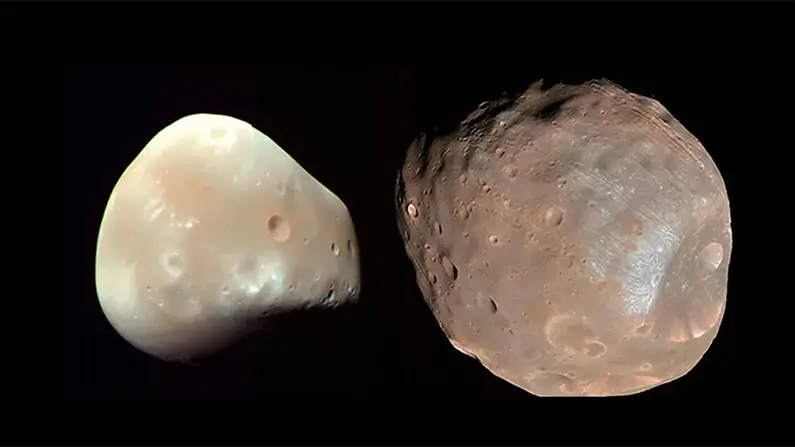
Our red-hued neighboring planet has two moons named Phobos and Deimos. These moons are small, irregularly shaped, and are most likely captured asteroids pulled in by Mars’ gravity. Phobos is the larger of the two and orbits very close to the planet, while Deimos is smaller and orbits farther away.
In the image below, you can see Phobos on the right and Deimos on the left. [source]
3 The big question: can humans live on Mars?…
Living on Mars in the future is a possibility that is being actively explored and debated within science and space research. Several major challenges must be overcome — including radiation, food production, protection from the harsh environment, and long-term isolation — before the planet could become habitable.
Many scientists and space agencies are working on developing the technologies and strategies needed to make this a reality, but there is still a long way to go before a human colony can be established on the Red Planet. [source]

You may also like
4 Why the planet Mars is red…
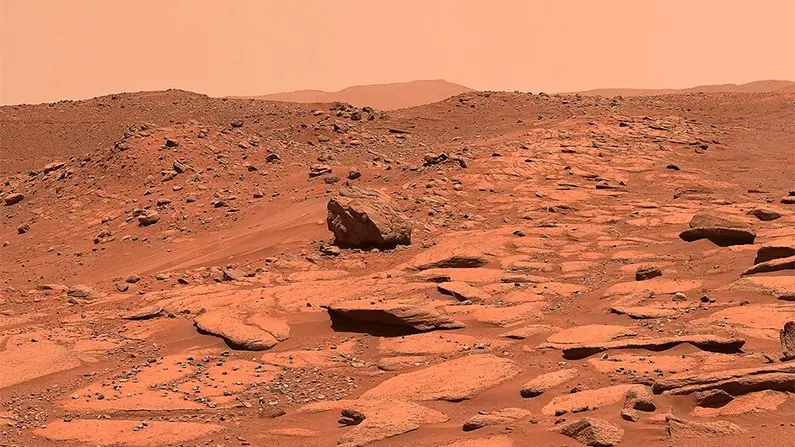
The planet’s reddish color is caused by the presence of iron oxide — or rust — on its surface. Its Earth-like terrain is covered in regolith, a mixture of rocks and minerals that contains iron oxide. When the iron in this regolith oxidizes, it takes on a reddish hue, giving the planet its distinctive red appearance as seen from Earth. [source]
5 Why humans cannot survive on Mars…
The extremely low atmospheric pressure on the planet makes it completely impossible for humans to survive without protection. If someone were to stand on Mars without a specially designed spacesuit, the oxygen in their blood would quickly begin to form bubbles — a process similar to decompression sickness — causing the body to collapse and leading to almost immediate death.
This is why advanced protective equipment is absolutely essential for even a brief stay on the Martian surface. [source]
6 How long it takes to travel to Mars…
If you were to travel from Earth to the Red Planet at 100 km/h, it would take 271 years and 221 days to get there.
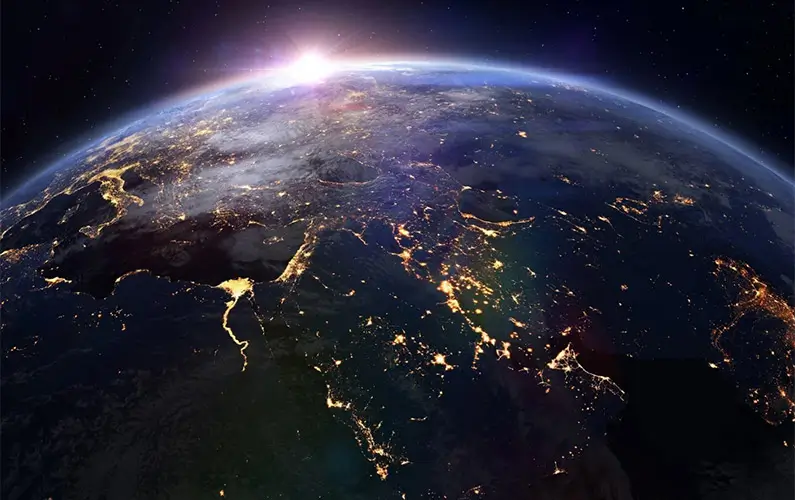
However, using a far more realistic method — a modern space rocket — a planned journey would instead take about six to nine months, depending on the circumstances and the exact conditions at launch. [source]
You may also like
7 Here you’ll also find the largest labyrinth in the solar system, called “Noctis Labyrinthus”…
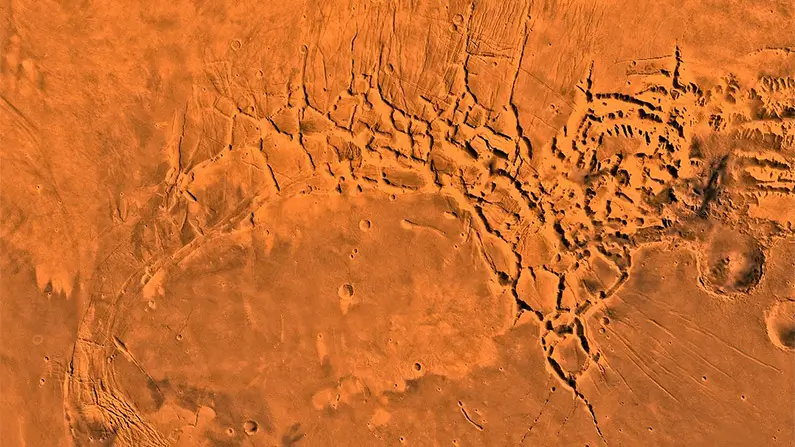
The largest maze of intersecting valleys in the entire solar system is located on the Red Planet and is known as Noctis Labyrinthus. This complex network of deep, narrow canyons stretches across a vast area, creating a truly impressive and mysterious geological formation. If you want to get a sense of its scale and complexity, take a look at the image below — it clearly shows how the valleys intersect in an intricate pattern that has fascinated scientists and space enthusiasts around the world. [source]
8 Terrifying sandstorms can occur on Mars…
The Red Planet not only has the largest labyrinth in the solar system, but also the largest and most violent sandstorms. These storms can produce winds reaching up to 200 km/h, last for weeks, and in the worst cases cover the entire planet. They most often occur when Mars is closest to the Sun. [source]
You may also like
9 What the atmosphere on Mars is like…
Mars has a much thinner atmosphere compared to Earth. It is composed primarily of carbon dioxide (about 95%), with small amounts of nitrogen, oxygen, and argon. The atmosphere is also far less dense than Earth’s, meaning the surface pressure is significantly lower.
This thin atmosphere also makes it difficult for the planet to retain heat, resulting in large temperature swings between day and night. At the equator, temperatures can reach around 20°C during summer daytime, but then drop to –73°C at night and during winter. [source]
10 When Mars will once again be closest to Earth…
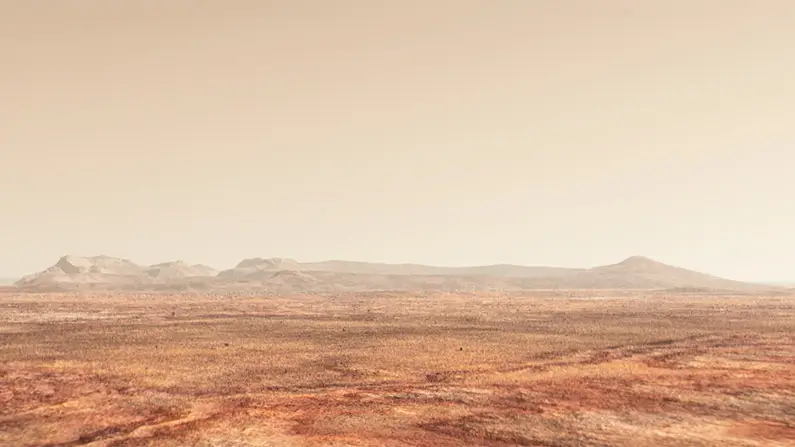
On August 27, 2003, Mars was the closest to Earth it had been in nearly 60,000 years. The next time the planet will come that close again will be around the year 2287 — at least approximately, as it ultimately depends on the future positions and orbital paths of the planets relative to one another. [source]

You may also like
5 Common Questions About Mars
Mars is known as the Red Planet because its surface is covered in iron oxide (rust), which gives the planet its distinct reddish color when viewed from Earth.
Yes — but not in liquid form on the surface. Mars contains water ice, especially at the poles and in permanently shadowed craters. Traces of water molecules have also been found in the soil.
Not yet. Mars has extremely low atmospheric pressure, harsh temperatures, and high radiation levels. Humans would need advanced habitats, protective suits, and reliable life-support systems to survive.
With current rocket technology, a trip to Mars takes about six to nine months, depending on alignment and launch conditions.
Yes. Mars has two small moons, Phobos and Deimos, which are believed to be captured asteroids. Phobos orbits very close to Mars, while Deimos orbits farther away.