

Snow is something most of us take for granted — it falls, it melts, and it turns familiar landscapes into something quiet and white. But beneath its soft surface lies a world of surprising science, strange behavior, and fascinating extremes. From how snowflakes form high in the atmosphere to the unexpected ways snow shapes ecosystems, weather patterns, and even sound, there’s far more going on than meets the eye.
In this article, we explore 10 surprising facts about snow that reveal why this frozen phenomenon is anything but ordinary.
1 To be clear: snow isn’t actually white…
Most people dream of a white Christmas — meaning a snowy one — even though the term isn’t entirely accurate. Snow itself isn’t truly white; it’s actually transparent. What makes it appear white is the way light reflects and scatters off the many sides of each snowflake, spreading the entire color spectrum in all directions.
We sincerely hope this didn’t turn your world completely upside down just now! [source]
2 Snow can also appear blue, red, and pink…
When Elvis Presley sang about having a “Blue Christmas“, he may have been more literal than we think. Snow can appear blue to the naked eye for reasons similar to why it looks white. When light penetrates deeper into snow, more red light is absorbed than blue, giving it a bluish tint.
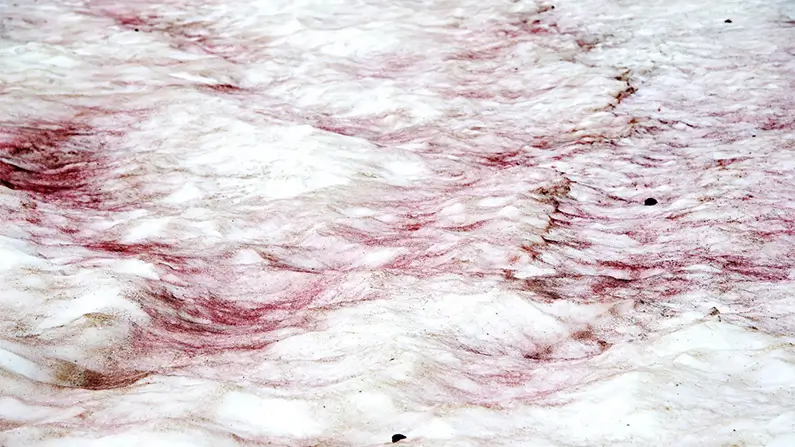
In polar and alpine regions, snow can even take on a pink or reddish color due to algae that contain red pigments. Below is an image taken in Antarctica, where the snow appears distinctly red. [source]
3 Temperature plays a major role in a snowflake’s shape and structure…
One of the key factors determining the form of individual snowflakes is the air temperature surrounding them. Studies of snow crystals have shown that long, thin, needle-like crystals tend to form at around –2 °C (28 °F), while lower temperatures of about –5 °C (23 °F) produce flat, plate-like crystals.
As a snowflake falls, additional temperature changes influence the development of its six branching arms, also known as its dendritic structure. [source]

You may also like
4 It’s a myth that snow can’t fall at above-freezing temperatures…
Snow can sometimes fall even when ground temperatures are above 0 °C (32 °F), depending largely on relative humidity. When humidity is high, precipitation usually falls as rain once temperatures rise above freezing. However, at lower humidity levels, snow can fall even when the air temperature is several degrees above zero.
In Sweden and other Nordic countries, this phenomenon is quite common — especially during the transition from winter to spring. [source]

5 The world’s largest snowflake was over 38 centimeters wide…
Although supporting evidence is limited, Guinness World Records lists the largest snowflake ever recorded as falling during a storm in January 1887 in Fort Keogh, Montana, USA. The snowflake was reportedly over 38 centimeters (15 inches) wide and about 20 centimeters (8 inches) thick, and was described by the farmer who saw it as being “larger than his milk pans.”
Talk about a cloud practically delivering a fully formed snowman straight from the sky! [source]
6 2.5 meters of snow — in just 18 hours…
The small village of Capracotta in southern Italy reported receiving around 250 centimeters (8.2 feet) of snowfall within just 18 hours on March 5, 2015. What makes this even more astonishing is that Capracotta isn’t located in the Alps — but in southern Italy.
That said, the village has long been known for receiving extreme single-day snowfalls. Despite this, Capracotta is home to only about 1,000 residents. [source]

You may also like
7 But the world record for snowfall belongs to Washington, USA…
The ski area at Mount Baker in Washington State holds the world record for seasonal snowfall, receiving an astonishing 2,895.6 centimeters (over 95 feet) of snow during the 1998–1999 winter season.
You can probably imagine just how thrilled skiers were that year! The image below shows Mount Baker during 1998. [source]

8 Snow can actually make the world quieter…
Freshly fallen snow absorbs sound waves instead of reflecting them, which is why the world often feels unusually quiet after a snowfall. Roads sound muffled, footsteps become softer, and even distant noises seem to disappear — all thanks to the tiny air pockets trapped between snowflakes that act like natural sound insulation. [source]

You may also like
9 Around 80% of the world’s freshwater is frozen as ice or snow…
Freshwater makes up only about 2.5% of all the water on Earth. Of that amount, roughly 80% is locked away as ice or snow, covering approximately 12% of the planet’s surface. [source]

10 The world’s first close-up photograph of a snowflake was taken as early as 1885…
The first person to ever photograph a snowflake was a farmer from the small town of Jericho, Vermont, USA. After years of experimenting with attaching a microscope to a bellows camera, Wilson Bentley successfully captured the first-ever photograph of a snowflake in 1885.
Over the course of his lifetime, he photographed more than 5,000 snowflakes and even published a book featuring 2,400 images of — yes — snowflakes. [source]
5 Common Questions About Snow
It forms when water vapor freezes into ice crystals inside clouds. As these crystals grow and combine, they become heavy enough to fall toward the ground.
Individual ice crystals are transparent, but their many surfaces scatter light in all directions, reflecting the entire visible spectrum and creating a white appearance.
Yes. It can occur when air temperatures higher up remain cold and humidity is low, allowing frozen precipitation to reach the ground before melting.
Blue hues occur when red light is absorbed more deeply, while pink or red tones are often caused by pigmented algae in polar or alpine environments.
Freshly fallen layers can absorb sound waves, making surroundings feel noticeably quieter by reducing echoes and background noise.