
Water (H₂O) is one of the most fundamental elements of life on Earth. Yet, despite being surrounded by it every day, there is still so much we don’t know about this fascinating substance. Water is full of surprising and downright strange facts that make it far more interesting than it may seem. From its unique properties to its vital role in our survival — here are ten things you probably didn’t know about water.
1 This is how much water exists on our planet…
There are about 1.5 billion cubic kilometers of water on Earth. This number includes all water found in oceans, lakes, rivers, glaciers, and underground sources. However, the vast majority of it is saltwater — only around 2.5% is freshwater. And even then, most of that freshwater is locked away in glaciers and ice caps, making only a tiny fraction easily accessible for life. [source]
2 How deep would it be if all Earth’s water were spread evenly…?
If all the water on Earth were distributed evenly across the planet’s surface, it would form a global ocean about 2,733 meters (≈ 8,967 feet) deep. This is based on the fact that Earth has a surface area of roughly 510 million square kilometers (≈ 197 million square miles) and holds around 1.5 billion cubic kilometers of water (≈ 360 million cubic miles). Additionally, about 71–75% of Earth’s surface is already covered by water, which explains why oceans dominate our planet. [source]
3 How little of Earth’s water is actually drinkable…
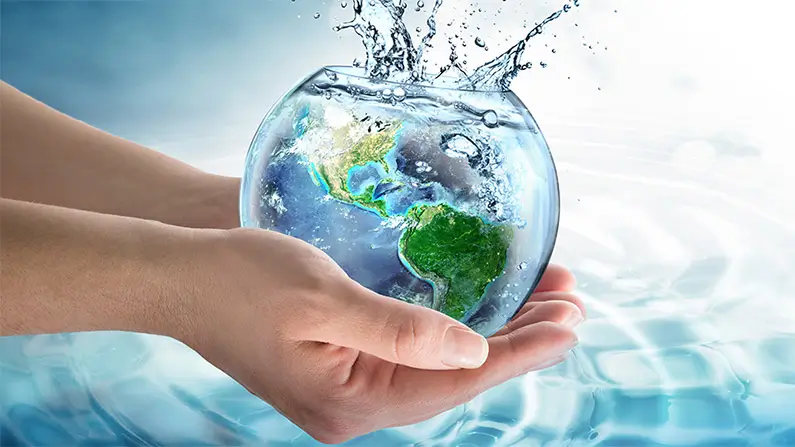
It’s easy to assume that access to water is guaranteed, but clean, drinkable water is scarce in many parts of the world, especially in developing countries. In fact, about 97% of all water on Earth is saltwater, making it unusable for direct human consumption. Roughly 2% is locked away in glaciers and polar ice, leaving only around 1% as freshwater. Even then, not all of that freshwater is easily accessible — just about 0.3% is available for human use. This highlights how incredibly valuable clean water truly is and why protecting this resource is so important. Even though countries like Sweden enjoy abundant water supplies, large parts of the world face serious shortages. [source]
You may also like
4 NASA discovered the largest known cloud of water vapor in the universe…
In 2011, scientists discovered an enormous cloud of water vapor near a distant quasar located about 12 billion light-years away. The quasar, known as APM 08279+5255, is surrounded by a massive reservoir of water vapor containing more than 140 trillion times as much water as all of Earth’s oceans combined. This makes it the largest known water supply ever discovered in the universe. Unfortunately, if Earth ever runs out of water, this cosmic backup won’t be much help — it’s sitting 12 billion light-years away, far beyond our reach. [source]

5 How much freshwater is locked away in Antarctic ice…
Antarctica has been covered in ice and snow for over 30 million years, dating back to when the continent separated from other landmasses and began to freeze due to changes in climate and ocean currents.
Scientists estimate that Antarctica contains around 26.5 million cubic kilometers of ice, representing roughly 24–30 billion trillion tons of ice. This vast ice sheet holds about 60–70% of all the freshwater on Earth — freshwater that is, for now, completely inaccessible. [source]
6 There are as many as 20 different phases of ice…
Ice isn’t just ice. In fact, scientists have identified around 20 different ice phases (known as Ice I through Ice XX), each representing a unique crystal structure that forms under specific temperatures and pressure conditions.
Ice I is the most familiar form — the kind we see in freezers and lakes at 0°C (32°F) and normal atmospheric pressure. The remaining phases, Ice II–XX, only appear under extreme conditions, such as very high pressure or extremely low temperatures, and each has its own distinct physical properties.
These different ice phases are more than just scientific curiosities. Studying them is crucial for research in material science, planetary science, and climate studies, helping scientists better understand everything from icy moons to Earth’s own climate system. [source]
You may also like
7 How much water humans drink on average…
On average, a person drinks around 1,000 liters of water per year, which equals roughly 2.7 liters per day (about 91 fluid ounces). This falls well within the recommended daily fluid intake for adults, which typically ranges between 2–3 liters per day (67–101 fluid ounces).
It’s important to note that individual water needs vary depending on factors such as age, sex, activity level, and climate. Because of this, the best advice is often the simplest: listen to your body and drink when you’re thirsty. Staying hydrated is less about exact numbers — and more about paying attention to your body’s signals. [source]
8 Hot water can freeze faster than cold water…
Under certain conditions, hot water can freeze faster than cold water, a phenomenon known as the Mpemba effect. The effect is named after Erasto Mpemba, a Tanzanian student who first observed it in the 1960s. Despite numerous experiments, the exact cause is still not fully understood, and there are hundreds of theories attempting to explain why it happens.
One leading explanation involves evaporation — hot water evaporates more quickly, reducing the amount of water that actually needs to freeze. Another theory focuses on convection, where warmer water creates more efficient internal circulation, allowing it to cool faster overall. In addition, cold water can sometimes remain liquid below its freezing point, a process called supercooling, which may delay freezing compared to hot water once freezing begins.
Even today, the Mpemba effect remains an active area of scientific research, with scientists continuing to investigate the precise mechanisms behind this counterintuitive phenomenon. [source]

You may also like
9 How much water a single shower actually uses…
Do you shower often? Then this might be worth thinking about. On average, a 10-minute shower uses around 200 liters of water (about 53 gallons). In comparison, flushing a toilet uses roughly 8 liters (about 2 gallons) each time — and leaving the tap running while brushing your teeth can waste a similar amount.
In other words, small everyday habits can add up to a lot of water. Being mindful of how we use one of our most valuable resources can make a real difference. [source]

10 How many people die each year from water-related causes…
An estimated 3.5 million people die every year from water-related causes, according to the World Health Organization (WHO) and the United Nations (UN). The most common causes are diseases linked to contaminated water, including cholera, dysentery, and typhoid fever.
It’s also important to note that the real number may be even higher, as many deaths in developing countries are never formally recorded or reported. Limited access to clean drinking water and proper sanitation remains a major global challenge and contributes to a significant burden of disease and mortality in many parts of the world. [source]
You may also like
5 Frequently Asked Questions About Water
There is no single rule for everyone, but most adults need around 2–3 liters of fluids daily. Needs vary based on activity level, climate, age, and overall health.
It is vital because every cell depends on it to function properly. It supports nutrient transport, temperature regulation, and waste removal, making survival impossible without it.
Pure liquid itself does not spoil, but contamination from containers, bacteria, or exposure can make it unsafe. Proper storage is key to maintaining safety.
Taste differences come from minerals, treatment methods, and local infrastructure. Elements like calcium, magnesium, and chlorine strongly affect flavor.
Not always. In many countries, tap supplies are just as safe or even more strictly regulated. Safety depends on local standards and testing, not packaging.