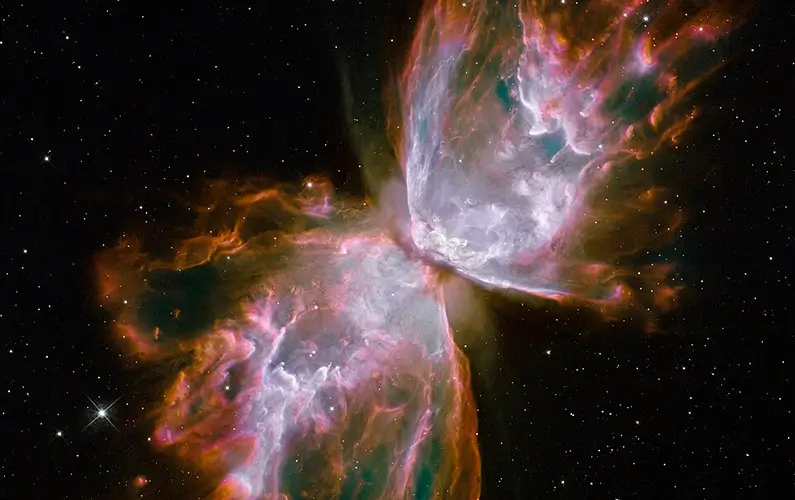
The Boomerang Nebula is a fascinating protoplanetary nebula located about 5,000 light-years from Earth, in the constellation Centaurus. It captured global attention when it was photographed by the Hubble Space Telescope in 1998, but as early as 1995, researchers at the La Silla Observatory in Chile made a groundbreaking discovery using the Swedish-ESO Submillimetre Telescope. They measured the nebula’s temperature at just 1 kelvin (−272.15°C), making it the coldest natural place in the universe known to humankind.
Below, you’ll find ten fascinating facts about the Boomerang Nebula—and chances are you haven’t heard them before!
1 The Boomerang Nebula is the coldest place in the universe — naturally speaking…
As mentioned in the introduction, the Boomerang Nebula is the coldest known place in the entire observable universe, at least when it comes to natural phenomena. Its temperature has been measured at an astonishing −272.15°C, which equals 1 kelvin—just one degree above absolute zero.
This extreme cold is caused by gas streaming out of the nebula at incredibly high speeds, creating a kind of natural “cooling system” through rapid expansion. It’s this very process that allows the temperature to drop to levels otherwise reached only in advanced laboratories on Earth. In other words, the Boomerang Nebula quite literally outfreezes the rest of the universe—without any human involvement at all (for once). [source]
2 Even colder than the remnants of the Big Bang…
We return once again to the theme of cold—because it’s simply too fascinating to ignore. Did you know that the Boomerang Nebula is actually colder than the universe’s ancient background radiation itself? The cosmic microwave background, which consists of the faint, cooling remnants of the Big Bang, permeates the entire universe and has a temperature of about −270°C, or more precisely 2.7 kelvin.
This means that the Boomerang Nebula is colder than what is essentially the universe’s default temperature, the baseline that nearly all objects and regions in space are measured against. That a single natural phenomenon can be colder than the lingering heat left over from the birth of the universe is, quite frankly, almost unimaginable. [source]
3 The Boomerang Nebula gets its color from the light of a dwarf star…
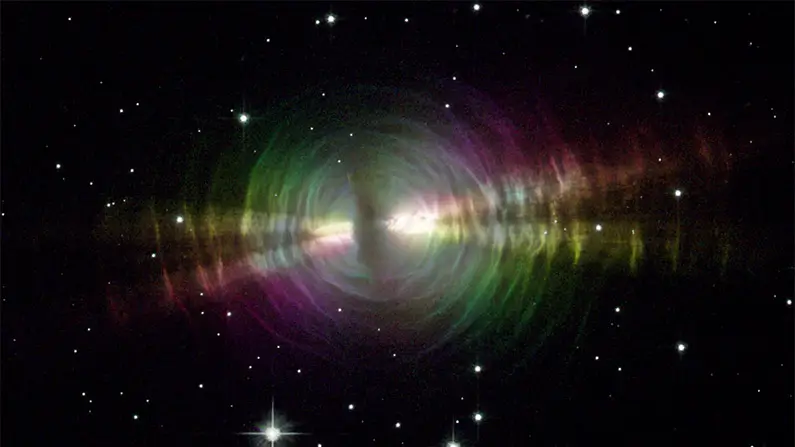
Despite lying thousands of light-years away, the Boomerang Nebula glows with an almost otherworldly light. Yet this light is not produced by the nebula itself—it is reflected. At the heart of the nebula lies a dying star in the process of becoming a white dwarf, and it is this stellar light that causes the surrounding cloud to shimmer.
The star’s light is scattered and reflected by tiny dust particles suspended in the nebula’s frigid gas clouds. This interaction is what creates the beautiful color variations seen in images, often appearing in shades of blue and white. The effect can be compared to how sunlight makes a snow-covered winter landscape sparkle—only on a vastly larger and far colder cosmic scale.
This phenomenon not only makes the Boomerang Nebula visually striking, but also provides scientists with valuable insights into particle composition, size, and the way light travels through space. [source]
You may also like
4 The Boomerang Nebula is still very young…
This simply means that the Boomerang Nebula is extremely young. In older planetary nebulae, ultraviolet radiation emitted by the central white dwarf causes the surrounding gases to glow brightly. In the case of the Boomerang Nebula, the central star has not yet reached that stage of its evolution.
The white dwarf at the nebula’s core does not yet emit strong ultraviolet radiation, which explains why the gas has not begun to shine in the way seen in more mature nebulae. This youthful phase offers astronomers a rare glimpse into an early stage of nebular development, before ultraviolet radiation reshapes and illuminates the surrounding material. [source]
5 The Boomerang Nebula got its name from how it appears from Earth…
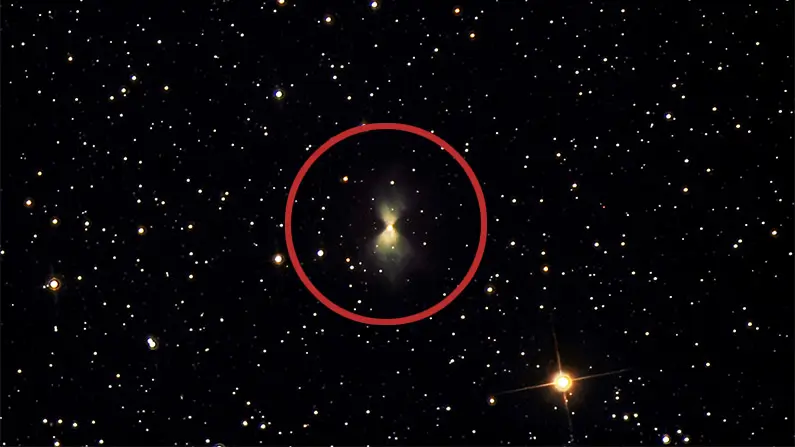
The name Boomerang Nebula was not chosen at random—it is based on how the nebula appeared in the earliest observations from Earth. When astronomers Keith Taylor and Mike Scarrott studied the object using ground-based optical telescopes in the 1980s, they observed a distinctly asymmetrical shape that resembled a boomerang, giving rise to its unusual name.
It later became clear, however, that this characteristic shape was partly an optical illusion, caused by the limitations of telescope technology at the time. When the Hubble Space Telescope was pointed at the object in 1998, it revealed a far more symmetrical, hourglass-like structure, with gas clearly streaming away from the central star in two opposite directions. [source]
6 The Boomerang Nebula moves faster than a rocket…
The gas clouds within the Boomerang Nebula are being hurled into space at an astonishing speed—around 500,000 kilometers per hour. That’s nearly 150 times faster than a typical rocket launched from Earth. This rapid outflow is one of the key reasons behind the nebula’s extreme cold, as the gas expands so quickly that it cools to temperatures close to absolute zero. [source]

You may also like
7 The Boomerang Nebula may help us understand the future of the universe…
Although the Boomerang Nebula lies far from Earth, it holds great significance for scientists because it offers a glimpse of what could happen to our own Sun billions of years from now. As the Sun approaches the end of its life, it too will shed its outer layers, forming a similar type of nebula.
By studying the Boomerang Nebula, astronomers gain valuable insight into these dramatic late-stage stellar transformations. In doing so, it provides a rare preview of the future of our solar system—a distant, cold yet colorful epilogue in the vast story of the stars. [source]
8 The Boomerang Nebula has been a debated name…
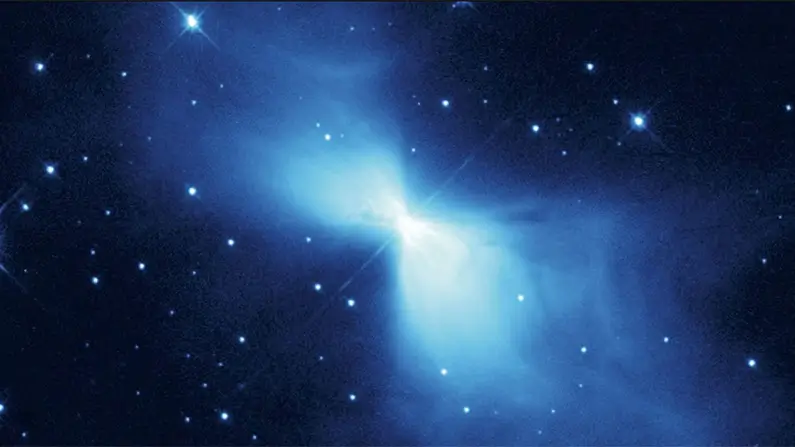
The name Boomerang Nebula has sparked some discussion within astronomical circles—not least because it is somewhat misleading. When the nebula was first observed using a ground-based telescope in Australia, its discoverers, Mike Scarrott and Keith Taylor, felt its shape resembled a boomerang, which is how it earned its name (as mentioned earlier in point 5). In an Australian context, the association was natural, given that the boomerang is a well-known cultural symbol.
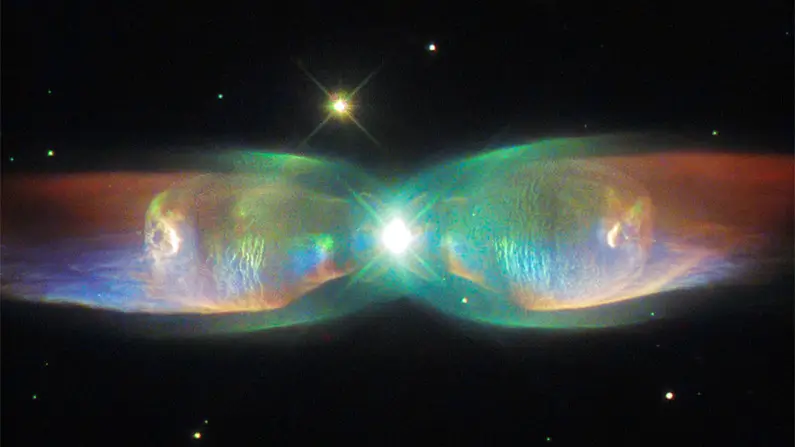
Later on, however, when high-resolution images from instruments such as the Hubble Space Telescope became available, scientists realized that the nebula actually has a far more symmetrical and complex structure. Rather than resembling a boomerang, it appears closer to an hourglass shape, or perhaps even a flying insect, with material being expelled in two opposite directions from its center.
Despite this, the name has endured—partly because it is well established, but also because it highlights how much our understanding of the universe can change with technological progress. What we see often depends more on our tools than on reality itself. [source]

You may also like
9 The Boomerang Nebula has lost an enormous amount of solar mass…
One of the most fascinating aspects of the Boomerang Nebula is how rapidly and violently its central star is changing. According to researchers at NASA, this dying star—on its way to becoming a white dwarf—has lost nearly 1.5 times the mass of our Sun over the past 1,500 years. Astronomically speaking, that is a staggering amount of material to be expelled in such a short time.
This intense mass loss is also the reason the nebula looks the way it does today. As the star sheds its outer layers in the form of gas and dust, it creates the distinctive hourglass-shaped shell we observe. The expelled material streams outward at extreme speeds—up to 500,000 kilometers per hour—dramatically cooling the surrounding region while shaping the nebula’s striking and unusual structure. [source]
10 There is actually a logical explanation for the Boomerang Nebula’s extreme cold…
The reason the Boomerang Nebula is so extraordinarily cold lies in the way gas is expelled from its central white dwarf. The gas streams outward at an incredible speed of 164 kilometers per second, allowing it to lose heat extremely efficiently as it expands.
This process works in much the same way as a refrigerator: when gas expands rapidly, it cools. In the case of the Boomerang Nebula, this natural cooling mechanism operates on a cosmic scale, driving temperatures down to levels found nowhere else in the natural universe. [source]

You may also like
5 Frequently Asked Questions About the Boomerang Nebula
It is a rare type of protoplanetary nebula, formed when a dying star rapidly ejects its outer layers. This short-lived phase occurs just before the star becomes a white dwarf.
Its extreme cold is caused by gas expanding outward at very high speeds. As the gas rapidly expands, it cools efficiently—much like gas inside a refrigerator—reaching temperatures close to absolute zero.
It lies roughly 5,000 light-years from Earth in the constellation Centaurus, in the southern sky, making it best observed from the Southern Hemisphere.
Measurements show temperatures as low as 1 kelvin (−272.15°C), which is colder than the cosmic microwave background radiation that fills the universe.
It offers a unique opportunity to study extreme cooling, stellar mass loss, and late-stage stellar evolution, helping astronomers better understand how stars like our Sun may evolve in the distant future.