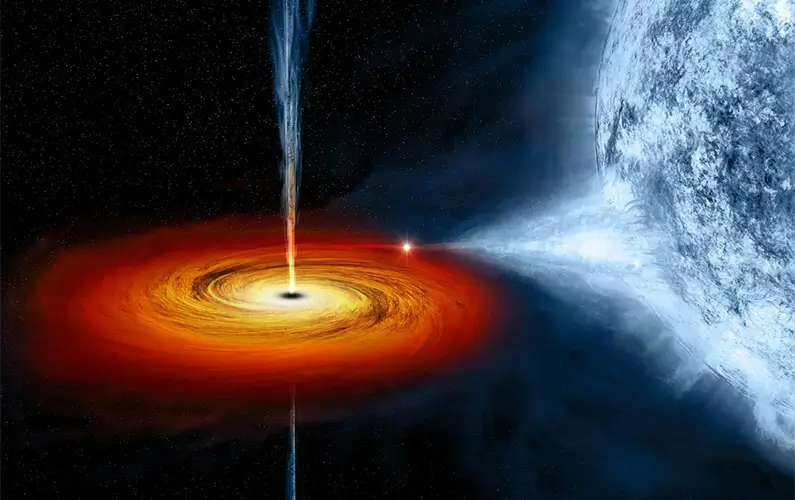
According to general relativity, black holes are regions of space where mass is concentrated so intensely that gravity becomes so strong that nothing — not even light — can escape. Any matter or light that crosses a black hole’s event horizon remains trapped and can never return, except possibly extremely slowly in the form of Hawking radiation.
It is also impossible to obtain a reflection or mirror image by shining light at a black hole, as no information can be retrieved about the matter that has fallen in. Despite knowing that black holes exist, our understanding of them remains very limited.
Below, however, are ten facts and curiosities about black holes that we actually do know.
1 The theory that every black hole contains at least one universe…
If life were a run through Wonderland, the rabbit hole might be a black hole — and this is just how deep it goes. Quantum gravity theories suggest that every black hole may contain a new universe, extending beyond our own.
This could mean that entering a black hole is like opening a door and stepping into an alternate reality. Confusing? Absolutely. [source]
2 Our universe may exist inside a black hole, according to one theory…
Scientists have long toyed with the idea that our universe contains millions of black holes — invisible cosmic traps drifting through space. But in more recent times, an even more mind-blowing possibility has emerged: that our entire universe exists inside a black hole.
This popular theory opens the door to concepts once thought purely fictional, such as time travel and parallel worlds. If a black hole is a gateway rather than a death trap, we may be standing on the threshold of a realm where the laws of physics no longer behave in the same way.
That said, it’s important to remember that this is just one of several competing theories. [source]
3 Black holes can slow down time, potentially making time travel possible…
Because black holes are masters of distortion, they do not follow the normal rules of time that govern the universe at large. They are surrounded by millions of kilometers of darkness, and their immense mass slows down time through a process known as time dilation.
This phenomenon also supports the idea that the faster you travel, the slower time passes. Could this be the key to time travel — not through a machine or spacecraft, but through a black hole itself? Stephen Hawking and several other great minds have at least explored this idea as part of their theoretical work. [source]

You may also like
4 They are considered the single deadliest force in the entire universe…
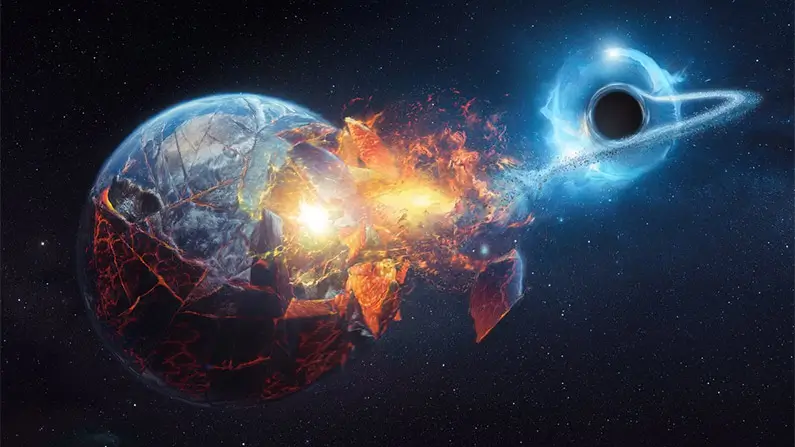
Black holes don’t just give birth to universes — they can swallow them whole as well. If a black hole were to come into contact with our planet, all the weapons of mass destruction on Earth combined would be insignificant compared to the catastrophic forces that would follow.
In fact, nothing we have ever observed compares to the destructive power of a black hole. At close range — defined here as coming within roughly 1.6 billion kilometers — our solar system would begin to spin out of control, and everything would be torn apart.
Scientists refer to this horrifying process as spaghettification. [source]
5 This is a more precise explanation of what “spaghettification” actually is…
Spaghettification is a coined term used to describe what black holes do to anything within a radius of roughly 1.6 billion kilometers. When a black hole spaghettifies something (or someone), it stretches the object to destruction through horizontal compression and extreme tidal forces.
This agonizing process can last for a very long time, depending largely on the size of the black hole. But why “spaghetti”? Because when matter approaches a black hole, it is compressed and elongated into noodle-like shapes. This phenomenon is sometimes also referred to as the noodle effect. [source]
6 The largest black hole ever discovered is 12 billion times bigger than our Sun…
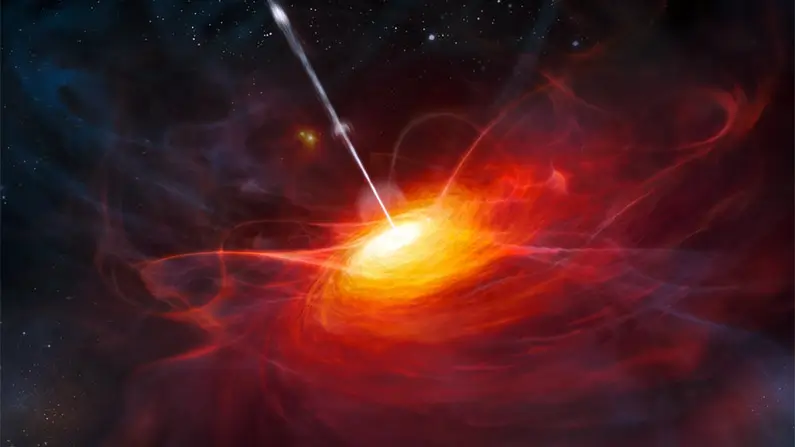
The 2015 discovery of SDSS J010013.02+280225.8 turned parts of astrophysics upside down. This cosmic mystery is so enormous that even the most advanced models struggle to explain its size relative to its age.
To put things into perspective, the black hole is believed to be “only” about 13 billion years old, yet it has a mass roughly 12 billion times that of the Sun — a scale that continues to baffle scientists. [source]

You may also like
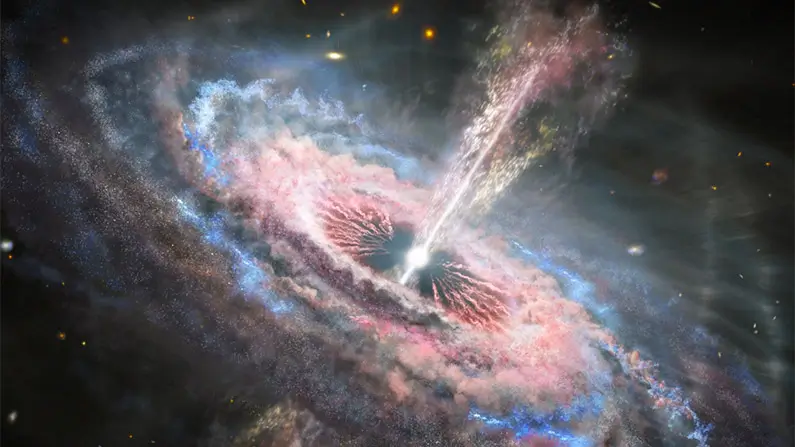
7 And it shines 429 trillion times brighter than the Sun…
This discovery is both unique and fascinating, as black holes are often associated with darkness, when in reality some of them are incredibly luminous.
This newly discovered black hole is the brightest massive quasar ever observed, radiating an almost unimaginable amount of energy into the universe. [source]
8 A black hole could fry Earth at the speed of light…
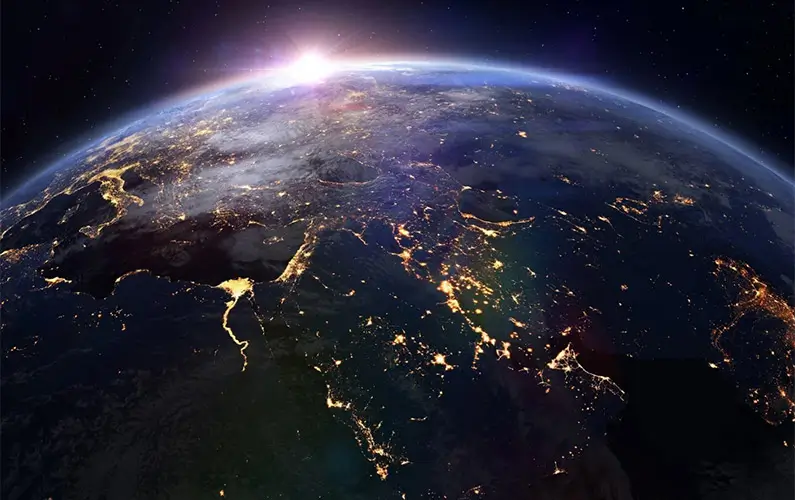
If we — meaning everyone on Earth — were accidentally pulled into a black hole, we might not even notice it at first. We would likely be instantly destroyed by intense radiation, at a rate that exceeds the speed of light. [source]
You may also like
9 The way black holes are formed is completely mind-blowing…
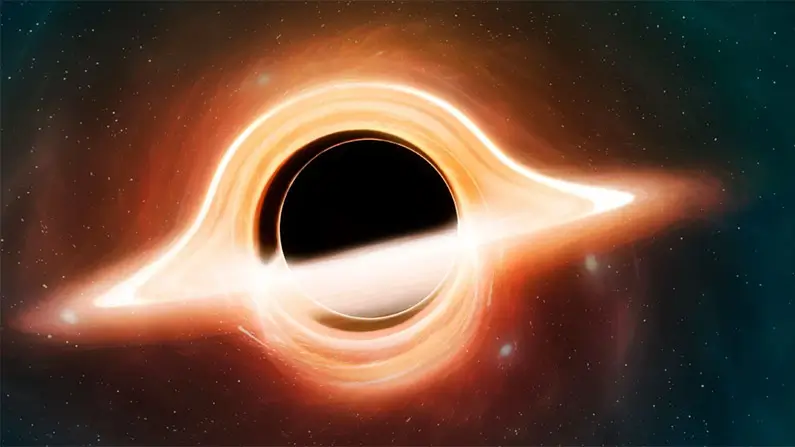
Supermassive black holes are believed to have formed during the earliest stages of the universe, with some likely being billions of years old. Younger black holes, on the other hand, are born when stars die. In fact, they are created from the remnants of stars while they are still in the process of collapsing.
Black holes live and die, much like humans, animals, and plants — but the legacy they leave behind is unmatched. They create and destroy, yet they themselves are also created and eventually destroyed.
In simple terms, when a star’s core collapses, it triggers a supernova — a massive explosion that blasts material into space while leaving behind an extreme gravitational pull so powerful that not even light can escape. Because these objects are so immense, they essentially pull everything inward and compress it intensely — and that’s where a black hole is born. [source]
10 Black holes consume everything — including each other…
Somewhere among drifting stars and shifting particles in space, a massive black hole is devouring another. This phenomenon is linked to galaxy mergers and represents a relatively recent revelation for astrophysicists and the scientific community as a whole.
It is worth noting that the black hole being consumed was the largest in the spiral galaxy observed, known as NGC 3393. [source]
You may also like
5 Common Questions About Black Holes
It is a region of space where gravity is so extreme that nothing can escape, not even light. This occurs when an enormous amount of matter is compressed into a very small area.
Most form when massive stars collapse and explode as supernovae. Some, however, are thought to have emerged during the earliest stages of the universe.
There is no known object close enough to pose a threat. To cause serious damage, it would need to be extremely close to our solar system.
No — they do not behave like cosmic vacuum cleaners. Objects must come very close to the event horizon to be affected in a dramatic way.
Current theory suggests you would experience extreme tidal forces that stretch and tear matter apart, a process known as spaghettification. What happens beyond that point remains unknown.