
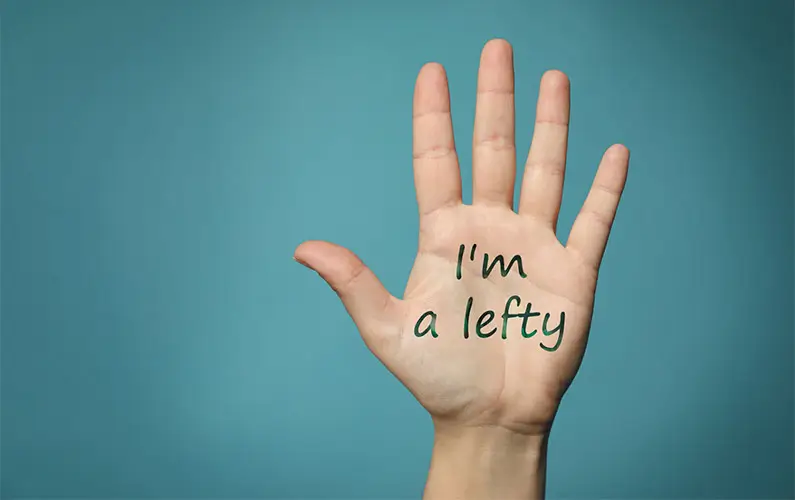
Being left-handed is something shared by only about 10–12% of the world’s population — and there are many fascinating and unexpected things that come with having a dominant left hand. In this article, we present ten interesting facts you probably didn’t know before. Some of them may surprise you, while others simply confirm why being left-handed is such a unique trait.
1 Around 10–12% of all people are left-handed…
It’s estimated that about one billion people are left-handed, which corresponds to roughly 10–12% of the world’s population. There are no exact numbers on how many people use their left hand as the dominant one — it’s simply a general estimate based on statistics and data from various countries. [source]
2 Many people with schizophrenia are left-handed…
According to studies, as many as 40% of all people diagnosed with schizophrenia are left-handed, which is a significantly higher proportion than in the general population. This has puzzled researchers for a long time, and although the connection is clear, the exact reason why left-handedness is so common among people with schizophrenia is still unknown.
Some theories suggest a link to brain asymmetry or early developmental factors during fetal growth. Others propose that differences in brain structure and function among left-handed individuals may influence how certain psychiatric conditions manifest. Research is still ongoing to better understand this complex relationship. [source]

3 Of course, left-handed people even have their own day…
What would being left-handed be without having your own day? Left-Handers Day is celebrated worldwide on August 13 every year, and has been since 1992, when it was established by the British organization Left-Handers Club.
The purpose of the day is to highlight the challenges left-handed people face in a right-handed world, but also to celebrate their unique perspectives and abilities. Events, campaigns, and activities are sometimes organized to raise awareness about the needs of left-handers — from ergonomic tools to education and workplace design. In other words, it’s a day for both pride and a reminder of inclusion. [source]

You may also like
4 Left-handed people can have certain advantages in the world of sports…
In many sports — such as tennis, boxing, and baseball — using the left hand as the dominant one can be a major advantage. Since the majority of players are right-handed, opponents are often unaccustomed to facing someone who plays from the opposite side. This makes it harder for them to predict movements and strategies, giving the left-handed player an unexpected edge and better opportunities to surprise their opponent in crucial moments. [source]

5 A myth that left-handed people live shorter lives…
There is no scientific rule suggesting that left-handed people die earlier than right-handed individuals. Research has not consistently shown any significant difference in lifespan based on hand preference. Many factors — including genetics, health behaviors, and environment — influence longevity.
Any claims that left-handed people have a shorter lifespan are usually misconceptions or based on limited or unreliable scientific evidence. [source]
6 The reason for this is unclear…
Among people with an IQ higher than 140, the majority are left-handed. Why this is the case is still a mystery, even though researchers have proposed many theories over the years. Some suggest it has to do with how the brain’s hemispheres cooperate — that individuals who use the less dominant hand in daily life may also have a more flexible brain structure, which can support creative and logical thinking. Others point to genetic factors or early environmental influences during fetal development.
Although the connection is not fully understood, there seems to be something unique about this pattern, which continues to fascinate both researchers and the public. [source]

You may also like
7 Many successful people are left-handed…
Some well-known examples of successful individuals who prefer using their left hand instead of their right include Barack Obama, Bill Gates, Jimi Hendrix, Angelina Jolie, David Cameron, and Oprah Winfrey, to name just a few. These individuals have reached prominent positions in politics, technology, music, and media, and their left-handedness is sometimes seen as part of their unique personality and creative ability.
There are theories linking left-handedness to increased creativity and alternative thinking styles, which may have contributed to their success. Even though left-handers make up only a small minority of the population, these examples show that there can be strength and innovation in going your own way — quite literally with your left hand. [source]

8 PTSD symptoms and hand preference: a puzzle researchers are trying to solve…
Studies show that if you suffer from post-traumatic stress disorder (PTSD), there is a greater risk that the symptoms will affect you more intensely if you prefer using your left hand compared to your right.
Why this connection exists is not yet fully understood, but some researchers believe it may be related to how the two hemispheres of the brain process emotions and stress. It’s an area that requires more scientific investigation to better understand how brain structure and hand dominance may influence mental health. [source]
You may also like
9 The wage gap between left- and right-handed people — an unexpected fact…
On average, left-handed individuals earn up to 12% less than their right-handed counterparts. The reasons for this wage gap are still being researched, but it is speculated that factors such as workplace adaptation, bias, and practical challenges may play a role. Despite having equal competence and education, the statistics show a clear difference in earnings, making this an important issue for both employers and society to recognize. [source]

Are you a lefty? Then there is roughly a 25% chance that your children will be left-handed as well, thanks to genetic factors. This means that while left-handedness is partially hereditary, genes don’t control everything — environment and other influences also play a role. Still, it’s evident that some level of genetic transmission occurs, making left-handedness something that can indeed run in families. [source]

You may also like
5 Common Questions About Left-Handedness
Left-handedness is believed to be caused by a mix of genetics, brain development, and environmental factors. While it runs in families, genetics only partially explains it — meaning there’s no single “left-handed gene”.
Some studies suggest that left-handers may have more cross-communication between brain hemispheres, which could contribute to creative thinking, problem-solving, and visual-spatial skills. However, this varies widely from person to person.
No. This is a myth. Modern research shows no significant difference in lifespan between left- and right-handed individuals. Earlier claims were based on flawed data.
Sometimes. Many tools and everyday objects — such as scissors, desks, spiral notebooks, and kitchen utensils — are designed for right-handed use. This can create practical challenges, though awareness and accessibility are steadily improving.
Yes, in some cases. In sports like tennis, boxing, fencing, and baseball, left-handers can have an advantage because opponents are less accustomed to facing left-dominant players, giving them a strategic edge.