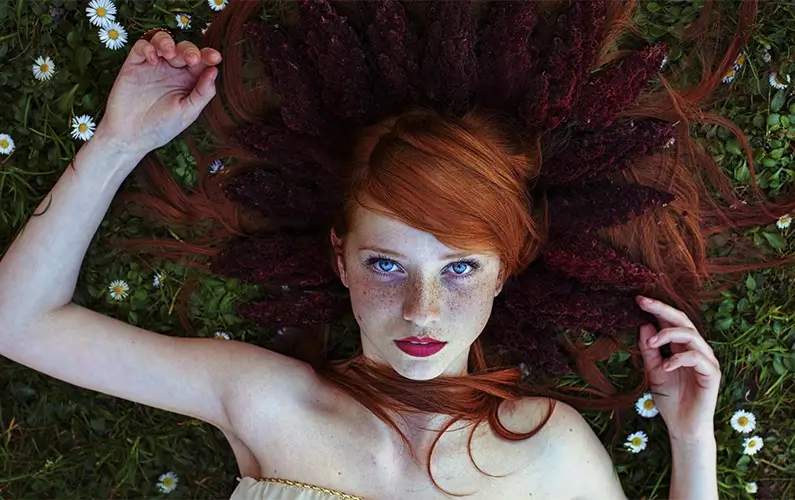
Redheads have long been surrounded by myths, fascination, and plenty of misunderstandings. Behind their uncommon hair color lies a range of scientific quirks, unexpected advantages, and surprising curiosities that most people have never even heard of.
In this article, we dive into ten facts that make redheads even more intriguing — and maybe a bit more fiery — than you ever imagined.
1 Red hair is the rarest hair color…
Red hair is one of the rarest hair colors in the world — only about 1–2% of the population are natural redheads. Scotland is often highlighted as the region with the highest concentration, with some estimates suggesting up to 13%, although research varies a bit. Even so, the country remains one of the clearest hotspots for the genetic variant that produces red hair. [source]
2 In the past, people believed redheaded children were conceived under ‘unclean circumstances’…
During the Middle Ages, red hair was sometimes associated with bad luck, sin, or ‘impurity‘. In certain folk beliefs, a redheaded child could even be seen as the result of sex at an inappropriate time — for example during menstruation or a morally questionable encounter. This was never a widespread belief, but rather a fragmented part of folklore and later interpretations of how ‘unusual traits’ were explained before the advent of modern genetics. [source]

3 It takes longer for redheads to fade and go gray…
Red hair ages a bit differently than other hair colors. Because the red pigment breaks down more slowly, many redheads tend to keep their color for a longer time. As the years go by, the hair often fades first into a lighter, almost blond shade before eventually turning gray or white. This doesn’t apply to everyone — but it’s significantly more common in redheads than in people with other hair colors. [source]

You may also like
4 Myth or truth: are redheads more sexually active…?
Some modern research suggests that women with naturally red hair may show slightly higher sexual activity and, in some cases, report more sexual partners than women with other hair colors. However, the reasons are unclear, and researchers emphasize that the correlation doesn’t necessarily reflect higher sexual desire — it may just as well be influenced by how redheads are perceived and treated by others. [source]

5 Redheads bruise much more easily…
Redheaded women report bruising more often than women with other hair colors. A study from the University of Louisville found that participants with natural red hair reported bruises significantly more frequently than dark-haired participants — despite having completely normal coagulation values. This means the tendency isn’t caused by the blood’s ability to clot, but by something researchers still don’t fully understand, although fair skin may make bruises more visible. [source]
6 Why red hair can skip generations…
Both parents must carry at least one copy of the recessive gene variant that produces red hair for a child to be born a redhead. Because the gene doesn’t express itself unless it’s inherited from both sides, red hair can appear unexpectedly in families where neither parent is red-haired themselves. [source]

You may also like
7 Redheads often have fewer hairs on their heads…
According to estimates, people with red hair have slightly fewer hairs on their heads than many individuals with other hair colors — for example, redheads are often estimated to have around 90,000 strands, compared with roughly 140,000 or more in blond individuals. The reason is believed to be that redheads tend to have somewhat thicker individual strands and lower hair density overall, though variation between individuals is significant. [source]

8 Redheads may require more pain relief — but can be less sensitive to certain types of pain…
People with natural red hair are often more sensitive to heat- and cold-related pain, yet paradoxically, they can be more tolerant of other types of pain, such as electrical stimulation. Studies have also shown that they sometimes need higher doses of anesthesia during surgery, because standard doses don’t always work as effectively for them.
This is due to variations in the MC1R gene, which doesn’t just influence pigmentation — it also affects how the body responds to pain and certain medications. So this isn’t a myth at all, but something both dentists and anesthesiologists actually need to take into account. [source]
You may also like
9 Redheads produce more vitamin D in low sunlight…
Research shows that people with natural red hair and very fair skin have a genetic advantage in low-sunlight environments: their skin produces vitamin D more efficiently than other skin types — even when the skin doesn’t tan as easily.
This is an evolutionary adaptation linked to the MC1R gene and the low amount of eumelanin in the skin. In practice, it means redheads can maintain healthier vitamin D levels even in northern countries with long, dark winters. [source]

10 Scotland, Ireland and the United States lead the rankings…
In Ireland, around 10% of the population has naturally red hair — one of the highest proportions in the world. In Scotland, estimates vary, placing the number of redheads anywhere between 5% and 11%, depending on the source. In the United States, an estimated 2–6% of the population has red hair — and despite the lower percentage, the U.S. still has the highest total number of redheads simply because of its large population. [source]
Plus The myth of the blue-eyed redhead — and what genetics actually says…
Many people assume that the ‘classic redhead’ has blue eyes, but genetically it’s quite the opposite:
- Red hair (recessive MC1R variant)
- Blue eyes (also recessive, but tied to the OCA2/HERC2 complex)
Having two recessive traits at the same time is rare, which makes the combination of red hair + blue eyes one of the rarest phenotypes in the world — often estimated at under 1% of the population.
Statistically, redheads are therefore more likely to have brown or green eyes, since the genes for those eye colors are more dominant and tend to override blue. [source]

You may also like
5 Common Questions About Redheads
Red hair is caused by a mutation in the MC1R gene, which affects how the body produces melanin. This mutation leads to higher pheomelanin levels, resulting in naturally red hair.
Studies suggest that redheads may have a higher sensitivity to certain types of pain and sometimes require more anesthesia. This is linked to the same MC1R gene mutation that creates red hair.
Yes — redheads make up only 1–2% of the world’s population, and the gene is recessive, meaning two carriers are needed for a child to be born with red hair.
Generally, yes. Because redheads produce less eumelanin, their skin has lower natural UV protection, which means they tend to burn more quickly than others.
Redheads don’t have a different baseline body temperature, but research suggests they may have a slightly altered sensitivity to hot and cold, again connected to the MC1R gene’s role in pain and temperature perception.