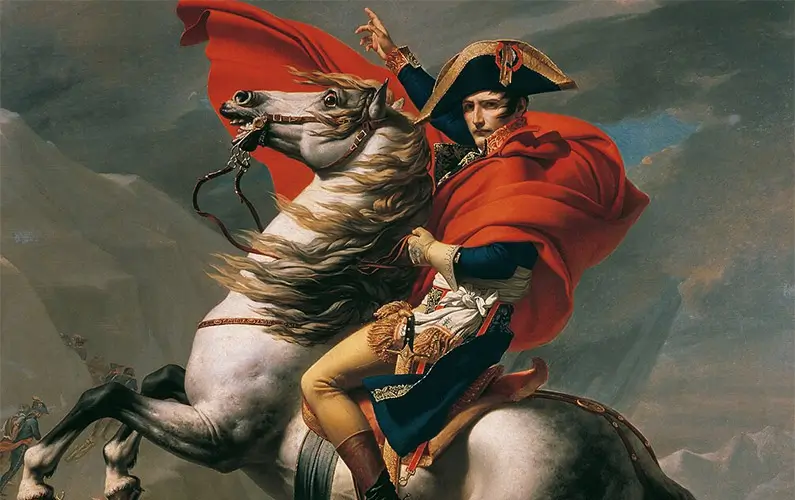
Napoleon I was born on August 15, 1769, in Ajaccio on the island of Corsica (as Napoleone Buonaparte, later Napoléon Bonaparte), and died on May 5, 1821, on Saint Helena in the South Atlantic. He served as Emperor of France from December 2, 1804, until April 6, 1814. As commander-in-chief of the French military, he conquered and ruled over much of Western and Central Europe, and for a few years also wielded power in Egypt.
The failed campaign against Russia weakened his position, eventually leading to his final defeat at the Battle of Waterloo and the fall of Napoleon. After losing at Waterloo, he was deposed and exiled to the remote island of Saint Helena in the middle of the Atlantic, where he died a few years later.
You’ve likely read about him in school at some point — but here are ten facts your teacher probably never told you!
1 Napoleon wasn’t nearly as short as people think…
Napoleon Bonaparte was not as short as the popular myth suggests. In reality, he stood at around 170 centimeters (about 5’6″–5’7″), which was perfectly average — even slightly above average — for a French man in the late 1700s. The misunderstanding about his height partly arose from differences between the French and British measurement systems. When the British converted his height from French inches, they misinterpreted the numbers, making him seem much smaller.
On top of that, the image of Napoleon as a tiny man was heavily influenced by British propaganda, which aimed to mock him and diminish his status as a leader. Contemporary caricatures reinforced this image, often depicting him as short, irritable, and power-hungry. This stereotype has survived into modern pop culture — despite being more political myth than historical fact. [source]
2 You can thank Napoleon for right-hand traffic in most of Europe…
Mandatory right-hand traffic was introduced across much of Europe by Napoleon Bonaparte, and for more reasons than just logistics. One major purpose was to reduce dueling between horse-mounted riders. Since most people are right-handed, left-hand traffic made it easier to draw a sword against an approaching rider — something Napoleon wanted to discourage to reduce violence and road duels.
Additionally, left-hand traffic had long been associated with the aristocracy. Riding or driving on the left side of the road was seen as an upper-class privilege, while right-hand traffic was viewed as the more common people’s side. By enforcing right-hand traffic in the territories he conquered, Napoleon signaled a break with the old aristocratic order while also creating greater uniformity within his expanding empire.
Britain, however, remained the exception. Because Napoleon never conquered the British Isles, they kept their traditional left-hand traffic — a practice they still follow today. This is why most of continental Europe drives on the right, while island nations like Britain, Ireland, and Malta continue to go their own way. [source]
3 France could just as easily have become Islamic…
In his effort to conquer Egypt, Bonaparte considered converting himself and his army to Islam as a way to win the trust of the local population and appear as an ally rather than an invader. He showed great tactical interest in the political power of religion and wanted to use it to his advantage.
However, the plan was quickly abandoned — not least because French soldiers would never accept Islam’s requirement of complete abstinence from alcohol. As a result, the idea remained nothing more than a strategic thought rather than a real possibility. [source]

You may also like
4 Napoleon was close friends with George Washington…
Napoleon Bonaparte held great respect for George Washington and viewed him as a role model in both leadership and revolutionary spirit. When the American president died in 1799, the French emperor demonstrated his admiration by declaring ten days of national mourning in France — an unusual and powerful gesture that crossed national boundaries. The act reflects Washington’s influence even on European leaders like Napoleon. [source]
5 Even braille exists thanks to Napoleon…
It is actually thanks to Bonaparte and his army that we have braille today. Napoleon wanted to develop a system that could be read and communicated without sound or light, and so a form of “night writing” was created as a military tactic. However, it turned out to be far too difficult for the French soldiers to learn.
The concept of “night writing” was later adapted and transformed — eventually becoming what we now know as braille. [source]
6 Napoleon’s first wife has descendants in today’s royal families…
Bonaparte loved his first wife, Joséphine de Beauharnais, so deeply that he divorced her specifically because she could no longer bear children. Today, Joséphine has five direct descendants in the current royal families of Europe.
The French warlord himself, however, is not an ancestor of any of Europe’s reigning royals — only Joséphine’s bloodline continued into modern royalty. [source]

You may also like
7 Napoleon’s penis is kept in a museum in the United States…
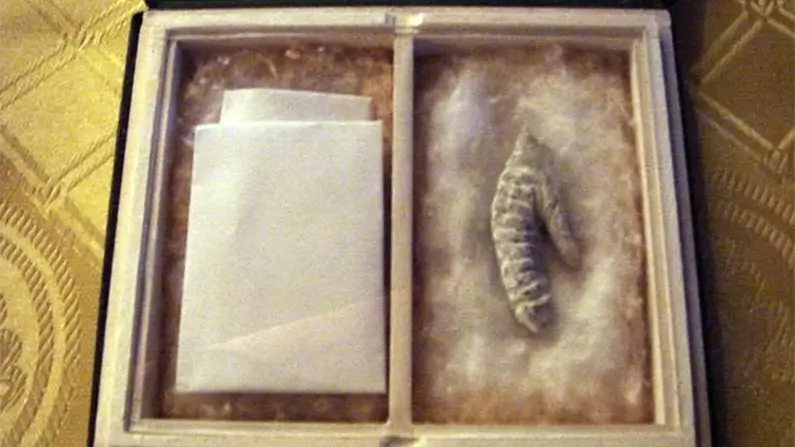
It may sound like something out of a myth, but it is actually true. Napoleon Bonaparte’s penis was reportedly removed during his autopsy in 1821, likely by a doctor with ties to the church. According to the story, a priest later took the unusual relic to the United States, where, after several changes of ownership, it now resides in a museum in New Jersey.
The authenticity of the body part has been questioned for years, but the tale continues to fascinate both historians and curious visitors alike. [source]
8 Bonaparte defended the Jews — long before the dark age of European antisemitism…
As early as the early 1800s, Bonaparte demonstrated an unusually progressive view of Jewish rights for his time. While working to emancipate the Jewish population in France, he stated clearly: “I will never accept any proposal that obliges Jewish people to leave France. To me, the Jews are the same as all other citizens of our country.”
His declaration stands in sharp contrast to the rise of European antisemitism that would follow, especially the extreme ideologies that came to define the 20th century under leaders like Adolf Hitler. [source]

You may also like
9 In just six days, Napoleon transformed all of Malta…
During Napoleon’s six-day stay in Malta, he carried out sweeping reforms: he overhauled the national administration, created twelve municipalities, established a public financial administration, abolished all feudal privileges and slavery, appointed twelve judges, and set up a public education system.
That’s probably more than most modern governments accomplish in an entire decade! [source]
10 His mistress slept with his arch-enemy…
After the Duke of Wellington defeated Bonaparte and the French army at the decisive Battle of Waterloo, he attempted in an unusual way to win over those closest to Napoleon. He directed his charm offensive toward two of Napoleon’s former mistresses, giving them gifts such as a war sword that once belonged to Bonaparte and a bold painting created by Wellington’s own sister.
According to historical accounts, one of these women ultimately chose the Duke of Wellington over Bonaparte — even in more intimate matters. [source]
5 Common Questions About Napoleon Bonaparte
Napoleon Bonaparte was a French military leader and statesman who rose to prominence during the French Revolution. He became Emperor of the French in 1804 and built one of the largest European empires since ancient Rome. His reforms reshaped law, education, administration, and warfare across Europe.
Despite the popular myth, Napoleon was not unusually short. He was about 170 centimeters tall, which was average — even slightly above average — for a Frenchman of his time. The myth of his short stature largely comes from British propaganda and misunderstandings between French and British measurement systems.
Napoleon was exiled twice due to military defeats and political pressure from European coalitions. After a disastrous campaign against Russia and his defeat in 1814, he was exiled to Elba. He later escaped, returned to power for the “Hundred Days”, but was decisively defeated at the Battle of Waterloo. He was then exiled to the remote island of Saint Helena, where he spent the rest of his life.
Napoleon’s most lasting achievement is the Napoleonic Code, a legal system that has influenced laws around the world. He modernized France by reforming its economy, education, military, and administration. He also expanded French territory across Europe and reshaped its political landscape, leaving a lasting legacy both in France and abroad.
Napoleon died on Saint Helena in 1821 at the age of 51. The official cause of death is listed as stomach cancer, though there have long been theories suggesting possible poisoning. Most modern research, however, supports stomach cancer as the most likely cause.