
Tyrannosaurus Rex (also known as the “Tyrant Lizard”) was a massive carnivorous dinosaur whose fossils have been found in North America, where it is believed to have lived during the late Cretaceous period, around 65–68 million years ago. Numerous discoveries have been made in U.S. states such as Alberta, Montana, Utah, and New Mexico. The only universally accepted species within the genus Tyrannosaurus is the type species T. rex, which was described and named by Henry Fairfield Osborn in 1905.
Over the years, some researchers have proposed that closely related dinosaurs such as Daspletosaurus and Tarbosaurus should be classified within the genus Tyrannosaurus, but these suggestions have not gained widespread acceptance. Tyrannosaurus rex is one of the most famous dinosaurs and was long considered the largest land-dwelling carnivorous animal to have ever lived. Since its discovery, however, several theropods likely even larger have been found — including Spinosaurus, Giganotosaurus, and Carcharodontosaurus — though none have achieved the same level of fame. Here are 10 facts you probably didn’t know about this gigantic predator!
1 This is what Tyrannosaurus Rex actually means…
The word “Tyrannosaurus” means “tyrant lizard”, which says quite a lot about its fierce and intimidating nature. The term “Rex” is Latin for “king”. So, put together, the name can essentially be translated as “the tyrant lizard king“.
2 Scientists have found T. Rex skeletons containing soft tissue and proteins…
According to reports from National Geographic, more than fifty Tyrannosaurus Rex skeletons have been discovered to date. Many of these finds have been almost completely intact, and at least one skeleton contained preserved proteins and traces of soft tissue. This discovery has significantly advanced scientific research on dinosaurs in general — and on Tyrannosaurus Rex in particular. [source]
3 The first T. Rex fossils were discovered in the early 1900s…
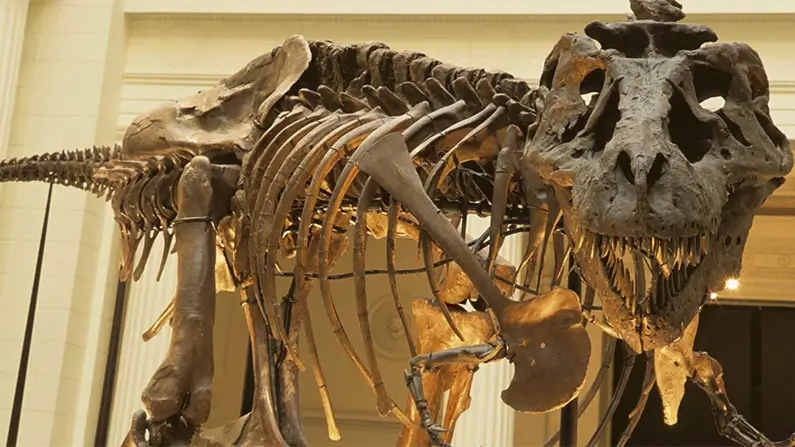
The first T. Rex fossil was discovered in 1902 by paleontologist Barnum Brown. Although the skeleton was incomplete, it was the first set of remains that could be identified as belonging to Tyrannosaurus rex. The discovery was made in the Hell Creek Formation in Montana, USA. Brown was working for the American Museum of Natural History, and his find became crucial to the early scientific understanding of this iconic dinosaur.
Brown later sold the skeleton to the Carnegie Museum of Natural History in Pittsburgh. However, this was not the only T. Rex skeleton he uncovered. A second specimen, excavated in the same area, is now displayed at the American Museum of Natural History in New York City. [source]
4 This is how many teeth a Tyrannosaurus rex had…
A Tyrannosaurus Rex had about 50 to 60 teeth. These teeth were massive and extremely powerful, with the longest ones reaching up to 30 centimeters (including the root). They were perfectly adapted for crushing bone and tearing flesh, making T. rex one of the most efficient predators of its time.
In addition to this, Tyrannosaurus Rex possessed one of the strongest bite forces of any land-dwelling animal in history. Scientists estimate that a T. rex could bite with a force of 35,000 to 57,000 Newtons (equivalent to 3,500 to 5,700 kilograms). This tremendous power allowed it to crush bones and consume entire chunks of its prey, giving it a huge advantage as the apex predator of its ecosystem. [source]
5 You can still see T. Rex footprints today…
Dinosaur footprints — including those of Tyrannosaurus Rex — can still be found millions of years after their extinction. The first known T. rex footprint was discovered in 1993 in New Mexico, USA. Another footprint was uncovered in 2007 in the Hell Creek Formation, the same area where the first two T. rex skeletons were found. These discoveries have provided scientists with valuable insights into dinosaur behavior and movement patterns. [source]
6 This is how old a Tyrannosaurus Rex could get…
A Tyrannosaurus Rex could live up to around 30 years. Scientists have been able to estimate its lifespan by studying growth rings in fossilized bones, similar to counting rings in a tree. These studies show that T. Rex experienced rapid growth during its teenage years, and then its growth rate slowed down once it reached adulthood. [source]
You may also like
7 How fast a Tyrannosaurus Rex could (probably) run…
There is still some debate among scientists about how fast a Tyrannosaurus Rex could actually run. Earlier estimates varied widely, but recent research and biomechanical models suggest that T. Rex likely reached speeds of around 17 to 25 km/h (10–15 mph). Some studies propose an even lower maximum speed due to its massive body weight and biomechanical limitations.
For comparison, Usain Bolt, the world-record sprinter in the 100m and 200m events, has a top speed of about 37.58 km/h (23.35 mph) — significantly faster than a T. Rex. [source]

8 We still don’t know exactly how many Tyrannosaurus Rex existed…
Exactly how many Tyrannosaurus Rex lived during their time on Earth has been difficult for scientists and paleontologists to determine. Fossil evidence suggests that there were not millions of T. Rex alive at the same time, but that they were relatively rare compared to many other dinosaur species. Any population estimates remain speculative, based on fossil discoveries and ecological modeling.
In other words, we’ll need to uncover more skeletons before we can form a clearer picture of their true population size and distribution. [source]
9 This is how much an adult Tyrannosaurus Rex weighed…
An adult T. Rex weighed approximately 5,000 to 8,000 kilograms (about 5 to 8 tons). This makes T. Rex one of the largest land-dwelling predators to have ever lived. Some individuals may have been even heavier, depending on age, sex, and natural variation.
For comparison, the largest living land animal today — the African elephant (Loxodonta africana) — typically weighs 4,500 to 6,800 kilograms (4.5 to 6.8 tons) for a fully grown bull. [source]
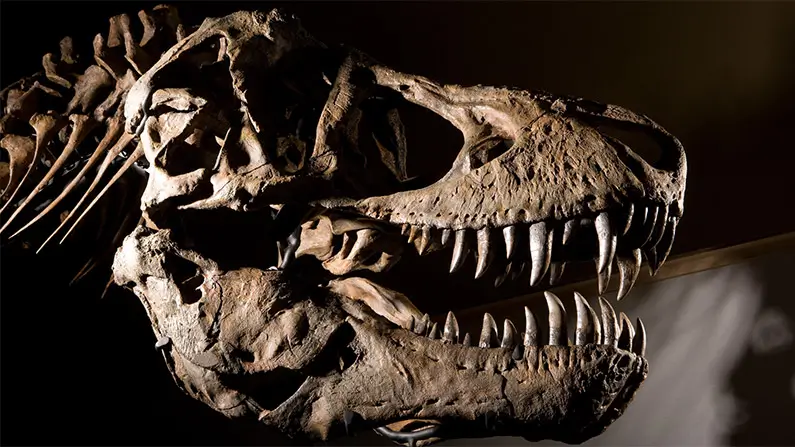
10 Tyrannosaurus Rex was both a hunter and a scavenger…
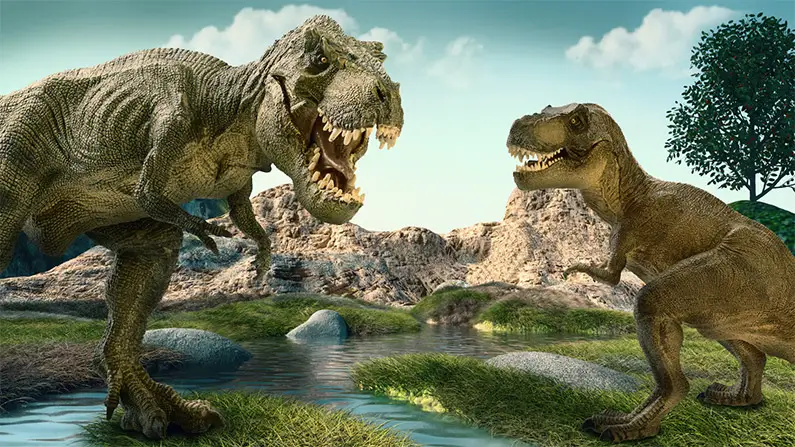
Tyrannosaurus Rex was both an active predator and a scavenger. Fossil evidence and scientific research suggest that T. Rex likely hunted large herbivorous dinosaurs such as Triceratops and Edmontosaurus, among others. Its powerful bite and incredibly strong jaws allowed it to crush both bone and flesh, giving it a versatile diet that included meat from its own kills as well as carcasses it could scavenge. [source]
Xtra Scientists believe Tyrannosaurus rex had scaly skin rather than feathers…
Whether Tyrannosaurus Rex had feathers has been a topic of debate in recent years, but current research suggests that T. Rex likely did not have feathers. The latest studies and fossil evidence indicate that T. Rex had scaly, reptile-like skin rather than a feathered covering.
Some smaller relatives of T. Rex — certain species of tyrannosauroids — have been shown to possess feathers based on fossil discoveries, but this does not appear to apply to the adult T. Rex itself. [source]
5 Common Questions About Tyrannosaurus Rex
Tyrannosaurus Rex was a carnivore that hunted large herbivorous dinosaurs such as Triceratops and Edmontosaurus. Evidence also shows that it scavenged when possible, meaning its diet included both fresh kills and carcasses.
A fully grown Tyrannosaurus Rex typically weighed between 5,000 and 8,000 kilograms (5–8 tons) and reached lengths of around 12 to 13 meters. It stood roughly 4 meters tall at the hips, making it one of the largest land predators ever known.
Most modern biomechanical studies suggest that Tyrannosaurus Rex could likely run at speeds between 17 and 25 km/h (10–15 mph). Its massive size limited its top speed, making it powerful but not particularly fast.
Current research indicates that adult Tyrannosaurus Rex most likely had scaly skin rather than feathers. While some smaller relatives had feathers, fossil evidence suggests that Tyrannosaurus Rex itself was mostly or entirely covered in scales.
Scientists estimate that Tyrannosaurus Rex could live up to about 30 years. This is determined by counting growth rings in its fossilized bones, similar to how tree rings are used to measure age.