
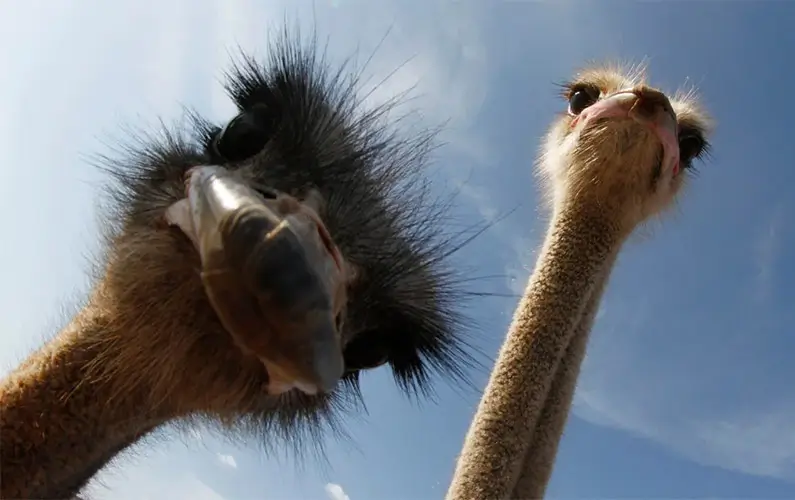
The ostrich (Struthio camelus) is an impressive bird, known for its great size, long legs, and long neck, and is native to Africa. Despite its massive stature, it cannot fly — much like the penguin. Together with its close relative, the Somali ostrich (Struthio molybdophanes), it is the largest living bird on Earth and also lays the largest eggs in the bird world. But the ostrich is not only famous for its size — it also has a relatively small brain, weighing only about 40 grams. Below, you’ll find ten fascinating facts about ostriches that you probably didn’t know!
1 It’s just a myth that ostriches bury their heads in the sand…
It’s a common myth that ostriches bury their heads in the ground when they feel threatened — an idea often shown in cartoons and popular culture. In reality, there is no documented case of an ostrich ever doing this.
When ostriches sense danger, they usually try to flee, or lie flat on the ground and camouflage themselves by pressing their long necks close to the earth to blend into their surroundings. So the next time you hear about an ostrich hiding with its head in the sand, you can be sure it’s nothing more than a myth. [source]
2 Ostriches once roamed freely across Europe 10,000 years ago…
Ostriches once roamed freely across Europe, Arabia, and Asia until around 10,000 years ago. The last non-African ostrich subspecies to live in the wild was the Arabian ostrich, which became extinct in the mid-20th century. [source]
3 This is why ostriches are often seen together with zebras…
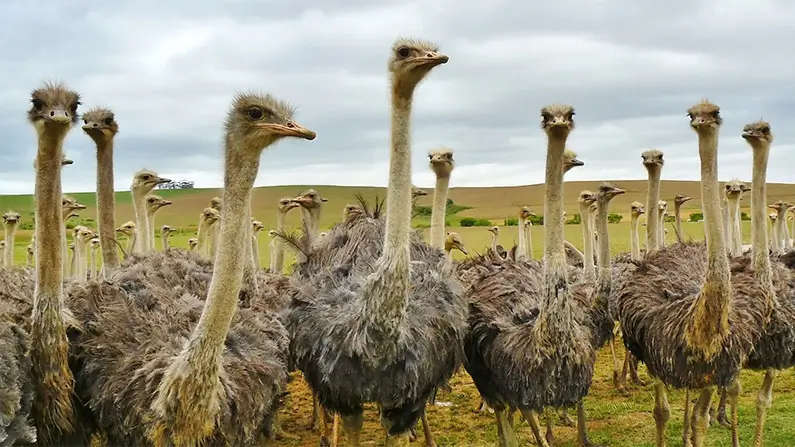
Ostriches and zebras are often seen living side by side in the wild — and it’s no coincidence. They team up to detect and avoid predators more effectively. Ostriches have exceptional eyesight and can spot danger from far away, while zebras make up for it with sharp hearing and a keen sense of smell.
Together, they form an efficient early warning system, using each other’s strengths to increase their chances of survival in the wild. [source]
You may also like
4 The eggs are incubated by both females and males…
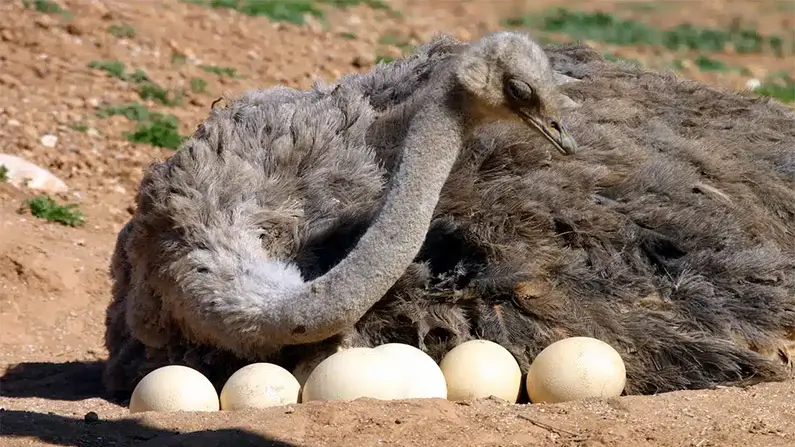
The incubation of ostrich eggs is a shared effort between females and males, divided in a clever way. During the day, females take care of the eggs, as their sand-colored feathers help them blend into the surroundings and avoid attracting predators. When night falls, males take over, since their darker plumage makes them harder to spot in the dark.
This ingenious division of labor ensures that the eggs receive maximum protection around the clock. [source]
5 The ostrich has both the largest and the smallest egg among birds…
The ostrich egg is truly impressive in more ways than one. It is the largest egg laid by any bird, yet when measured by proportion, it is actually the smallest egg relative to the bird’s body size. Despite being the world’s largest bird, the ostrich lays an egg that is surprisingly small compared to its massive body — a fascinating contrast in the natural world. [source]
6 Their feathers are widely used in the automotive industry…
Ostrich feathers are not only beautiful and unique — they are also exceptionally effective at removing dust. In fact, the automotive giant BMW uses a large rotating wheel filled with thousands of ostrich feathers to carefully remove dust particles from car bodies before painting.
This method helps ensure a perfect paint finish and demonstrates how natural materials can be used in innovative ways within modern industry. [source]
You may also like
7 An ostrich’s eyes are larger than its brain…
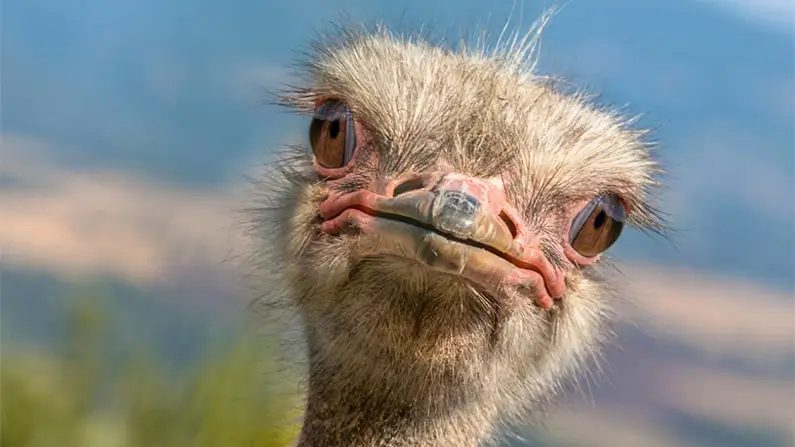
Another fun fact about ostriches is that they have the largest eyes of any land-dwelling bird. In fact, their eyes are larger than their brain. This unique trait gives them excellent eyesight, helping them spot predators from a distance.
On the other hand, despite their impressive vision, ostriches also have a tendency to be a bit clumsy. [source]
8 This is how long it takes to boil an ostrich egg…
Hard-boiling an ostrich egg is not for the impatient. A single egg often weighs between 1.2 and 2 kilograms and is equivalent in volume to about 24 chicken eggs. To fully hard-boil it, you’ll need nearly two hours in boiling water — a serious challenge for both your stove and your patience.
It might be a fun experiment to try once, but unless you have an entire morning to spare (and a very large pot), you’re probably better off sticking to chicken eggs for breakfast. [source]

You may also like
9 Rome celebrated military victories by releasing ostriches for the crowd to hunt…
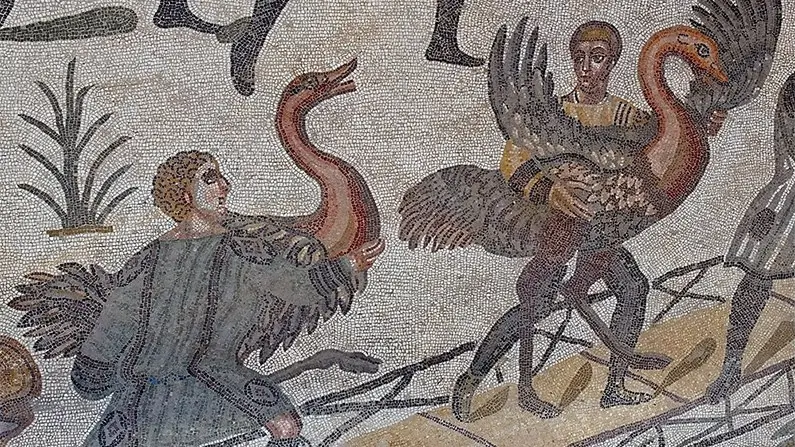
In ancient Rome, major military victories were not only celebrated with speeches and triumphal parades, but sometimes with brutal spectacles in the Colosseum. According to historical accounts, on one such occasion as many as 1,000 ostriches were released into the arena — along with 1,000 wild boars and 1,000 deer.
The crowd was told they could take whatever they wanted — but only if they could kill the animals themselves. The event turned into a violent public spectacle, where entertainment and survival instinct collided, and animals became the centerpiece of a macabre celebration of imperial power. [source]
10 North Korea once tried to solve food shortages with ostrich meat…
North Korea once attempted to address its food shortages by turning to ostrich farming. However, most of the ostrich meat reportedly ended up on the plates of the richest and most powerful elites in Pyongyang.
During the 1990s, the country invested heavily in ostrich breeding, and today there are several ostrich farms located near the capital. [source]

You may also like
5 Common Questions About Ostriches
No. They are completely flightless, but compensate with powerful legs that allow them to run at extremely high speeds.
They can reach speeds of up to 70 km/h (43 mph), making them the fastest running birds on land.
They can be. A strong kick can cause serious injury, especially if the animal feels threatened or cornered.
They are the largest eggs laid by any living bird, each weighing up to 2 kilograms and equal to about two dozen chicken eggs.
They are native to Africa’s savannas, deserts, and open plains, where wide visibility helps them detect predators.