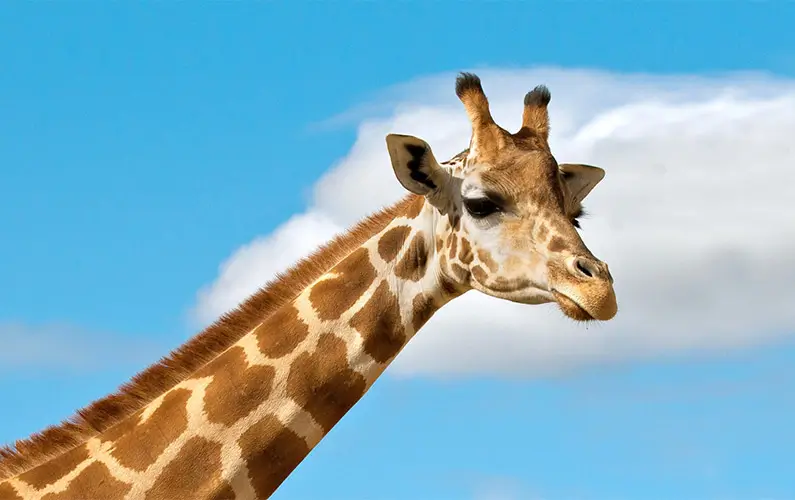
In the animal kingdom, few creatures are as majestic and fascinating as giraffes (Giraffa camelopardalis). Their long necks and distinctive spotted patterns make them true icons of the African savannas. But behind their elegance lies a world of unique adaptations and intriguing behaviors. Take a closer look at these remarkable animals as we reveal 10 astonishing facts about giraffes that you may not have known before.
1 How long a giraffe typically lives…
A giraffe in the wild usually has an average lifespan of about 20 to 25 years. In captivity, however, giraffes can live longer — often up to 25 to 30 years or more, depending on the quality of care and their overall health. [source]
2 Giraffes don’t need much sleep…
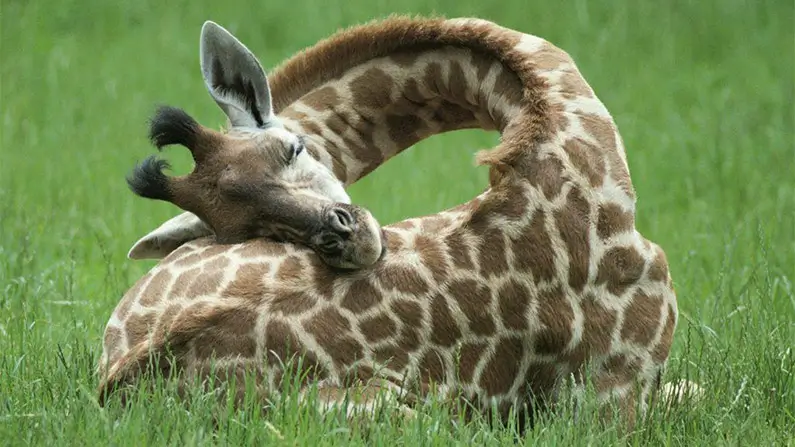
An adult human is recommended to sleep between 7–9 hours per day. Giraffes, however, only need 5 to 30 minutes of sleep within a 24-hour period.
They have adapted to sleep in short intervals while standing up, often with one eye open to stay alert to potential dangers. Their extremely short sleep requirement is linked to their vulnerability to predators in the wild and their need to be ready to flee at any moment. Below you can see an image of a sleeping giraffe — this time lying down. [source]
3 A giraffe’s tongue is incredibly long — and here’s why it has a bluish color…
Did you know that a giraffe’s tongue is not only extremely long — usually around 45 to 50 centimeters (18–20 inches) — but also incredibly flexible and strong? Its blue-black color helps protect it from sunburn when the giraffe stretches it up to 45 centimeters out of its mouth to reach high branches. It’s even long enough for them to clean their own ears! [source]

You may also like
4 Giraffe calves learn to stand almost immediately…
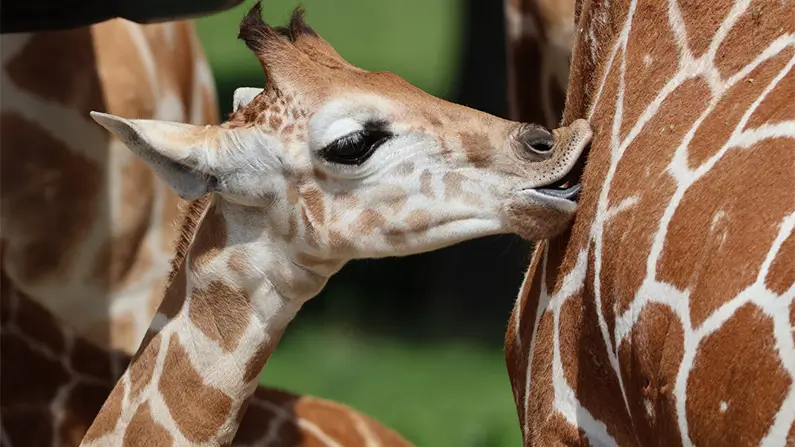
The gestation period for a giraffe lasts around 15 months on average, though it can vary between 13 and 15 months depending on individual factors. When a giraffe calf is born, it can stand up within half an hour, and after about 10 hours it can already follow its family and run around. This rapid development allows the young to quickly adapt to their environment and keep up with the herd. [source]
5 Where giraffes live — and what they prefer to eat…
Giraffes primarily inhabit savannas, open woodlands, and shrublands in sub-Saharan Africa. Their natural range includes countries such as Kenya, Tanzania, South Africa, Namibia, and Botswana, among others.
As for their diet, giraffes are herbivores and mainly eat leaves from trees and shrubs. They especially prefer acacia leaves, but also consume leaves from other trees available in their habitat. Thanks to their long necks, they can reach high branches that other animals cannot, giving them access to a diet of taller vegetation. An adult giraffe typically eats 30 to 45 kilograms (65–100 lbs) of leaves and shoots per day. [source]

You may also like
6 The Romans believed giraffes were an unnatural hybrid between a camel and a leopard…
The Greek and Roman word for giraffe was “Camelopardalis“, derived from the ancient belief that a giraffe was a kind of unnatural hybrid between a camel and a leopard, based on its long neck and spotted coat. This misconception stemmed from early descriptions of the giraffe and how it was perceived by ancient explorers and writers. [source]
7 Giraffes can go longer without water than a camel…
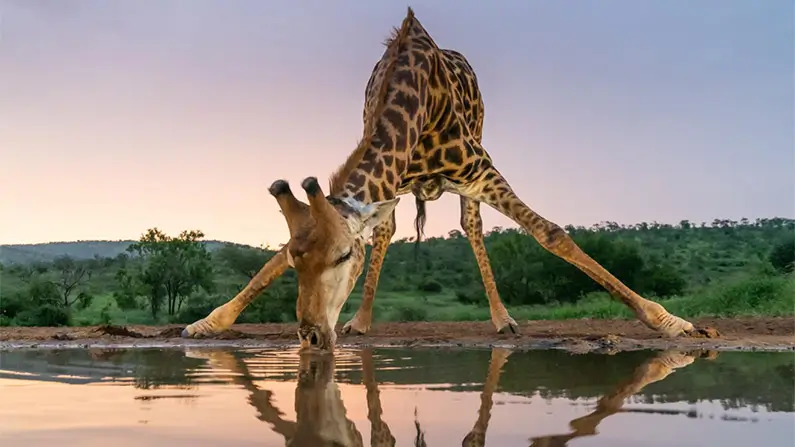
Giraffes are adapted to survive without water for long periods, especially since they often live in dry, savanna-like environments. An adult giraffe can typically survive up to three weeks without drinking water, although they will drink whenever it’s available. Their bodies are highly efficient at conserving moisture, and they can obtain much of their hydration from the moist, leafy vegetation they eat, such as tree and shrub leaves.
And if you’ve ever wondered what it looks like when giraffes drink water, just take a look at the picture below — it does look a bit comical, doesn’t it? [source]
8 The blood-pressure regulation system in a giraffe’s neck inspired a new G-force suit for fighter pilots…
A giraffe’s blood-pressure regulation system has inspired the development of a new type of G-force suit for fighter pilots. Giraffes have a unique mechanism in their neck that helps counteract the enormous height difference between the head and the heart when they bend down to drink or eat.
This system has been studied to create suits that increase human tolerance to high G-forces, allowing pilots to perform complex tasks — such as solving a Rubik’s Cube or even holding a conversation — under extreme forces like 9G. Normally, the human body can only withstand around 5G before it may lead to fainting or loss of consciousness due to blood-pressure changes and reduced oxygen to the brain. [source]
You may also like
9 The giraffe has only one living relative…
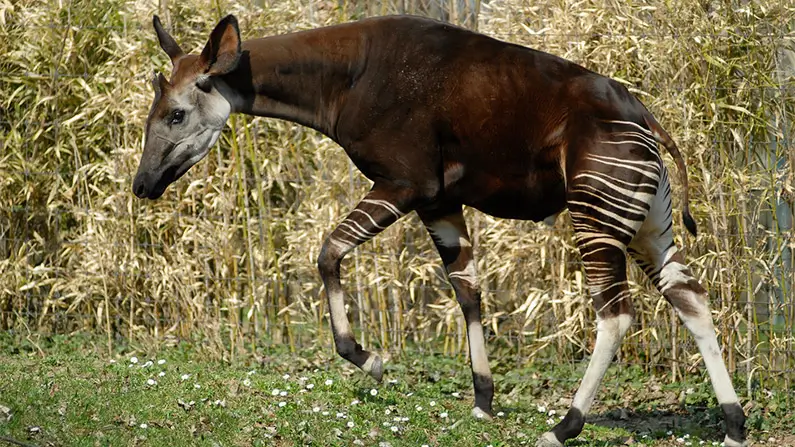
The okapi (Okapia johnstoni) is the only living relative of the giraffe. The okapi is an even-toed ungulate belonging to the giraffid family (Giraffidae). It lives exclusively in the tropical rainforests of the Democratic Republic of the Congo in Central Africa.
Although the okapi and the giraffe are related, they are physically and behaviorally quite different. While giraffes are adapted to dry savannas and known for their characteristic long necks, okapis live in dense forest environments and have much shorter necks. You can see an image of an okapi below — and you can definitely spot a few similarities!
10 Giraffes are not endangered, but there is a risk they could become so…
Giraffes are classified as vulnerable, meaning there is a risk that they could become endangered, according to the IUCN (International Union for Conservation of Nature). Their exact population is difficult to determine due to their wide distribution across Africa and the varying numbers in different regions. Estimates indicate that there are approximately 68,000 to 111,000 wild giraffes left in the world. There are international conservation programs and efforts in place to protect giraffe populations and their habitats. [source]
You may also like
Xtra Giraffes have the same number of neck vertebrae as humans…
Humans and giraffes have the same number of neck vertebrae, despite the giraffe’s neck being 1.8 to 2.4 meters (6–8 feet) long on average. The exact length can vary depending on age and sex, as males (bulls) generally have longer necks than females (cows). [source]
5 Common Questions About
Giraffes evolved long necks primarily to reach leaves high up in trees, especially acacias. Another theory suggests that long necks also help males in necking battles, where they use their heads as weapons to compete for mates.
A giraffe can run up to 60 km/h (about 37 mph) in short bursts. Despite their awkward appearance, their long legs allow for surprisingly fast and efficient movement.
Yes — though they are usually quiet. Giraffes produce low-frequency humming and vibrations, especially at night. They can also snort, hiss, and grunt, but many of their sounds are too low for humans to hear.
Giraffes sleep very little — usually just 5 to 30 minutes per day. They often sleep standing up and may rest with one eye open to stay alert to predators.
Giraffes are herbivores that prefer leaves from tall trees, especially acacias. Their long necks and prehensile tongues allow them to reach foliage other animals cannot. An adult giraffe may eat 30–45 kg (65–100 lbs) of vegetation daily.