

Today, the elephant (Elephantidae) is the only living proboscidean, and is sadly on the path toward extinction due to widespread poaching. The elephant family includes the Asian elephant, the African savanna elephant (formerly called the steppe elephant), and the African forest elephant, as well as mammoths and several other extinct groups. Elephants have been used as helpers in both agriculture and forestry for thousands of years and are now a protected species — primarily because of their valuable ivory. Below, you’ll find ten more facts that you probably didn’t know about these giants!
1 Just like humans, elephants comfort each other when things get tough…
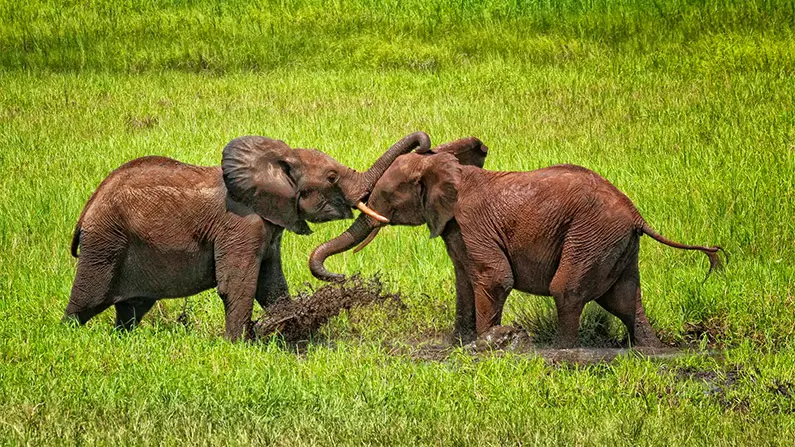
Elephants comfort one another when they’re distressed using gentle touches and soothing trunk strokes. Previously, only humans, great apes, and birds in the crow family were known to display this kind of behavior. [source]
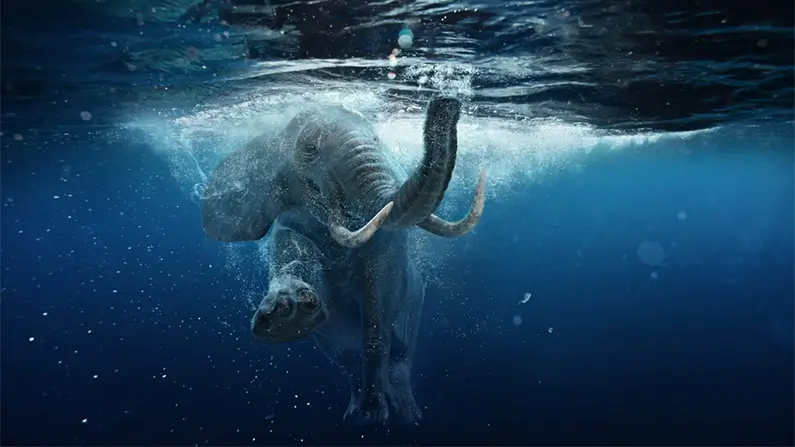
2 Elephants are excellent swimmers…
Elephants swim by using their legs and moving with a kind of march-like motion through shallow water. African elephants have even been recorded swimming up to 48 km (30 miles) in a single stretch. They can swim for six hours nonstop and then rest without sinking — much like how humans float in water. [source]
3 They have a dominant tusk…
Just like humans tend to be right-handed or left-handed, elephants are usually right-tusked or left-tusked. Their dominant tusk is easy to spot because it will be more worn down than the less-used tusk. [source]
You may also like
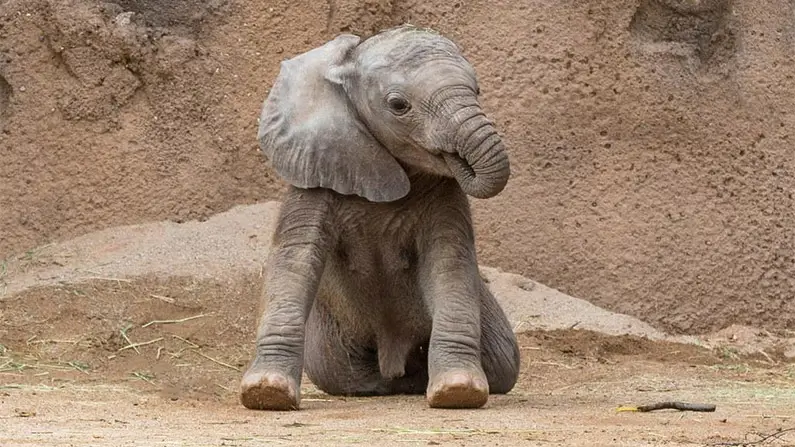
4 Baby elephants suck their trunks just like human babies suck their thumbs…
Elephants are more similar to us than we might think. Baby elephants suck on their trunks in the same way that human babies suck their thumbs. And it certainly looks adorable — just take a look at the picture below! [source]
5 Elephants mourned a famous conservationist as if he were ‘one of the family’…
When Lawrence Anthony, an international conservationist known as “The Elephant Whisperer“, passed away, several of the elephants he had worked to save came to his family’s home to mourn him — in the same way elephants typically grieve the death of one of their own. [source]
6 Their ‘dancing’ is rarely a good sign…
Even though it may look cute or charming when an elephant appears to “dance”, it is never a good sign. This behavior usually indicates that the elephant is mentally distressed and depressed due to confinement and restricted freedom and social interaction. [source]
You may also like
7 Why elephants don’t develop cancer as often as humans…
Despite their enormous size compared to humans, elephants are five times less likely to develop and die from cancer because they have at least 40 copies of the TP53 gene — a gene that destroys cancer cells before they become a problem. Humans, by comparison, only have two copies. [source]
8 America’s first circus elephant was killed by a religious fanatic…
The first circus elephant in the United States was named Old Bet, and she arrived in the country in the late 1700s. She toured in various shows and quickly became a crowd favorite. But in 1816, her story ended tragically when she was shot and killed by a man in Maine. He believed it was morally wrong for people to pay money to watch an animal perform and viewed his action as a religious stand. The incident drew significant attention and has since become a notable part of early American circus history. [source]

You may also like
9 They bury and mourn their dead…
In 2004, an elephant attacked and killed a mother and her child, and then proceeded to bury their bodies before leaving the scene. Elephants are known to bury their dead and revisit the burial sites for generations. The burial of the woman and her child is not unique — elephants have been documented burying deceased humans on several occasions. [source]

10 21 elephants proved the durability of the Brooklyn Bridge in New York City…
After the grand opening of New York City’s Brooklyn Bridge, rumors spread that the bridge was unstable and could easily collapse. To prove that the structure was safe, P.T. Barnum marched 21 elephants across the bridge on May 17, 1884. [source]
You may also like
5 Common Questions About Elephants
An elephant’s trunk is a multifunctional tool used for breathing, smelling, drinking, grabbing, and communication. The trunk contains over 40,000 muscles, making it one of the most versatile organs in the animal kingdom.
Tusks are elongated teeth used for digging, stripping bark, fighting, and lifting objects. Elephants rely heavily on their tusks, but poaching has led to some populations evolving to grow smaller or no tusks at all for survival.
Elephants typically live between 60 and 70 years in the wild. Some have been recorded living even longer, but captivity often shortens their lifespan due to stress and limited space.
There is no solid scientific evidence that elephants fear mice. However, elephants can be startled by sudden small movements, which may contribute to the myth. Their actual fears are more often related to humans and predators.
Elephants communicate through sounds, body language, and vibrations. They use low-frequency rumbles that can travel several kilometers, allowing them to coordinate over vast distances.


