
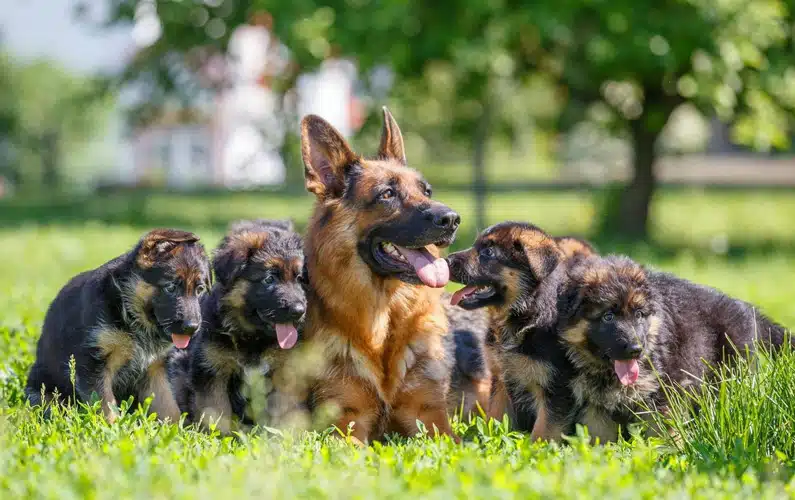
The German Shepherd is one of the most admired dog breeds in the world — and for good reason. Known for their intelligence, loyalty, and versatility, these dogs excel as family companions, working dogs, and true everyday heroes. But beyond their impressive reputation lies a breed full of surprising traits, fascinating history, and lesser-known abilities. In this article, we uncover 10 kickass and amazing facts about German Shepherds that show why they continue to stand out as one of the most remarkable dog breeds on the planet.
1 German Shepherds have an extraordinary sense of smell…
Humans have around 400 different types of scent receptors, also known as olfactory receptors, located in the nasal cavity and responsible for identifying smells. Dogs, on the other hand, can have up to 300 million scent receptors.
Compared to many other dog breeds, the German Shepherd possesses a truly world-class sense of smell, which explains why they excel as police dogs and tracking dogs. Among many other roles, German Shepherds are widely known for bomb and drug detection, tracking, and search and rescue missions. [source]
2 German Shepherd is the perfect protector…
German Shepherds are known for being fearless and confident (although, during puppyhood, they often go through a phase where they are afraid of almost everything). A German Shepherd will stand its ground with confidence and is well suited to act as either a guard dog or a protector, depending on the situation.
They may be reserved toward strangers, but they are not aggressive. This natural protective instinct provides a strong sense of security for the dog’s owner. However, it also comes with responsibility. You should be committed to spending time activating and training your dog to ensure your companion feels comfortable around strangers and other dogs.
If you do, you will truly benefit from everything the German Shepherd has to offer. [source]
3 Parachuting is everyday life for a German Shepherd…
German Shepherds are one of the most common and popular dog breeds in the military, especially in the United States, where they are a clear favorite due to being highly intelligent, easy to train, flexible, and physically strong.
The German Shepherd is ranked as the third most intelligent dog breed in the world, after the Border Collie and the Poodle. In the U.S., the military has even trained these dogs to take part in active military missions, where they parachute from aircraft alongside their handler. [source]

You may also like
4 German Shepherds is known for their versatility…
If there’s a job to be done, all you have to do is ask your dog. German Shepherd owners are well aware that their dogs were developed as true working dogs. In fact, the ideal German Shepherd has a body structure and abilities specifically suited for hard, demanding work, which has always been the breed’s primary purpose. This means your dog can excel at almost anything.
From dog sports such as racing, agility, tracking, therapy work, and service dog roles – German Shepherds can do it all, almost literally. The only thing holding your dog back is the time and energy you’re able to invest in training. It’s no surprise that people often assume your dog is a police or service dog, especially children. [source]

5 The German Shepherd is a very fast dog for its weight…
A German Shepherd in its prime can run at speeds close to 30–40 km/h (18–25 mph). While they aren’t the fastest runners overall, this is still extremely impressive relative to their size and weight. To put it into perspective, the fastest dog breed is the Greyhound, which can reach speeds of up to 72 km/h (45 mph). Meanwhile, Usain Bolt, the fastest human on Earth, has reached speeds of around 43 km/h (27 mph). [source]
7 You definitely don’t want to be bitten by a German Shepherd…
A German Shepherd’s bite force exceeds 1,060 newtons, or 238 PSI, which is the commonly used measurement. A bite from this breed can be brutally powerful and may cause serious injuries that require medical treatment or even surgery. The German Shepherd is ranked as having the seventh strongest bite force of all dog breeds (!). [source]

You may also like
6 Stricter breed standards in Europe than in the U.S.…
The German Shepherd has changed somewhat since Max von Stephanitz—considered the developer of the modern breed in 1895—began his breeding program, depending on where you live. American breeders developed breed standards set by the American Kennel Club (AKC), which place a strong emphasis on body shape and elegant movement, making German Shepherds highly sought after as show and performance dogs.
European breeders, however, largely continue to follow Max von Stephanitz’s original standards, which prioritize health, temperament, and working ability. These standards are overseen by the German Shepherd Club of Germany, which requires dogs to pass a series of rigorous tests. American breeding standards do not require these tests, marking a key difference between the two approaches. [source]

8 German Shepherds were widely used during World War I and World War II…
Max von Stephanitz was deeply committed to developing the German Shepherd as a versatile working breed. As urbanization reduced the need for herding dogs, he introduced this intelligent and highly trainable dog to police and military work. During both World War I and World War II, German Shepherds performed heroic service and were used extensively in combat zones.
In World War I, German Shepherds proved their bravery alongside German soldiers on the battlefield, serving as Red Cross dogs, rescuers, guard dogs, messengers, and sentries. They also guided wounded and blinded soldiers to safety for medical treatment. In 1917, a dog named Filax of Lewanno was honored in Westminster as a war hero after leading 54 soldiers to safety. [source]

You may also like
9 German Shepherds were the first guide dogs in the U.S.…
In June 1928, Morris Frank brought his dog Buddy to the United States from Switzerland, where dogs were trained to assist soldiers who had been blinded during World War I. Morris demonstrated Buddy’s abilities by having her guide him safely across a very busy street in New York City, in front of a crowd of reporters.
Buddy’s flawless navigation proved the potential of guide dogs and sparked widespread interest in using German Shepherds to assist people with visual impairments. Today, most guide dogs are Labradors and Golden Retrievers, and German Shepherds are no longer the most common breed in this role. Instead, they are now widely regarded as best suited for police and military work—or as loyal companion dogs. You can see a photo of the famous duo below! [source]

10 They haven’t always been called German Shepherds…
Today, we know these dogs as German Shepherds, but that hasn’t always been the case. After World War I, many countries avoided anything associated with Germany. As a result, in 1917 the American Kennel Club began calling them simply “Shepherd Dogs”.
The same trend appeared in Europe, where the breed became known as “Alsatian Wolf Dogs”. Many years later, both American and European kennel organizations restored the original name. Today, the breed’s official name is once again German Shepherd. [source]
You may also like
Xtra It would almost be a crime not to mention Rin Tin Tin in an article about German Shepherds…
An American soldier rescued the dog on a battlefield in France during World War I, making him one of the earliest and most famous rescue dogs. But his story didn’t end there. Rin Tin Tin soon became the most famous German Shepherd of all time. Between 1922 and 1931, he appeared in an incredible 27 films, and he went on to become the first non-human ever awarded a star on the Hollywood Walk of Fame. [source]
5 Common Questions About German Shepherds
Yes, German Shepherds can be excellent family dogs when properly trained and socialized. They are loyal, protective, and often very gentle with children in their own family. However, they need consistent training and mental stimulation to thrive in a family environment.
No, German Shepherds are not naturally aggressive. They are confident and protective, which can sometimes be mistaken for aggression. Poor breeding, lack of training, or insufficient socialization are usually the real causes behind problematic behavior.
German Shepherds are among the smartest dog breeds in the world, typically ranked in the top three. They learn commands quickly, excel at complex tasks, and are widely used as police dogs, military dogs, service dogs, and search-and-rescue dogs.
Yes, German Shepherds are high-energy dogs that require daily physical exercise and mental challenges. Long walks, training sessions, playtime, and problem-solving activities are essential to keep them balanced and prevent boredom-related issues.
The average lifespan of a German Shepherd is around 9–13 years. With good breeding, proper diet, regular exercise, and routine veterinary care, many German Shepherds can live long, healthy, and active lives.