

Saint Bernards are a dog breed from Switzerland. They belong to the Molosser type and are classified as mountain dogs, although they were never primarily used as livestock guardians or herding dogs. Modern Saint Bernards haven’t been rescue dogs either — the type we know today has been bred almost exclusively as a companion dog. But if you already own a Saint Bernard or are planning to get one, you probably knew all of that already! So let’s skip ahead to the more entertaining parts instead!
1 Perhaps the world’s sleepiest dog…
Need a reliable napping companion? Then a Saint Bernard might be just right for you. This large and gentle breed sleeps an average of around 14 hours a day, and some individuals may even need up to 18. Their calm pace and impressive sleep requirements have earned them the occasional nickname: the ‘sleeping dog‘. [source]
2 Surprisingly lively for its size…
Despite its impressive size, the Saint Bernard is a surprisingly cheerful and spirited dog. At the same time, it’s a calm, steady, and affectionate family companion that loves staying close to its people. The breed also has a strong guarding instinct, which means it may be quick to alert — especially in busy, built-up areas where there’s a lot going on. If you live in a city, you may need to expect a fair amount of barking. [source]
3 Swiss monks once tried to make the breed more cold-resistant…
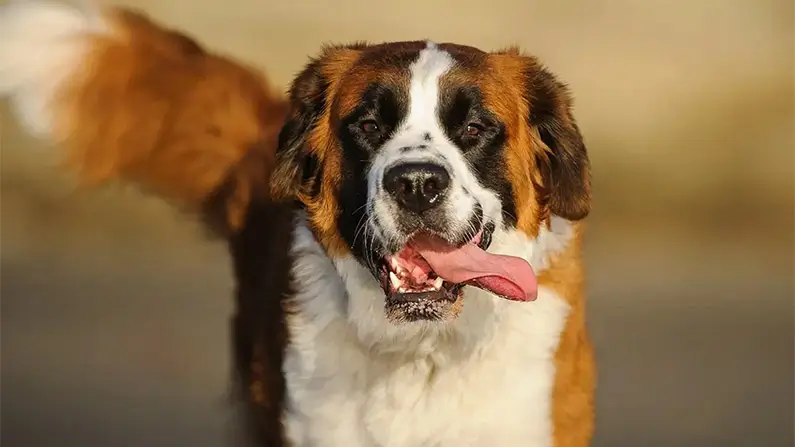
After an especially harsh winter, Swiss monks attempted to cross the Saint Bernard with Newfoundlands in hopes of producing a dog with a thicker, more cold-resistant coat. The experiment, however, didn’t go as planned. The longer fur collected snow and ice, weighing the dogs down and ultimately making them less effective in mountain rescue work. Traces of this crossbreeding can still be seen today — the breed exists in both short-haired and long-haired varieties. [source]

You may also like
4 More Saint Bernards live in warm climates than cold ones…
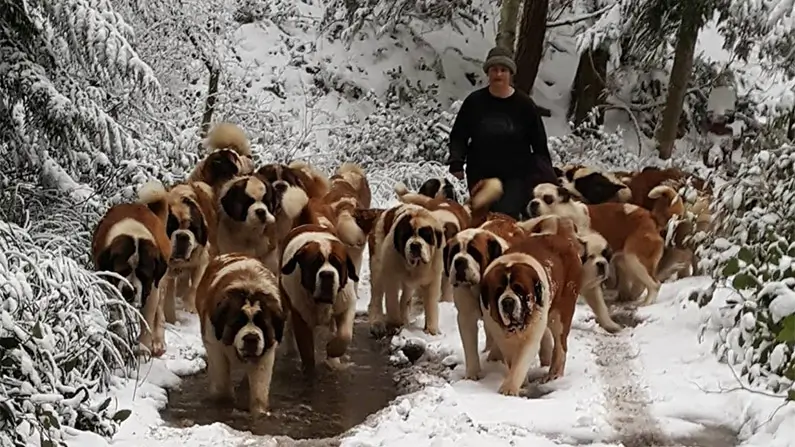
Think Saint Bernards only belong in chilly mountain regions? Not quite. There’s actually an entire island in British Columbia where Saint Bernards are so common that they’ve almost become a hallmark of the place. [source]
5 Saint Bernards shouldn’t be bathed too often…
Saint Bernards have a lot of fur, but that doesn’t mean you need to rush to the groomer all the time. Their coat is naturally oily and water-repellent — a trait that once helped them keep snow and ice at bay while working in the Alps. For that reason, you should be careful not to bathe them too frequently, as shampoo can strip away the essential oils that protect their coat and keep it in good condition. [source]
6 The perfect family dog — but make sure to start training early…
Saint Bernards are gentle giants in every sense of the word. They’re calm, patient, and have a strong desire to cooperate with and please their families. Their easy-going temperament makes them excellent family dogs, and their intelligence means training usually goes smoothly — as long as you start early, while they’re still small enough to handle easily.
Because they often don’t realize just how large they really are, they may accidentally knock over children or guests purely out of friendliness. That’s why early and consistent training is essential for teaching good habits right from the start. [source]

You may also like
7 What would an article about Saint Bernards be without mentioning a few records…?
The Saint Bernard is already known as an impressively large breed, but throughout history certain individuals have far exceeded the breed’s usual size. Some believe this may be connected to the fact that the breed was crossed with Mastiffs in 19th-century Britain, in an attempt to produce even bigger and more powerful dogs.
One of the most famous giants was named Plinlimmon. He stood nearly 88 centimeters (34.5 inches) at the shoulder and weighed over 95 kilograms (209 pounds) — a size that made him almost legendary in his time. He was sold to an American buyer for an astonishing 7,000 dollars, an enormous sum back then.
In 1981, another record-breaker, Benedictine V Schwarzwald Hof from Michigan, earned a place in the Guinness Book of Records after reaching an incredible weight of 142 kilograms (314 pounds!), making him one of the heaviest Saint Bernards ever documented. [source]
8 Expect a lot of drool (!)…
The Saint Bernard’s characteristic head shape, with its loose skin and hanging lips, means the breed drools far more than many other dogs. The drooling can increase even more when the dog is hungry, warm, or excited, as saliva production kicks into high gear.
To keep things manageable, you can help by avoiding overheating and keeping food and treats out of sight. Even so, the drooling is often so substantial that many owners rely on dedicated “drool cloths” to keep both their dog and their home reasonably dry. [source]
You may also like
9 But of course, Saint Bernards do come with some health concerns…
Like many large dog breeds, Saint Bernards are more prone to certain health issues, especially those affecting the bones and joints. One of the most common problems is that their rapid growth during puppyhood and adolescence can strain their developing skeleton, making a balanced diet and regular exercise particularly important.
The breed also has an increased risk of bone cancer, hip dysplasia, and elbow dysplasia, as well as eye conditions such as ectropion and entropion, where the lower eyelid becomes looser and may turn outward. Other conditions that can occur include epilepsy, skin problems like eczema, and certain heart muscle diseases.
One condition that has received special attention in research is the neurological disorder polyneuropathy, which affects the dog’s nerve function. Although the list may sound long, the Saint Bernard is not among the most disease-ridden breeds — but it’s wise to be aware of the potential health challenges that can arise. [source]

10 The Saint Bernard that saved over 40 lives and became an icon of the breed…
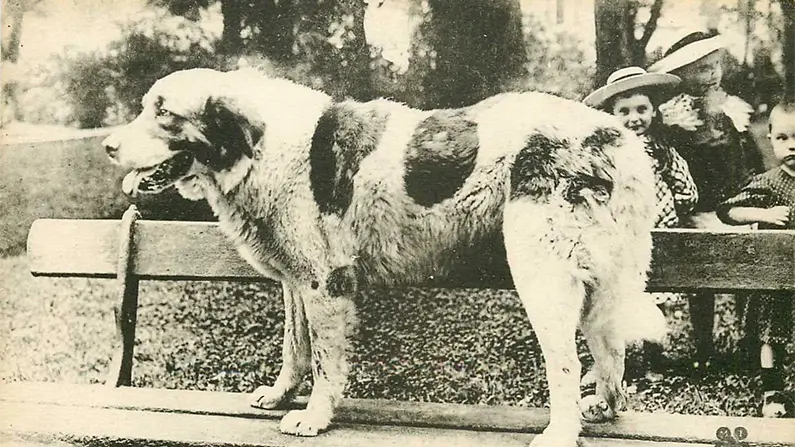
Barry (1800–1814) is one of the most famous Saint Bernards in history. He worked as a rescue dog at the monastery at the Great St. Bernard Pass in the Swiss Alps, near the Italian border. During his lifetime, Barry saved a large number of people who had become lost or stranded in the harsh mountain climate, and his efforts turned him into a legend.
At the Cimetière des Chiens pet cemetery in Asnières-sur-Seine, France, there is a monument in his honor with the inscription that he rescued 40 people and was killed by the 41st. According to the dramatic tale, he was mistaken for a wolf by an escaped prisoner or a soldier from Napoleon’s army. However, this story has since been disproven by the Natural History Museum in Bern.
According to the museum’s records, Barry was retired in 1812, when a monk brought him to Bern. There he lived out his final years and died a natural death in 1814. After his death, Barry was preserved through taxidermy, and already the following year he was put on display at the museum. His body was restored in 1923 and can still be seen today. A painting of him also hangs in the monastery hospice at the St. Bernard Pass.
Exactly how many lives Barry saved is still debated — some estimates go as high as one hundred people. Regardless of the precise number, Barry has become a symbol of courage, loyalty, and the remarkable history of the Saint Bernard. In 1977, he was also honored by Walt Disney, which produced the TV film Barry of the Great St. Bernard. [source]

You may also like
5 Common Questions About Saint Bernards
Yes. Saint Bernards are gentle, patient and friendly, making them excellent family dogs, especially with children.
Saint Bernards are very large dogs. Adult males can weigh up to 90 kg (200 lbs) and stand over 70 cm (28 inches) tall at the shoulder.
Yes. Saint Bernards are known for heavy drooling, especially after eating or drinking, which is something owners should be prepared for.
They are intelligent but can be stubborn. Saint Bernards respond best to calm, consistent and positive training methods.
Saint Bernards were bred for mountain rescue work in the Swiss Alps, where they helped locate and save travelers lost in snow and avalanches.