

Grasshoppers are often seen as simple insects that jump through fields and chirp on warm summer days. But behind those powerful legs and clicking sounds lies a surprisingly complex and fascinating creature. From their incredible jumping abilities to their role in ecosystems — and even their strange behaviors — grasshoppers are far more interesting than they first appear.
In this article, we explore 10 facts you probably didn’t know about grasshoppers, revealing why these small insects deserve a much closer look.
1 Grasshoppers have their ears on their stomachs…
A grasshopper’s hearing organs are not located on its head, but rather on its abdomen. A pair of thin membranes that vibrate in response to sound waves are positioned on either side of the first abdominal segment, hidden beneath the wings.
This simple eardrum-like structure allows grasshoppers to hear the songs of other grasshoppers, helping them communicate and locate one another. [source]
2 They are truly incredible jumpers…
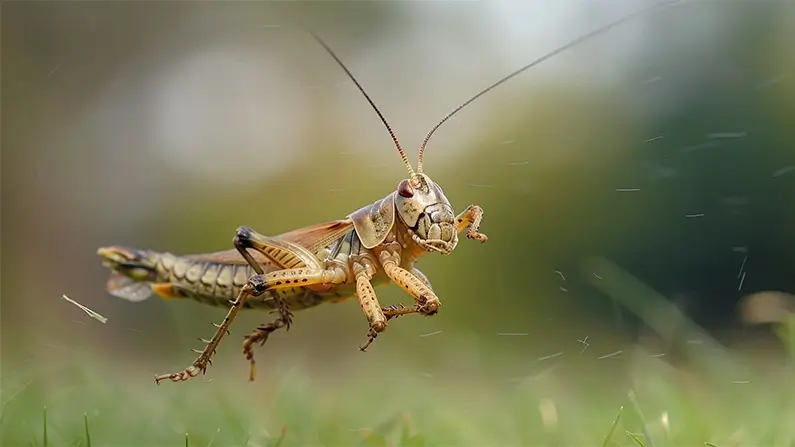
If you’ve ever tried to catch a grasshopper, you know just how far they can leap to escape danger. If humans could jump the way grasshoppers do, we would be able to easily clear the length of an entire football field in a single jump.
Their powerful hind legs make them some of the most impressive jumpers in the insect world. [source]
3 Grasshopper swarms can have devastating consequences…
A single grasshopper may not cause much damage on its own — even though it eats about half its body weight in plants every day. But when large swarms form, their combined appetite can completely destroy entire crops, leaving farmers without harvests and communities without food.
In 2006, researchers reported in a study that damage to forage crops caused by grasshoppers amounts to around $1.5 billion annually. In 1954, a swarm of desert locusts consumed more than 75 square kilometers of wild and cultivated vegetation in Kenya. [source]

You may also like
4 And yes — they can fly too…
Because grasshoppers have such powerful jumping legs, people sometimes forget that they also have wings. They often use their jumping ability to launch themselves into the air, but most species also have fairly strong wings that allow them to fly.
This combination of jumping and flying helps grasshoppers escape predators and other threats more effectively. [source]

5 They are also an important source of protein…
Humans have eaten grasshoppers for centuries, and they have a long tradition as a nutritious food source in many cultures around the world. According to the Bible, John the Baptist is said to have eaten grasshoppers with honey while living in the desert, showing that their consumption has deep historical and cultural roots.
In many parts of Africa, Asia, and the Americas, grasshoppers are a common and valued part of the local diet. They are collected, dried, or fried and eaten as snacks or used in various dishes. Grasshoppers are especially valuable because they are rich in protein, vitamins, and minerals, making them an important food source — particularly in regions where access to other protein-rich foods is limited.
In recent years, interest in eating insects such as grasshoppers has also grown in the Western world, as they are seen as a sustainable and climate-friendly alternative to traditional meat. [source]
6 Grasshoppers lived long before the dinosaurs…
Modern grasshoppers descend from ancient ancestors that existed long before dinosaurs walked the Earth. Fossil records show that the very first primitive grasshoppers appeared during the Carboniferous period, more than 300 million years ago. This makes grasshoppers one of the longest-surviving insect groups on the planet, having endured major changes in climate and ecosystems over immense spans of time.
Most discovered specimens are preserved as fossils in sedimentary rock, providing researchers with valuable insights into their evolutionary development. Interestingly, scientists have also found grasshopper nymphs — the post-egg larval stages — preserved in amber, which is fossilized tree resin. These finds offer a rare and detailed look at early life stages that ordinary fossils cannot provide.
Together, these discoveries show how grasshoppers have adapted and evolved over hundreds of millions of years. [source]

You may also like
7 They can spit in self-defense…
If you’ve ever handled or tried to catch a grasshopper, you may have had one spray a brown liquid at you in protest. Researchers believe this behavior serves as a defense mechanism, with the fluid helping to deter predators.
Some people even refer to this as grasshoppers spitting “tobacco juice“, likely because they have historically been associated with tobacco crops. [source]
8 This is how many grasshopper species scientists estimate exist worldwide…
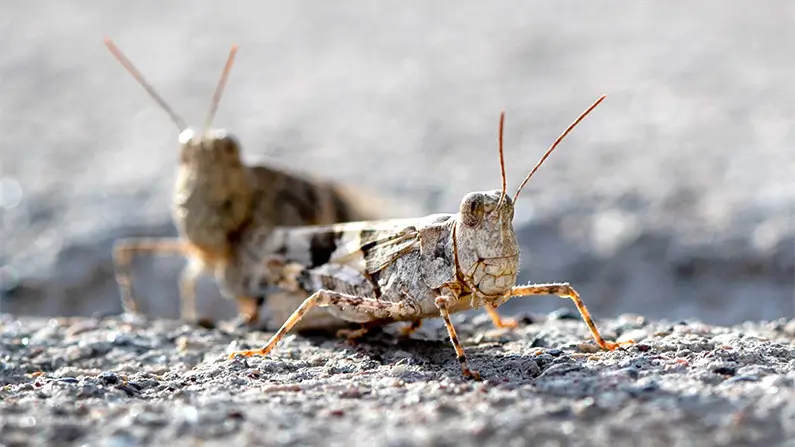
Grasshoppers belong to one of the most widespread and diverse insect groups on Earth. They are found in nearly all climate zones — from dry deserts to lush grasslands and mountainous regions. Scientists estimate that there are around 11,000 different grasshopper species worldwide, making them an exceptionally large and varied group.
Many species are still not fully documented, and new ones are regularly discovered in hard-to-reach regions such as tropical rainforests and highlands. Each species has its own unique adaptations, color patterns, and sounds, making grasshoppers a fascinating subject of study for entomologists around the world. [source]

You may also like
9 Climate largely determines their lifespan…
A grasshopper’s lifespan depends heavily on the climate it lives in. In regions with cold winters, grasshoppers usually survive the season only in the egg stage, as adult individuals cannot withstand low temperatures.
In warmer climates, however, grasshoppers can live for several years, allowing them to reproduce multiple times and remain active much longer. [source]
10 Grasshoppers can actually “sing” using their legs — not their mouths…
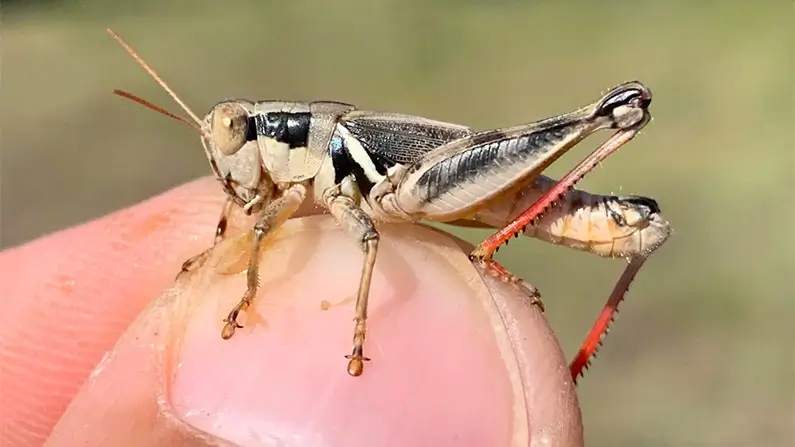
Grasshoppers don’t produce sound by calling out or making noise with their mouths. Instead, they create their distinctive sounds by rubbing their powerful hind legs against their wings, a process known as stridulation.
Each species has its own unique rhythm and pattern, allowing other grasshoppers to recognize the correct species, identify potential mates, and even judge how strong and healthy the performer is. In a way, these sounds function as both communication and courtship — a kind of natural love song echoing through fields and grasslands. [source]
5 Common Questions About Grasshoppers
No. They are harmless to people and do not bite or sting, though large swarms can cause serious damage to crops.
They have extremely powerful hind legs, allowing them to leap great distances to escape predators quickly.
They mainly feed on grasses, leaves, and crops, which is why they can become a major agricultural problem in large numbers.
Their lifespan depends on climate, but most live several months, surviving winter only as eggs in colder regions.
Yes. They produce sounds intentionally to communicate, attract mates, and signal strength using leg–wing movements.