
In the world of the oceans, sea lions, or eared seals (Otariidae), stand out as magnificent acrobats, with their powerful foreflippers and elegant swimming movements. Dive into their fascinating lives, from coastal colonies to the mysteries of the deep sea, and discover the remarkable beauty of these marine artists in these ten facts you probably didn’t know about these captivating animals!
1 How sea lions differ from seals…
Sea lions and seals are both marine mammals belonging to the group known as pinnipeds, but there are several important differences between them. One of the clearest distinctions is that sea lions have visible external ear flaps, while seals only have small ear openings with no external ears.
Another key difference lies in how they move. Sea lions use their strong foreflippers to steer and propel themselves through the water, giving them impressive agility both while swimming and when moving on land. Seals, in contrast, are more streamlined swimmers and rely mainly on their hind flippers for propulsion, which makes them extremely efficient in open water.
Their lifestyles also differ. Sea lions are more commonly found in coastal areas, where they gather in large, social colonies and spend time resting and basking in the sun. Seals are more adapted to life at sea and are often seen farther offshore. In general, sea lions tend to be more social and vocal, while seals are usually more solitary or live in smaller groups. [source]
2 Sea lions can actually roar like real lions…
Sea lions are well known for their vocal behavior and are among the loudest marine mammals in the animal kingdom. During the breeding season or when they feel threatened, they often produce a wide range of sounds — including deep, roar-like calls.
This impressive ability to vocalize, combined with the distinctive mane seen in adult males, has helped shape their resemblance to land-dwelling lions. It’s also the reason why they were given their name, reflecting both their appearance and their powerful, commanding voices. [source]

3 Sea lions mainly dive into the water to escape danger or find food…
Sea lions belong to the family of eared seals and are well adapted to life both on land and in the water. They spend a great deal of time along coastlines and beaches, where they form colonies and engage in activities such as breeding and raising their pups.
Although sea lions are excellent swimmers and capable divers, they primarily enter the water to avoid predators, hunt for food, or feed. Their diet typically consists of fish, squid, mollusks, and crustaceans, and they are widely known for their hunting skills and agility in the water. [source]

You may also like
4 Their mating rituals differ from those of most other animals…
For sea lions, mating rituals are somewhat different compared to many other animal species. During the breeding season, females may adopt submissive postures to attract dominant males.
Mating usually takes place on land or in shallow water and can be relatively brief — lasting anywhere from a few minutes to several hours. Most species typically breed only once per season, making the timing of these rituals especially important. [source]

5 A sea lion can hold its breath for more than 20 minutes…
Sea lions are capable of remarkably long dives, although the exact duration varies depending on the species and the individual’s physiology. In general, they can hold their breath and remain underwater for up to 20 minutes or even longer.
That said, most dives are much shorter. Under normal conditions, sea lions typically stay below the surface for less than 10 minutes at a time, especially when foraging in shallower waters. [source]
6 The reason why sea lions eat stones isn’t fully understood, although several theories exist…
Sea lions have occasionally been observed swallowing stones, and the exact reason behind this behavior remains unclear. Scientists have proposed several theories to explain why this happens.
Some suggest that ingesting stones may help with buoyancy control, while others believe it could aid in digestive cleaning or even wearing down teeth naturally. There are also marine researchers who argue that sea lions may simply swallow stones accidentally while feeding on the seafloor. [source]

You may also like
7 It’s still unclear exactly where sea lions originally came from…
To this day, scientists do not know with complete certainty where sea lions originated. What is clear is that they are mammals, meaning their ancestors once lived on land. They are closely related to seals and walruses, but identifying their closest land-dwelling ancestor remains a challenge.
As members of the order Carnivora, sea lions share ancestry with animals such as bears, cats, and dogs, as well as badgers and weasels, which were long thought to be their closest relatives. However, more recent taxonomic research suggests that sea lions may actually be more closely related to bears and raccoons. The same studies also indicate that they are more closely related to walruses than to true seals. [source]
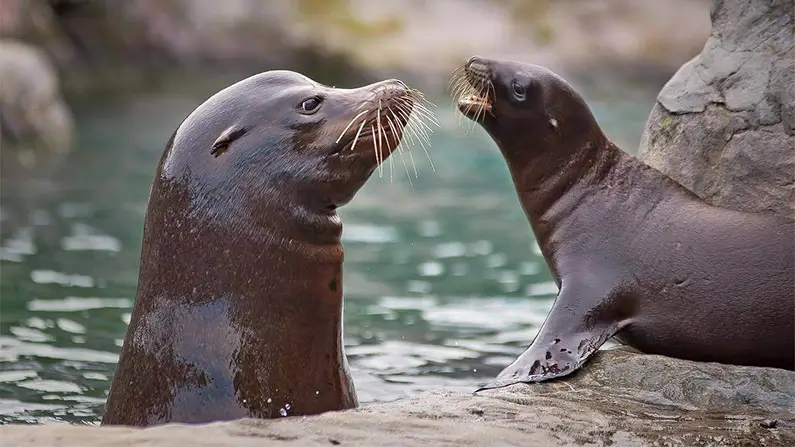
8 They are considered highly intelligent animals…
Regardless of where they originally came from, sea lions are widely regarded as highly intelligent animals. Numerous studies and observations have shown that they possess strong abilities in learning, memory, and problem-solving.
Sea lions have also been successfully trained in captivity to perform a wide range of tasks and tricks, highlighting their cognitive skills. Their ability to adapt to different environments and situations further suggests a high level of intelligence and behavioral flexibility. [source]

You may also like
9 They are frequently hunted by killer whales…
Sea lions face constant threats from several powerful predators, most notably killer whales, great white sharks, and hammerhead sharks. These marine hunters regularly prey on sea lions, making them a key part of the ocean food chain.
Young pups are especially vulnerable, as they are still learning to navigate their aquatic environment and are less experienced at detecting the dangers that may lurk beneath the ocean’s surface. [source]

10 Sea lions struggle with diseases worsened by global warming…
Observations and research have shown that Galápagos sea lions, especially young individuals, are vulnerable to parasitic infections — most notably the eye fluke Philophthalmus zalophi. These parasites can cause severe eye damage, which may have serious consequences for survival, particularly among pups.
Rising ocean temperatures, often linked to climate change, may increase the prevalence of such parasites. This, in turn, can further negatively impact sea lion populations, making environmental changes an even greater threat to their long-term survival. [source]

You may also like
5 Frequently Asked Questions About Sea Lions
They are generally not aggressive toward people, but they are large, strong wild animals and can become defensive if they feel threatened or approached too closely.
They are considered highly intelligent, with strong learning abilities, good memory, and advanced problem-solving skills. This is why they are often used in training and research.
They are mainly found along coastlines in the Pacific Ocean, including North and South America, parts of Asia, and island regions such as the Galápagos.
Their diet consists mostly of fish and squid, but they may also consume crustaceans and other marine organisms depending on availability.
These sounds are used for communication, especially during breeding season, to establish dominance, attract mates, and warn rivals or potential threats.