

Sharks are one of three groups of cartilaginous fish, with more than 500 known species. They live mostly in the ocean, though a few can venture into freshwater for parts of their lives. Unlike most fish, sharks lack a swim bladder and instead rely on clever buoyancy tricks — including a large oil-rich liver and a lightweight skeleton made of cartilage. Even so, most would sink if they stopped swimming, and species that roam deep waters tend to stay in motion constantly. Some sharks must swim non-stop just to breathe — these are known as obligate ram ventilators.
Around 200 shark species live entirely on the seafloor, another 200 split their time between the seabed and open ocean, and only about 25 live exclusively in open water. Shark diving has become a global passion, so here are 10 fascinating facts you’ll want to know about the rulers of the sea.
1 How many teeth sharks have – and how many they lose in a lifetime…
The average shark sports 40–45 teeth at any one time, arranged in up to seven rows. Sharks lose teeth with surprising ease — but they also regrow replacements almost instantly. Over the course of a lifetime, a single shark may churn through as many as 30,000 teeth.
Luckily for them, dental bills are not a concern. [source]
2 A shark’s skeleton is made of cartilage, not bone…
A shark doesn’t have a single bone in its body. Instead, its entire skeleton is made of flexible cartilage — a defining feature of cartilaginous fish, and very different from the skeletons of bony fish and mammals.
This lighter, bendable structure gives sharks a major advantage in the water, making them faster, more agile swimmers and far easier to maneuver in the ocean’s currents. [source]

3 Sharks are older than both dinosaurs and Saturn’s rings…
Sharks have existed for around 400 million years, making them one of the oldest groups of vertebrates on the planet. They swam Earth’s oceans long before the dinosaurs appeared, which lived roughly 230 to 65 million years ago. Their overall design has changed remarkably little over time, turning sharks into one of the most successful and well-adapted groups in the sea.
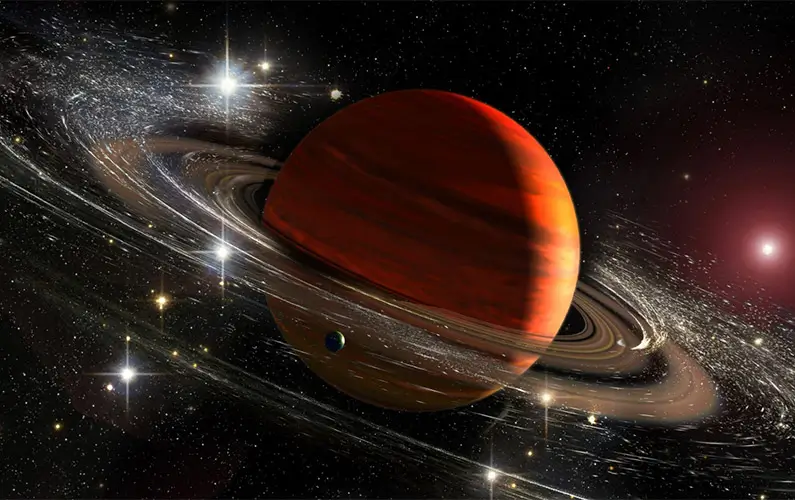
In fact, sharks are even older than Saturn’s rings. While estimates vary, the rings are believed to be much younger, likely forming somewhere between 10 and 100 million years ago — mere newcomers compared to sharks. [source]
You may also like
4 What sharks eat – and how long they typically live…
Sharks are predators, most often hunting fish, squid, crustaceans, and at times even seabirds or smaller shark species. Larger and older individuals may tackle bigger prey such as seals or sea turtles.
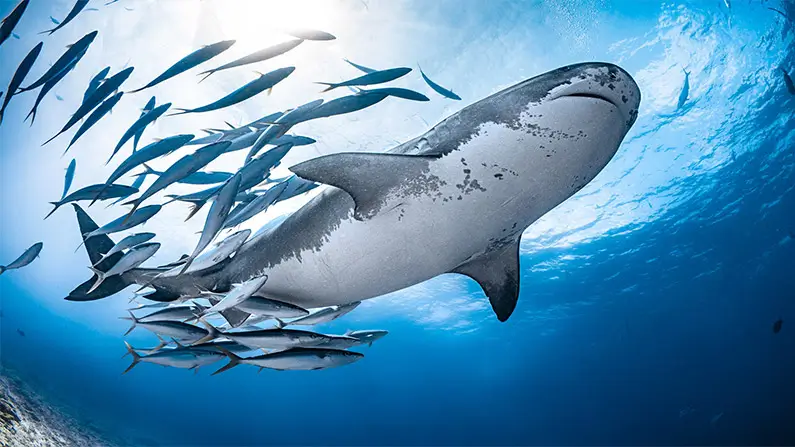
When it comes to lifespan, it varies widely between species. Smaller sharks typically live 20–30 years, while larger species — including the whale shark (Rhincodon typus) — can reach 70–100 years, and possibly even longer under the right conditions. [source]
5 Human litter is one of the biggest threats to sharks…
Shoes, chairs, boxes of nails, entire wine bottles — even the back half of a horse — are just some of the bizarre objects found inside sharks’ stomachs over the years.
Human pollution poses a serious danger to sharks and other marine animals. They can suffer injury or death when they become entangled in, or swallow, plastic waste drifting through the oceans. Plastic and other debris also disrupt shark habitats and the wider marine ecosystem — a chain reaction that ultimately threatens their survival. [source]
6 You’re more likely to die from lightning than a shark…
Roughly 30 people are killed by shark attacks worldwide each year. That’s a tiny risk compared with many other causes of death — including bee stings and lightning strikes.
For every person killed by a shark, it’s estimated that around two million sharks are killed by humans, mainly through targeted fishing and accidental bycatch. [source]

You may also like
7 Why hammerhead sharks are born with soft heads…
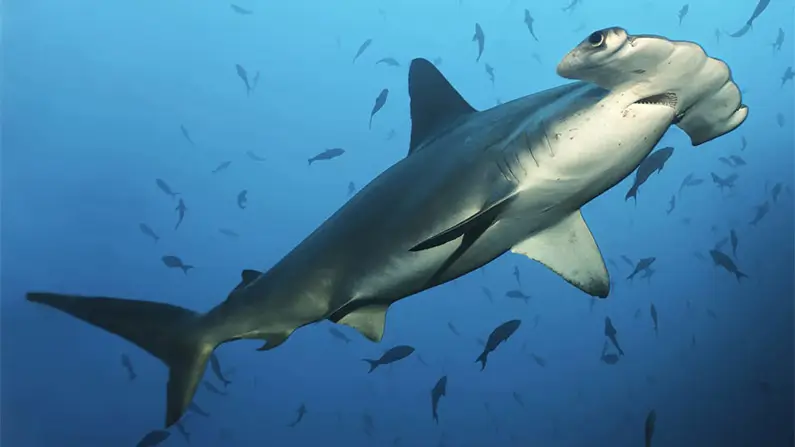
The hammerhead shark (Sphyrna zygaena) is famous for its distinctive hammer-shaped head. But when a hammerhead is born, its head is actually soft and flexible. This prevents the pup from being injured — or getting stuck — while passing through its mother’s birth canal.
A photo below shows what a hammerhead looks like in all its glory — and yes, they truly have one of the most unusual faces in the ocean. [source]
8 The smallest and largest shark species…
At just 18 centimeters long, the dwarf lanternshark (Etmopterus perryi) is the tiniest shark in the ocean. At the opposite extreme is the whale shark (Rhincodon typus), which can grow over 15 meters in length and weigh up to 1,800 kilos — and in some cases, even more. [source]

You may also like
9 Sharks rarely develop cancer – but it does happen…
Sharks seem to have an unusual resistance to cancer, and researchers are actively studying why. Some studies have explored whether shark cartilage could play a role in future cancer treatments.
However, it’s important to remember that sharks are not completely immune. They can develop cancer — they just appear to have biological defenses that make it far less common than in humans and many other animals. [source]

10 Sharks have exceptional hearing and some of the sharpest noses on Earth…
One lesser-known fact about sharks is that they possess remarkably acute hearing. Certain species can detect the movements or struggling sounds of prey from as far as a kilometer away beneath the surface.
Sharks also have an extraordinary sense of smell. Their specialised olfactory organs — located in the nasal cavity and connected directly to the brain — allow them to pick up scents with incredible precision. Some species can detect odor concentrations as low as one part per million, enabling them to track smells across long distances. This powerful sensory system is crucial for finding food, navigating the oceans, and thriving in their environment. [source]

You may also like
5 Frequently Asked Questions About Sharks
They are cartilaginous fish with more than 500 known species, ranging from tiny deep-sea forms to the massive whale shark.
Not usually. Most species avoid people, and attacks are extremely rare compared with how many humans enter the ocean every day.
Most incidents happen because they mistake humans for prey, or are curious. They don’t view humans as food and typically swim away after a single bite.
Water flows over their gills, extracting oxygen. Some species must keep swimming to move water across their gills, while others can rest on the seafloor and pump water manually.
They are top predators that keep marine food webs balanced, helping prevent the overpopulation of certain species and maintaining healthy oceans.