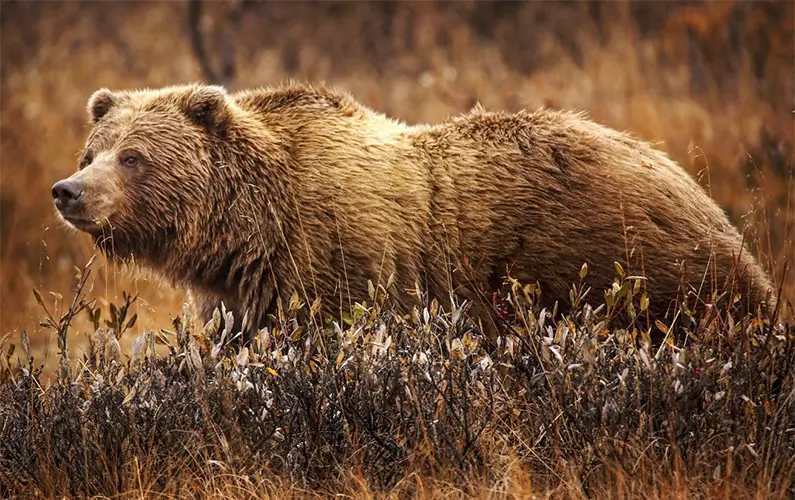
Grizzly bears (Ursus arctos horribilis) are often recognized as a subspecies of the brown bear and live alongside other brown bear populations in North America. The grizzly bear is a large and compact brown bear, characterized by grayish tips on the outer layer of its fur, which give it a distinctive grizzled appearance. Although the animal does not live in the wild here in Europe, it frequently appears in American films, which has contributed to the strong interest surrounding this iconic bear. Below are ten facts you may not have known about grizzly bears.
1 Grizzly bears are large and dangerous – but above all (and unexpectedly) extremely fast…
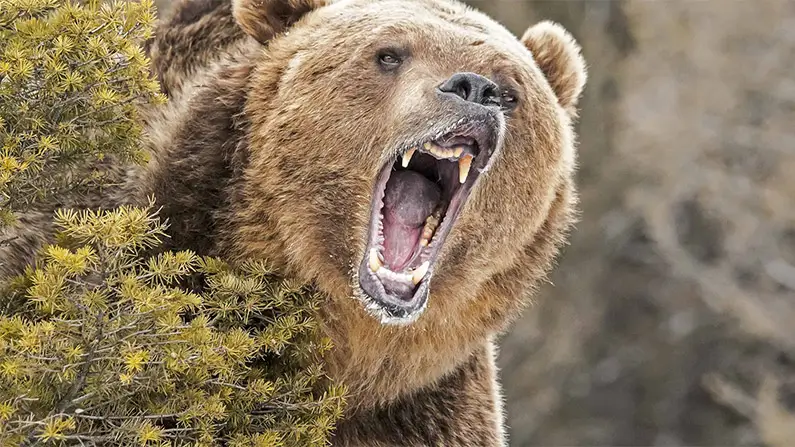
Grizzly bears can weigh up to 360 kilograms (with females usually weighing about half as much as males) and typically live 20–25 years in the wild. If you ever consider trying to outrun an aggressive grizzly bear, it’s probably time to think again — they can reach a top speed of an astonishing 56 km/h, despite their massive size! [source]
2 This is most likely how the grizzly bear got its name…
It is believed that grizzly bears originally took their name from the word “grisly”, meaning “grim” or “terrifying”. Their scientific classification, Ursus arctos horribilis, was also inspired by their fearsome reputation and was assigned by a naturalist in 1815. [source]
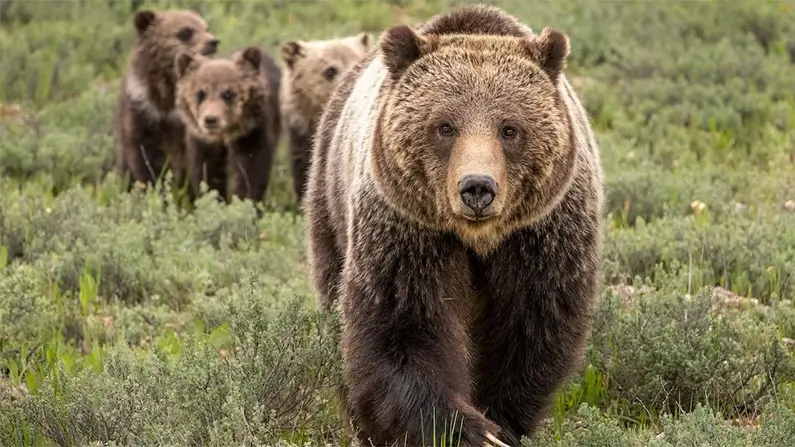
3 Grizzly bears are considered apex predators…
This means they sit at the very top of the food chain. They hunt large mammals such as moose, deer, and even bison, using a combination of speed and immense strength to bring down their prey.
Grizzly bears also have a highly varied diet that includes berries, insects, fish, and carrion, making them true opportunistic predators. They play a crucial role in their ecosystems by controlling animal populations and contributing to the natural nutrient cycle. [source]

You may also like
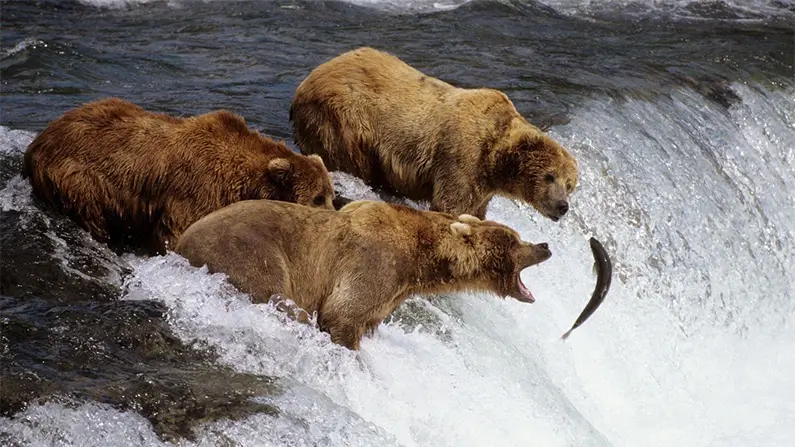
4 Grizzly bears often catch salmon in large groups…
Each year, grizzly bears gather along salmon rivers as the fish swim upstream to spawn. During this period, as many as 20 grizzly bears can be seen in the same area, where they catch salmon leaping out of the water with their paws—or sometimes directly with their mouths. This behavior is a vital part of their life cycle and a truly fascinating natural spectacle. [source]
5 Grizzly bears don’t hibernate in quite the same way as many other animals…
Grizzly bears have a highly varied diet and don’t eat only meat, as many might assume. Their diet also includes nuts, berries, fruit, leaves, and small animals such as mice. As winter approaches, they enter a period of hyperphagia, during which they eat enormous amounts of food to store fat for the cold months ahead.
Although grizzly bears enter a state of reduced activity during winter, they do not experience true hibernation like some other animals. Instead, they enter a lighter form of dormancy, meaning they can still wake up and move if necessary, while relying on stored body fat to survive long periods without eating. [source]
6 It’s a myth that grizzly bears can’t climb trees…
It is a common misconception that grizzly bears are unable to climb trees. Although they are large and heavy, and their long claws make climbing more challenging, it is far from impossible for them to do so.
However, their size and weight do limit their climbing ability compared to smaller bears such as black bears, and they are not nearly as agile in trees as some other species. The strength of the branches also plays a key role—branches must be strong enough to support the bear’s massive weight. [source]
You may also like
7 The grizzly bear’s absolute favorite delicacy is moths…
Although grizzly bears enjoy eating many different insects, moths rank at the very top of their menu. Researchers have observed bears willing to climb to alpine elevations in Montana’s Glacier National Park to feast on these flying snacks. It has also been documented that bears will flip over rocks and spend up to 14 hours a day searching for these specific insects. During this time, they can consume as many as 40,000 moths. [source]
8 Grizzly bears are also classified as cannibals…
In addition to being omnivores, grizzly bears can also be considered cannibalistic. They have, for example, been observed feeding on the remains of black bears in Canada. In a study on bear feeding behavior published in 2017, researchers documented a 10-year-old male feeding on a 6-year-old brown bear. The younger bear was a female consumed by the older male. [source]
You may also like
9 “Prizzly” – the result of a grizzly bear and a polar bear mating…
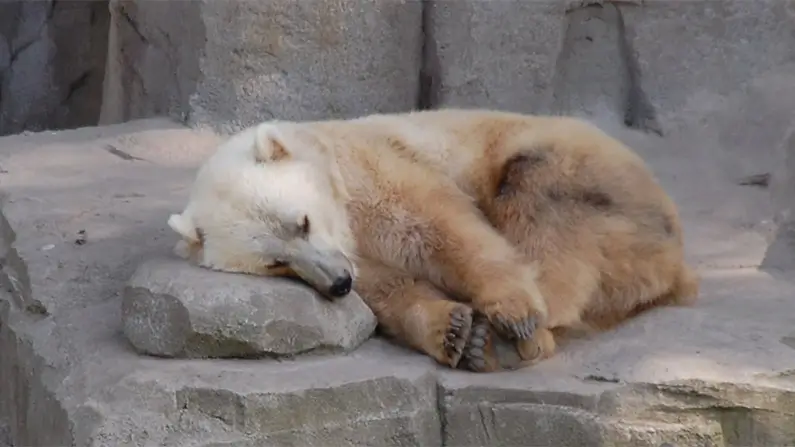
In parts of Alaska and Canada, where grizzly bears and polar bears share habitat, there have been rare sightings of what observers call “grolar bears” or “pizzlies”. With large heads and light-colored fur, these hybrids are born from mating between a grizzly bear and a polar bear. Typically, it is male grizzly bears that wander into these regions and mate with female polar bears. Researchers believe that climate change is one of the reasons these two species are encountering each other more frequently. In the image below, you can see a so-called prizzly. [source]
10 Grizzly bears take excellent care of their cubs…
Females typically do not have their first cubs until they are between four and seven years old. Pregnancy lasts 180 to 266 days, and the cubs are born blind, weighing only around 0.5 kilograms at birth. The mother remains with her cubs in a safe den until they are old enough to begin exploring the world, which usually happens after a few months. She then continues to nurse and fiercely protect her cubs for two to three years, and will not raise another litter until the current cubs have left her side. [source]
You may also like
5 Common Questions About Grizzly Bears
Yes, they can be dangerous, especially if they feel threatened, surprised, or are protecting cubs or food. However, attacks are rare, and most encounters end without injury if people behave calmly and responsibly.
They are much faster than most people expect, reaching speeds of up to 56 km/h (35 mph) over short distances, making them faster than a sprinting human.
They primarily inhabit North America, with populations found in Alaska, western Canada, and parts of the northwestern United States, favoring forests, mountains, tundra, and river valleys.
They are omnivorous and highly adaptable, eating everything from berries, roots, insects, and fish to large mammals and carrion, depending on season and availability.
Not in the strictest sense. They enter a state of reduced activity during winter, relying on stored body fat, but they can wake up and move if disturbed, unlike animals in true hibernation.