
Neptune is the eighth planet from the Sun — a so-called gas giant — and is named after Neptune, the Roman god of the sea. Since Pluto is now classified as a dwarf planet, Neptune is the outermost of the major planets in our solar system. With that said, here are ten facts you probably didn’t know about our blue giant at the edge of the solar system!
1 Neptune was the outermost planet between 1979 and 1999…
On August 24, 2006, when the International Astronomical Union decided that Pluto would no longer be classified as a planet, Neptune officially became the outermost planet in the solar system.
However, Neptune had already held that position between 1979 and 1999, because during that period Pluto’s orbit brought it closer to the Sun than Neptune. [source]
2 Neptune was discovered through mathematical prediction…
The discovery of Neptune is unlike that of any other planet in our solar system. Unlike Mars or Venus, which have been known since antiquity, Neptune was discovered because of strange irregularities in Uranus’s orbit. Astronomers noticed that Uranus moved in a way that didn’t fully match the expected calculations, suggesting that an unknown celestial body was affecting its motion through gravity.
Through precise mathematical calculations, researchers were able to predict the exact position of the new planet before it had ever been seen through a telescope. This makes Neptune the only planet in our solar system whose existence and location were first predicted mathematically, long before it was visually confirmed.
The discovery marked a major milestone in astronomy and demonstrated the power of mathematical modeling in space research. [source]
3 The planet is likely as old as our Sun…
There are still some uncertainties, but scientists assume that Neptune’s age is approximately the same as the Sun’s. This means it likely formed around 4.5 billion years ago, at the same time the rest of the solar system took shape.
This estimate is based on studies of the Sun’s evolution and the formation of the other planets, giving researchers a clearer picture of how long this distant world has existed. [source]
You may also like
4 It takes Neptune 164.8 years to orbit the Sun…
Neptune is the most distant planet in our solar system and lies farthest from the Sun. It takes about 164.8 Earth years for the planet to complete a full orbit.
Since Neptune was discovered as recently as 1846, it has only completed one single full orbit since then. Its first full revolution after its discovery was not completed until 2011, highlighting just how slow and extended its orbital path is compared to the inner planets.
This slow movement provides unique opportunities for astronomers to study its long-term changes over time. [source]
5 Neptune has an incredibly strong gravitational force…
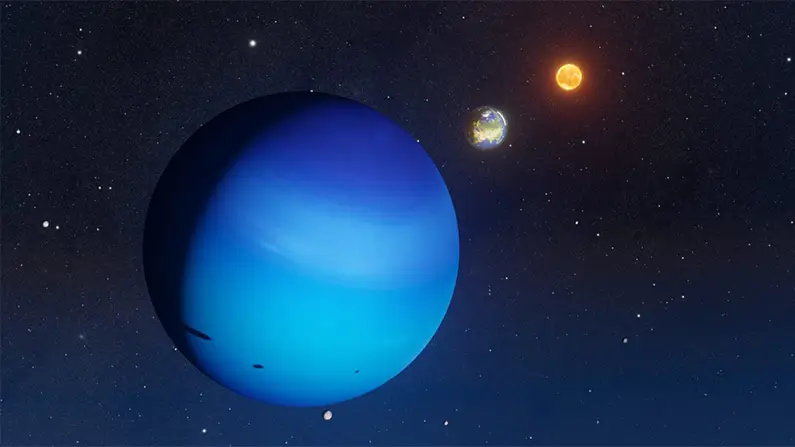
This planet has a very powerful gravitational pull, and compared with the other planets in our solar system, it ranks second only to Jupiter. Its intense gravity affects not only its own moons but also contributes to the complex dynamics of the surrounding space environment.
Even though Neptune is smaller than Jupiter, its gravity is still significant and plays a crucial role in keeping its many satellites in orbit. [source]
6 Why Neptune has its characteristic blue hue…
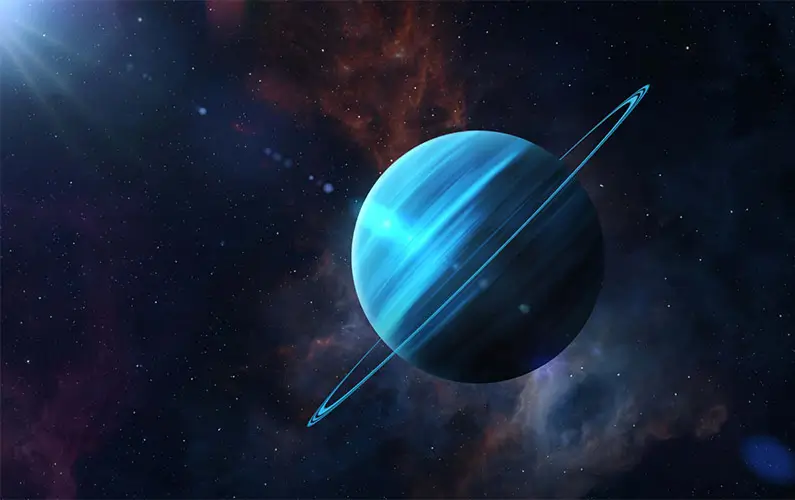
Neptune is the smallest of the gas giants in our solar system and has an atmosphere that in many ways resembles those of the other gas planets. Its atmosphere is composed mainly of helium and hydrogen, the most common elements found in such massive worlds.
In addition, smaller amounts of methane, ammonia, water vapor, and ice particles are present. The methane plays a particularly important role because it absorbs red light and reflects blue, giving the planet its distinct and beautiful blue color. [source]
You may also like
7 Neptune is home to incredibly powerful winds…
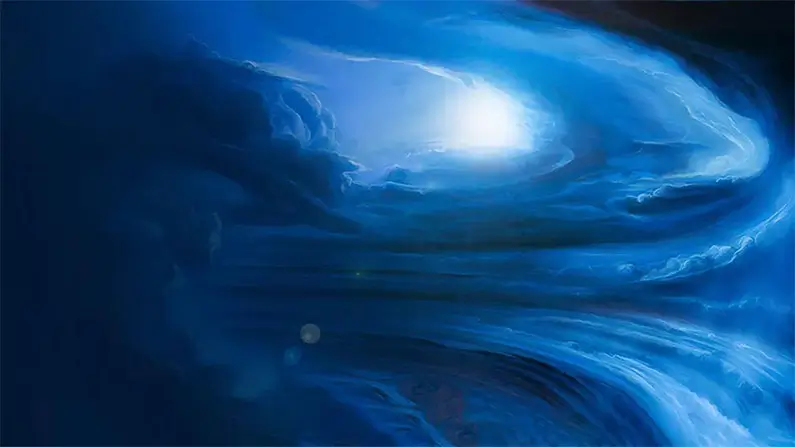
The winds on this distant gas giant can reach astonishing speeds of over 2,000 kilometers per hour (1,240 mph). This is the highest wind speed ever recorded anywhere in our solar system.
Such powerful winds create massive storms and highly turbulent atmospheric conditions, making Neptune one of the most dynamic and fascinating planets to study when it comes to weather and climate beyond Earth. These extremely fast winds are a clear sign of the complex and active atmosphere surrounding the outermost planet in the solar system. [source]
8 A gigantic spot on the planet has completely vanished…
One of Neptune’s most recognizable and striking features was long the Great Dark Spot, observed on the planet’s surface. This massive storm system had an impressive diameter of about 16,000 kilometers (nearly the size of Earth).
Dark spots of this kind are storm systems, and Neptune’s dark spot was an enormous and powerful tempest. In both shape and location, it strongly resembled Jupiter’s famous Great Red Spot, which is also a gigantic storm on another gas giant in our solar system.
However, Neptune’s dark spot has since completely disappeared, indicating that storms on Neptune may be more short-lived and dynamic than those on Jupiter. Observations show that the planet’s atmosphere is highly active and constantly changing, making Neptune a fascinating world to study. [source]
You may also like
9 The enormous distance between our planet and Neptune…
The distance between Earth and Neptune is about 4.4 billion kilometers (2.7 billion miles). If you were to drive a car at 110 km/h (68 mph), it would take roughly 4,500 years to reach the planet.
Even with a rocket, the journey would be incredibly long — traveling at 11 kilometers per second would still take about 12–13 years to get there. [source]
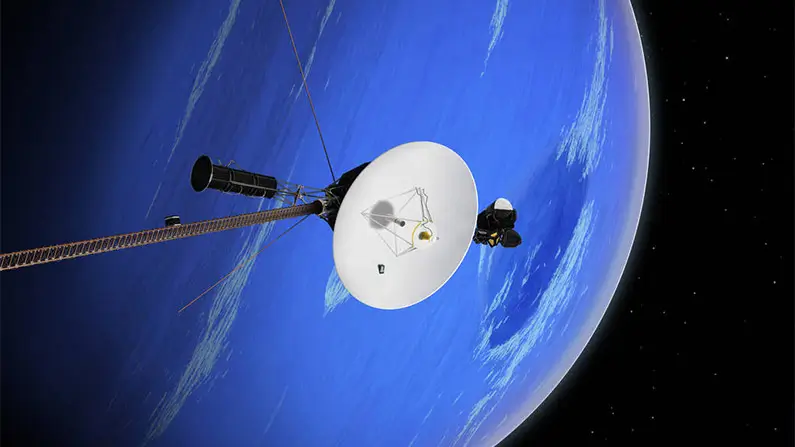
10 The gas giant formed differently from the inner solar system…
Neptune and the other gas giants were likely formed in a different way than the planets in the inner solar system, and there are several theories about their origin. Just like all the other planets, the gas giant was created from the remaining gas and cosmic dust left over from the nebula that formed the Sun. [source]

You may also like
5 Common Questions About Neptune
Neptune appears blue because its atmosphere contains methane, which absorbs red light and reflects blue. This gives the planet its deep, striking blue color.
Neptune needs 164.8 Earth years to complete one orbit around the Sun. It has only completed one full orbit since its discovery in 1846.
Neptune is an ice giant, composed mainly of hydrogen, helium, and methane, along with ices such as water, ammonia, and methane. Its composition makes it very different from rocky planets like Earth.
Neptune has the fastest winds in the entire solar system, reaching speeds of over 2,000 km/h (1,240 mph). These winds create massive storms and dramatic atmospheric activity.
Yes. Neptune has 14 known moons, including the large and unusual Triton, which orbits in the opposite direction of the planet’s rotation. Neptune also has a faint but complex ring system, made up of dust and ice particles.