
Kangaroos (Macropodidae) are a type of marsupial belonging to the family Macropodidae. The word “kangaroo” isn’t a strict scientific classification, but it generally refers to the larger species within the genus Macropus, including the red kangaroo and the eastern grey kangaroo.
These iconic marsupials are native to Australia, and there are around 45 different species — a fact many people may not know. Being a marsupial means the female carries her young in a pouch on her abdomen, known as a marsupium. A newborn joey, no bigger than a human thumb, crawls into the pouch right after birth. Safe and warm, it nurses there for about six months before it’s ready to start venturing out on its own.
Below are ten fascinating facts you’ll want to know about kangaroos — especially if you’re dreaming of exploring Australia!
1 Researchers want to transfer fart-friendly bacteria from kangaroos to cows — for the sake of the climate…
Kangaroos emit almost no methane gas, which means they don’t produce significant methane when they pass gas. Scientists are trying to harvest these unique bacteria from kangaroos and introduce them to cows, which could dramatically reduce greenhouse gas emissions. That’s because methane from cattle is a far bigger climate problem than exhaust fumes from cars. [source]
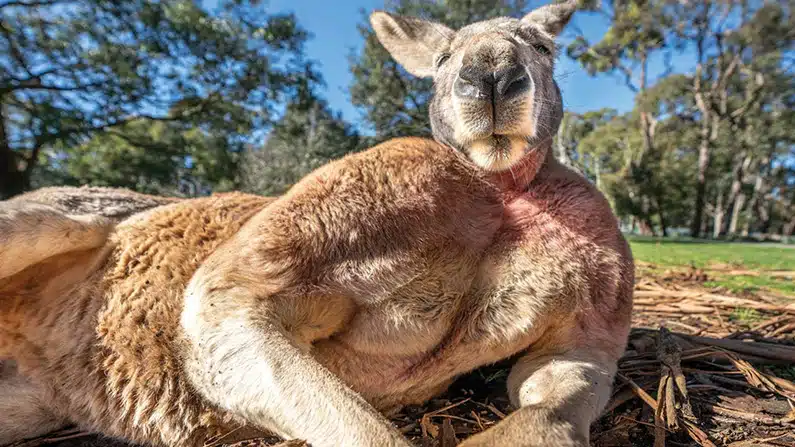
2 Male kangaroos flex their biceps during mating season…
Not unlike humans, a male kangaroo will try to impress a female by showing off his muscles — especially those big, bulging biceps. In kangaroo society, bigger biceps mean higher attractiveness, and the male with the largest muscles usually gets the most mating success. [source]
3 A kangaroo will happily drown an enemy if it has to…
Kangaroos are smarter than many realize. When chased or threatened, they will sometimes lure predators or other attackers toward a body of water. Once there, the kangaroo can use its size and strength to push the enemy underwater, attempting to drown it. This behavior is a survival tactic and shows the kangaroo’s intelligence and adaptability. [source]

You may also like
4 A myth says kangaroos can’t move their legs independently — but they can’t walk backward…
You’ve probably heard the claim that kangaroos can’t move their legs independently and therefore have to hop to get around — but that’s not quite true. Kangaroos can move their legs separately, and they’re able to walk, climb, and hop in different ways. They’re actually quite capable of walking long distances, using their back legs and tail as support. Hopping just happens to be a fast and energy-efficient way for them to cover shorter distances, thanks to their powerful back legs and spring-like anatomy.
However, one thing is true: kangaroos cannot walk backwards. Their bodies simply aren’t built for reverse motion. That’s one reason the kangaroo appears on the Australian coat of arms, alongside the emu — both animals only move forward, symbolizing national progress. [source]
5 The kangaroo Lulu was celebrated for showing sympathy…
Lulu, a kangaroo rescued as a joey and raised by a farmer and his family in Australia, became famous for displaying behavior that could be interpreted as sympathy and loyalty.
When the farmer was struck by a falling branch and knocked unconscious, Lulu stayed by his side and made noises to attract attention. Thanks to her efforts, the farmer’s family found him and was able to save his life. This kind of response is highly unusual for kangaroos, and Lulu was praised for her actions. [source]
6 Kangaroos know how to use those biceps too…
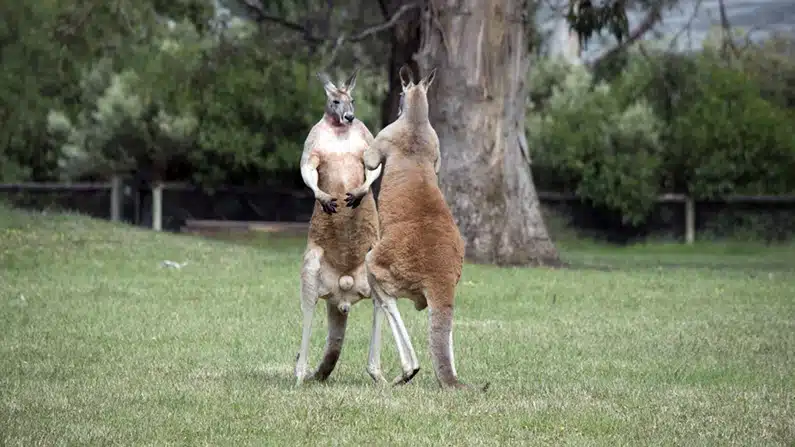
Back to those famous kangaroo muscles: a kangaroo knows exactly how to apply a chokehold and understands what effect it has on an opponent when fighting other kangaroos. And yes — kicking is absolutely part of the arsenal as well. Most fights break out during mating season, when males battle for access to females. [source]
You may also like
7 Most kangaroos are left-handed…
Kangaroos show a clear preference for using their left hand (or rather, left forelimb) for different tasks, making them “left-handed” to a far greater extent than most other animals. Research has shown that kangaroos — especially the red and grey species — often use their left hand when eating or grooming. This is a fascinating exception in the animal kingdom, where most four-legged species don’t display the same level of hand dominance seen in humans. [source]
8 Kangaroos have a rather unique reproductive system…
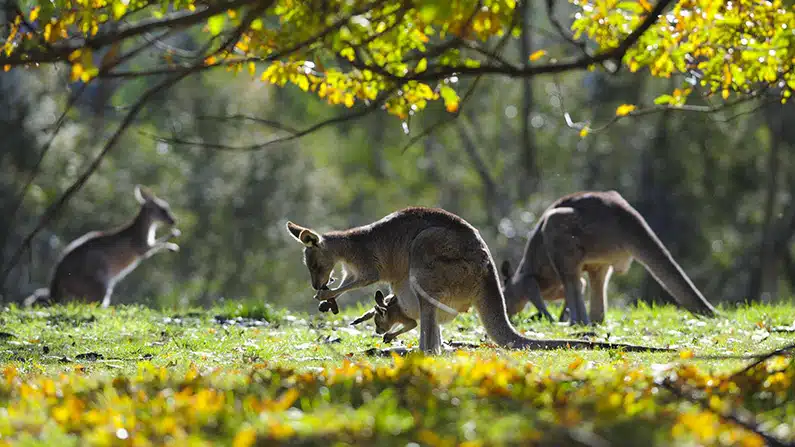
Females have three vaginas: the two outer ones transport sperm to two separate uteruses, while the middle vagina is used for giving birth. Males have a two-pronged penis, positioned below the testicles, which allows them to deliver sperm to both of the female’s uteruses. This unusual setup is part of what makes marsupials like kangaroos so fascinating from a biological standpoint. [source]

You may also like
9 Kangaroos kill more people every year than sharks…
It might sound surprising, but there’s a reason. Kangaroos can become highly aggressive, especially during mating season or when they feel threatened, and their powerful hind legs and sharp claws can cause serious injuries. In some cases, those injuries have been severe enough to cause death — often through traffic collisions where a kangaroo is hit, or when people try to handle them in a dangerous way.
Shark attacks, on the other hand, are extremely rare, even though they receive major media attention whenever one occurs. Most shark attacks don’t result in death, and very few people are affected each year. So even though kangaroo-related incidents are less famous, they are actually more common than shark attacks. [source]
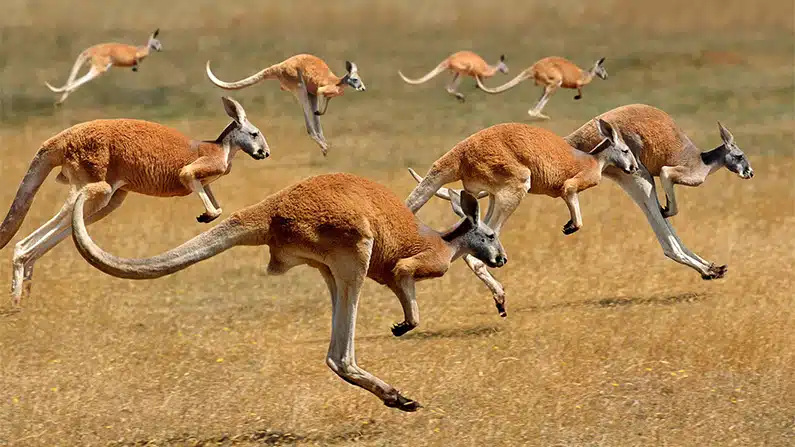
10 Kangaroos are fast and can jump incredible distances…
The red kangaroo (Macropus rufus), the largest of all kangaroo species, is known for its impressive speed and leaping ability. These kangaroos can reach top speeds of up to 56 km/h while hopping, making them among the fastest in their group. They can also clear more than eight meters in a single bound and reach a height of up to 1.8 meters. Their powerful hind legs and specialized anatomy make them exceptionally skilled at covering long distances quickly and efficiently. [source]

You may also like
5 Frequently Asked Questions About Kangaroos
Mostly grasses, herbs, leaves, and shrubs. They are herbivores with stomachs that can ferment tough plant material, letting them extract nutrients efficiently in dry environments.
They are native to Australia and thrive in a range of habitats — from open grasslands and bushland to desert regions. Groups often gather in loose mobs for safety and feeding.
They can hop at high speeds, reaching up to around 56 km/h (35 mph) with powerful back legs. At lower speeds, they use a slower movement supported by their tail.
They defend themselves with strong kicks, sharp claws, and by boxing motions with their forelimbs. Some will lure predators into water and use their strength to overpower them.
It’s a defining feature of marsupials. Babies are born tiny and underdeveloped, then continue growing in the pouch where they stay warm, nurse safely, and develop until they can survive outside.